topic
Topic: Autonomous research loops
emerging (2 primary sources, and no longer a merge-back candidate) - S13
About this note
Status: emerging (2 primary sources, and no longer a merge-back candidate) - S13
karpathy/autoresearch and S22 the Darwin Godel Machine. Created 2026-08-03 by
ADR-0017; merge-back trigger resolved
2026-08-05 by ADR-0020.
Basis, and the two sources are almost opposites evidentially. S13 is a T4 personal repository
whose design is fully inspectable and whose results are a single unreproducible PNG - strong design
claims, weak empirical ones, labelled so throughout. S22 is ICLR 2026 main track with open-sourced
code and two ablations that isolate its claimed components, which makes it the best-evidenced source
in this brain on any subject. ~~This note is a candidate for merge back into agents.md if no second
primary source arrives.~~ It arrived.
What the pairing buys, beyond a source count. S13 supplies a practitioner's freezes, stated as design and unmeasured. S22 supplies ablations - remove the archive and progress plateaus lower, remove self-improvement and it plateaus earlier - so for the first time this note can say a structural choice was tested rather than merely reasoned. And the two disagree productively on the one thing they both got wrong-adjacent: S13's accept rule had no notion of variance and banked a random-seed change (claim 114), while S22 built a staged evaluation with a promotion threshold "chosen based on the noise observed in preliminary runs". One loop ignored noise and one designed around it, and the second is the one that worked.
Living, cross-source synthesis on agents that iterate on an artifact unattended, accepting or rejecting each change against an automated metric. Many sources feed this note; merge and de-duplicate as they arrive (architect persona). Every claim cited.
Not literature-search agents. In this kit "research" as a verb means the
/researchstage - gathering external evidence intosources/<id>/context/. This note is about the other thing: a loop that runs experiments. The name is deliberately long to keep the two apart (ADR-0017).
On this page
What this coversSynthesisThe engineering happens before the loop startsThe freeze is usually a declaration, and it is worth knowing which of yours are enforcedThe accept rule is where these designs spend the least, and it is where they leakVersion control is a sufficient experiment database, if an experiment is a diffRunning a loop hundreds of times is a context problem before it is a compute problemAutonomy is a suppressed default, and the freezes are what earn itWhen the loop carries a second objective, publish the exchange rateWhat the results actually look like, and how to read themThe artifact you iterate on is the proseAn archive beats a lineage, and it is the first ablated claim this note holdsWhat must not be modifiable, now stated by two sourcesThe loop amplifies whatever its verifier cannot see, and three sources now say soKey claimsKey visualsOpen questions / conflictsSources feeding this topicWhat this covers#
The setup an unattended improvement loop needs before it can be trusted to run for hours with nobody watching: what must be frozen and what may move; which resource is held constant so that heterogeneous changes stay comparable; how the metric is made invariant to what the agent may change; where the loop's state and audit trail live; the accept/reject rule and its statistical behaviour; the per-iteration cost of running a loop hundreds of times; and how to read the results of such a loop honestly.
Adjacent, and deliberately not re-homed here - these live in agents and evals and are
cross-referenced, not restated: claim 7 (closed-loop auto-tuning on production data), claim 10
(self-tuning via a prompt optimizer), claim 31 (scaffolding as an expiring bet, tested by ablation),
claim 34 (do not let the producer grade its own work), claim 59 (one loop, one objective).
Synthesis#
The engineering happens before the loop starts#
The single organising finding from S13, and the reason the topic exists. An autonomous loop is nine
steps of shell commands and needs no framework - karpathy/autoresearch contains no agent code at
all, because the agent is whatever coding harness you point at a markdown file [S13 n16,
README.md:44]. What the repository actually is, is a set of decisions taken before the agent
starts, after which the loop is trivial.
Four things are frozen, and each answers a question the previous one leaves open. The derivation matters more than the list - it is what transfers to a domain that is not model training:
- The editable surface. Exactly one file; everything defining the experiment is read-only
[S13
n1]. In S13 the hyperparameters are module-level constants with no CLI, which makes an experiment a diff rather than a command line - and that is what lets the next three decisions work. - The resource held constant. If the agent may change model size and shape, two runs are not
naturally comparable. S13 holds wall-clock time (300 seconds), not steps and not tokens
[S13
n3]. Fixing steps rewards shrinking the model; fixing tokens makes efficiency invisible. Fixing time puts a faster kernel, a better optimizer and a longer schedule on one axis - so efficiency becomes part of the objective without being part of the metric. - The metric's units. Bits-per-byte rather than per-token loss, and evaluation always at a
fixed sequence length whatever the model trained at [S13
n4]. Any degree of freedom that changes the metric's units is a way to improve the number without improving the thing, and an optimizer finds it with no intent to cheat. - The holdout. One validation shard pinned inside the read-only file and excluded from both the
tokenizer corpus and the training dataloader [S13
n2].
Where the defence lives is the transferable part: in the code layout, not in the prompt. None of the four is an instruction to the agent; all four are properties of a module the agent has been told not to open. Generalised: if you point an agent at a scored artifact, the score's definition, its input data and its units belong in a module the agent has no reason to import.
The freeze is usually a declaration, and it is worth knowing which of yours are enforced#
S13's read-only boundary is a banner comment and a line of markdown - no sandbox, no import hook,
no checksum, no permission bit [S13 n1]. Exactly one invariant is structurally enforced (the
pinned holdout, n2), and it is the one whose violation would be most damaging and most greppable.
This is not a flaw to fix reflexively - an enforced version costs a container or a git hook, and a non-adversarial agent respects the declaration. The lesson is that under this design an enforced invariant and a written-down one look identical in the source tree, and you should know which is which before you rely on one.
The accept rule is where these designs spend the least, and it is where they leak#
Two independent weaknesses in S13 sit on the decision path rather than the computation path, and the pattern is worth carrying:
The producer prints its own grade. evaluate_bpb is frozen, but the editable file imports it,
calls it, formats the result and prints it - and the agent reads its score by grepping that print
[S13 n5]. Nothing compares the number in the log to what the frozen function returned. This is
claim 34 arriving as a plumbing fact rather than a prompting one, and that is the more useful
form: you can separate generator from evaluator perfectly at the level of functions and still route
the evaluator's output through the generator's hands on the way to the decision. The fix is one
open() in the frozen module.
The rule has no notion of variance. "If val_bpb improved (lower), advance the branch; if equal
or worse, git reset" - no repetition, no seed averaging, no threshold, no error bar [S13 n11].
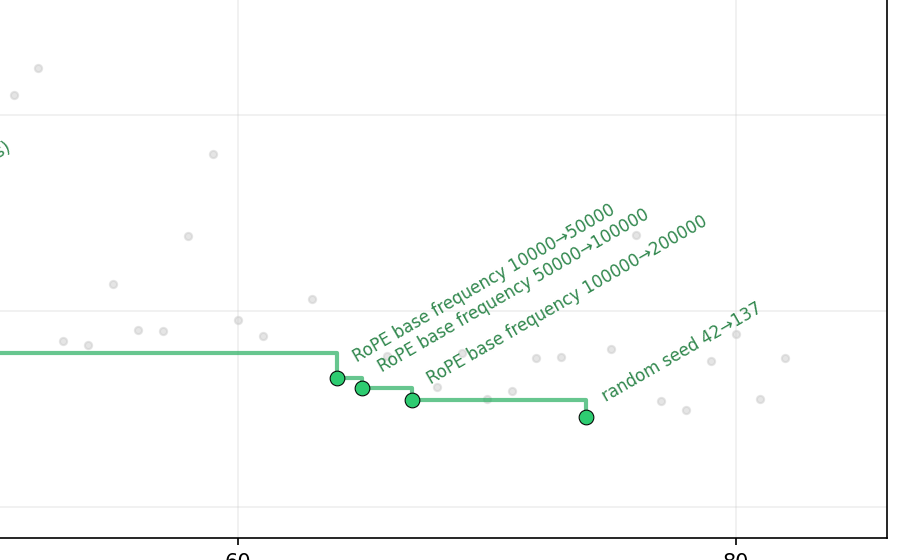
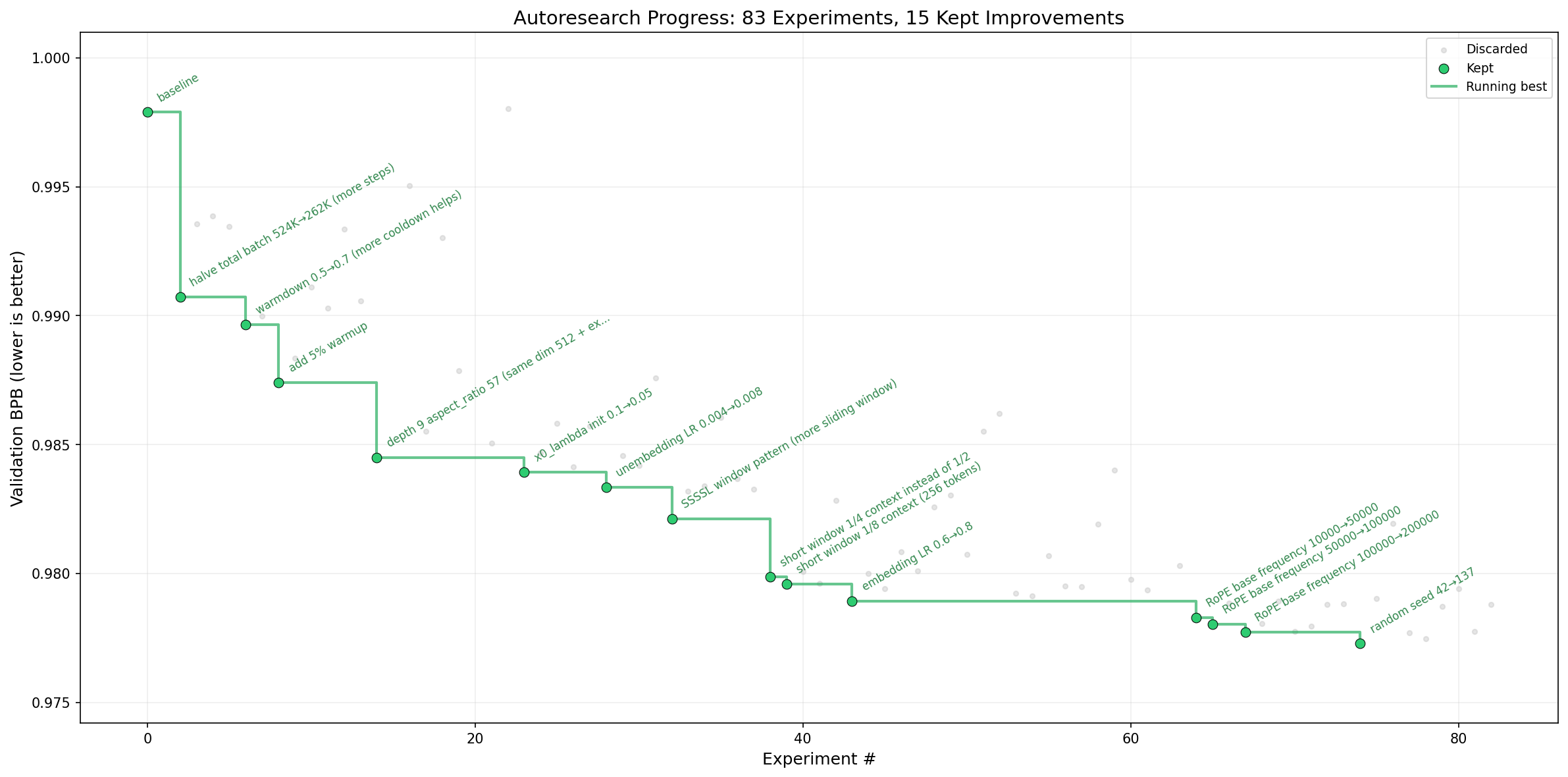
The consequence is visible in the source's own published run: the fifteenth and final kept
improvement of 83 experiments is a change of random seed. That is not a failure of the agent's
judgement; it is the rule executing correctly on an input it cannot recognise.
That experiment also measures the loop's noise floor for free - reseeding changes nothing real,
so whatever it "improved" is a lower bound on how much the score moves for no reason. Read off the
chart it is roughly 0.0005 bpb, and at least three other accepted changes appear smaller than that
[S13 n12, needs-check - deltas read off a rendered PNG, and the floor rests on n=1].
The compounding is the part to carry: every accepted change permanently moves the baseline all later
experiments are judged against, and nothing ever re-tests a kept change [S13 g3]. So a lucky
accept does not merely add a spurious row - it raises the bar for every subsequent real improvement.
Version control is a sufficient experiment database, if an experiment is a diff#
Branch per run, commit per experiment, git reset as the discard operation, branch tip as
current-best [S13 n6]. No tracker, no registry. This works because of the first freeze: with
hyperparameters as in-file constants, the thing being tracked is a sequence of diffs and the
operation needed most is "undo the last one".
The sharpest small idea: the ledger is deliberately untracked [S13 n7]. Discard is git reset,
so anything committed is inside the thing that gets rewound, and the row you most want to keep is
the one describing the experiment that just failed. Stated generally - in any loop whose failure
mode is rollback, the audit trail must not be rollback-able. (The instruction is the source's; the
derivation is this brain's - the source gives no reason.)
The price is paid in the same breath: because the ledger was never committed, the author's own published results cannot be reproduced from the repository.
Running a loop hundreds of times is a context problem before it is a compute problem#
The scarce resource is not the GPU - that is busy exactly 300 seconds per iteration whatever
happens. It is the agent's context, and S13 spends three separate mechanisms on it: the training log
is a single carriage-returned line, tee is forbidden, and the result is read with grep rather
than by opening the file - roughly two lines per five-minute experiment [S13 n8]. The artifact
is given a machine-readable reporting interface (nine key: value lines) so the driver never parses
prose.
The cost is per-iteration and therefore multiplied by the iteration count, which is the number to
design against; 500 wasted tokens per experiment is 50,000 across a night. Related: empty output is
the error signal - "if the grep output is empty, the run crashed" - which costs zero tokens in the
common case, paired with a fast-fail in the artifact that kills a NaN run rather than spending the
remaining budget [S13 n17].
Autonomy is a suppressed default, and the freezes are what earn it#
S13 instructs the agent in capitals never to check in: "do NOT pause to ask the human if you should
continue... The human might be asleep" [S13 n9]. This is not a capability added but the default
that most agent guidance works to install, deliberately removed.
Two properties make it defensible here, and they are the test to apply elsewhere: the check-in has no information to offer (the decision is a scalar comparison against a protected metric, so a human woken at 3am adds nothing the rule does not encode), and the blast radius is a branch - nothing deployed, nothing sent, nothing irreversible, with the holdout structurally out of reach. The freezes above are what make "disable all permissions" a defensible instruction here and an alarming one almost anywhere else.
The instruction carries a second half that is easy to skim and is load-bearing: an idea-generation
fallback ladder for when the agent runs out of ideas (think harder, read the papers cited in the
code, re-read the in-scope files, combine previous near-misses, try radical changes). Without it
"never stop" degrades into re-trying variations of the last success. Whether it works is untestable
from this source, because the reasoning behind each experiment is never recorded [S13 g1].
When the loop carries a second objective, publish the exchange rate#
S13 gives the agent simplicity as a second goal beside the metric, and resolves the conflict not with
a preference but with four worked numeric trades - a 0.001 improvement costing 20 lines of hacky
code is refused, a 0.001 improvement from deleting code is kept, a ~0 improvement that simplifies
is kept [S13 n10, single-leg]. Claim 59 says a loop holding two objectives trades them off
untunably; this is a partial answer to it that does not require splitting the loop - specify the
rate rather than the preference. Note the limit: the ledger has no complexity column, so the trade
is made in the agent's head and is never recorded or audited.
What the results actually look like, and how to read them#
From S13's single published run, all needs-check [S13 n13, n14, n15]:
- Yield is low and that is fine. 15 keeps in 83 experiments (~18%). The loop's advantage is not intelligence, it is indifference to rejection.
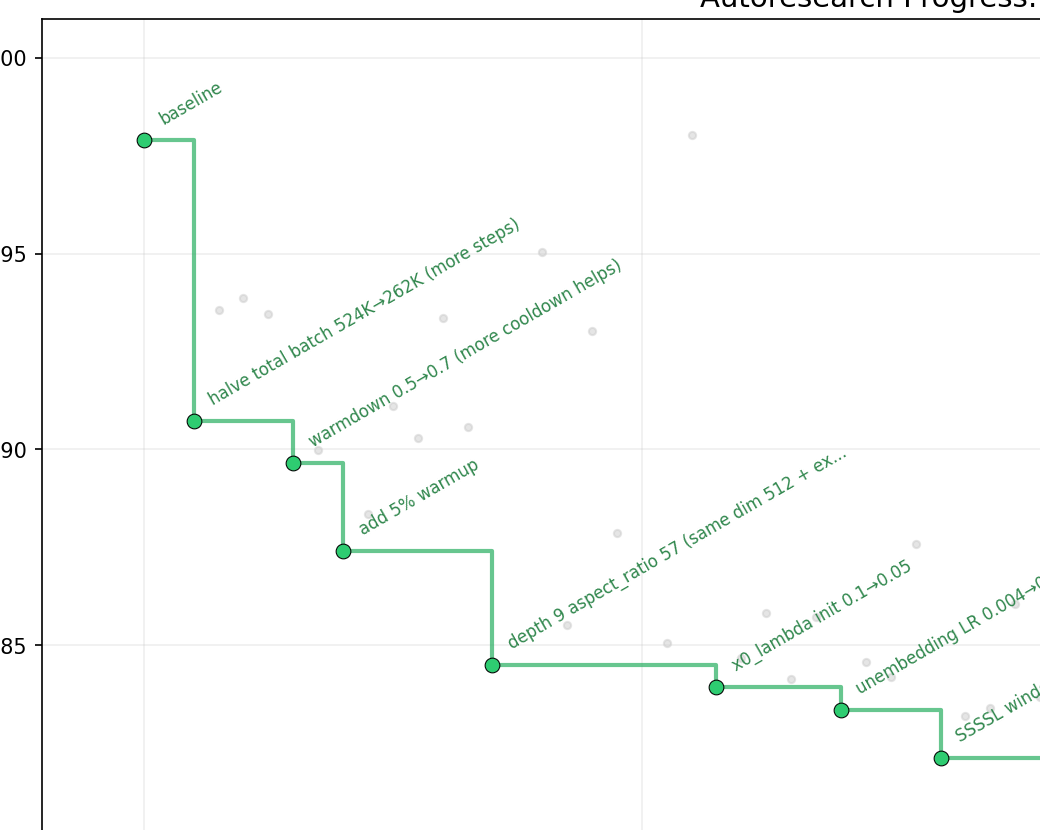
- Gains are front-loaded - four of fifteen in the first eight experiments, and they are schedule and sizing knobs, which is the wall-clock budget choice showing up directly in the results.
- The search is greedy coordinate descent and nothing else was available. Three consecutive kept experiments walk one hyperparameter monotonically. Each experiment is judged against the current tip, so there is no way to evaluate a combination, compare two directions, or escape a local optimum other than a "rewind, very very sparingly" escape hatch with no stated criterion.
- A ~22-experiment plateau in the middle, escaped for reasons the design did not record.
- Read the chart's code before the chart. The shipped figure filters out crashes and everything
scoring worse than
baseline + 0.0005, while its title counts all 83 - so the visible near-miss cloud is not the failure population [S13n15].
The artifact you iterate on is the prose#
The author's own framing: "you're not touching any of the Python files like you normally would as a
researcher. Instead, you are programming the program.md" - and he calls that file "essentially a
super lightweight 'skill'" [S13 n16]. 115 lines of markdown hold the setup ritual, the rules, the
output contract, the ledger schema, the loop and the autonomy policy. Every gap identified in this
note is a markdown edit rather than an engineering project, which is the strongest argument that
the inversion is real and not a slogan. See skills.md, which records this as the
second instance in this brain of the pattern outside a coding-assistant context.
An archive beats a lineage, and it is the first ablated claim this note holds#
S13 froze rollback-as-discard: any change that did not improve the metric was reverted with
git reset. S22 measures what that costs
(S22 n8, claim 174).
Take the obvious search first. Hold the current best agent, ask it to modify itself, keep the child if it scores better. Now ask what happens the first time a self-modification is bad: you have damaged the only agent you have, and every later improvement starts from the worse version. The failure compounds, because an agent degraded at editing code is degraded at exactly the capability it needs to repair itself. S22 runs that configuration as an ablation and it plateaus lowest of three.
The alternative is to keep everything. S22 maintains an archive of every agent ever produced and selects the next parent from the whole archive, weighting selection proportionally to score and inversely to how many children an agent already has, with every agent retaining non-zero probability (claim 175). One bad child then costs one iteration rather than the run.
The payoff is visible and it is the argument for the whole design. At iterations 4 and 56 the agent scored below its parent. A hill-climber discards that branch; the archive let the search continue down it and produce an agent that outperformed every predecessor. An accept rule that only moves forward cannot cross a valley - which is a plain statement of what S13's rollback-as-discard freeze buys and what it costs.
Both S22 ablations matter and they separate cleanly. Freeze the meta-agent so it never improves at improving - the prior ADAS approach - and gains "taper off quickly", plateauing in the middle. Keep only the latest agent and it plateaus lowest. Neither component is decoration, and this is the only ablation-backed claim about self-improving architecture anywhere in this brain.
What must not be modifiable, now stated by two sources#
S13 gave this note its organising idea: the four things you freeze before letting an agent change everything else. S22 freezes two, for stated reasons, and one of them is sharper than anything S13 had (claim 176).
The viability gate. Only agents that compile and retain the ability to edit a codebase are admitted to the archive; everything else is discarded, because only those can continue self-modifying. Note what kind of check that is - not a quality bar, since an agent much worse than its parent is still archived. It is a liveness invariant, deliberately separate from the performance metric, and it is the only thing standing between the system and a self-modification that ends the run by breaking the tool it needs to modify itself.
The meta-level. Archive maintenance and parent selection are "fixed and not modifiable by the DGM". Ask what lifting that restriction would do and the reason is immediate: a system that can rewrite its own selection criteria can rewrite them to prefer itself, and the empirical evidence that was supposed to discipline the search is then produced under rules the search chose.
This is claim 113 avoided by construction, and the contrast with S13 is exact. S13's autoresearch had a protected metric whose value nonetheless reached the decision through code the agent could rewrite - separation at the level of functions did not deliver separation in fact. S22 puts the deciding machinery outside the modifiable surface entirely. The principle both sources point at: the thing that decides what counts as improvement must not be inside what improves.
It also bounds S22's own framing. The search is open-ended within a human-designed search procedure, which is the same concession S18's authors made about their architecture search, and the paper records it as future work.
The loop amplifies whatever its verifier cannot see, and three sources now say so#
The most important thing this note holds, and it is now stated from three independent directions (claim 177).
S22's Safety Discussion says it plainly of their own system: if evaluation benchmarks "do not fully capture all desired agent properties (e.g., safety and robustness), the self-improvement loop could amplify misalignment over successive generations".
| Source | Form | What it says |
|---|---|---|
| S13, claim 114 | Observed | A loop with a real, cheap, automatic verifier banked a change of random seed as its final improvement, because the accept rule had no notion of variance |
| S19, claim 162 | Predicted, adversarially | An attacker's step in a self-refining skill runs without error, the loop treats "no error" as validation, and the procedure is optimised around the adversarial step |
| S22, claim 177 | Predicted, by the builders | If the benchmark misses a property, successive generations compound the miss |
All three are one statement: a self-improving loop optimises what it can measure and compounds what it cannot. And claim 124 is the frame that explains all three - verification, not generation, is the rate limit, so a loop improves at the rate its verifier can discriminate and degrades at the rate its verifier is blind.
S22's safeguards follow from taking that seriously, and what they are not is the instructive part: sandboxed execution, a strict per-execution time limit, a modifiable scope confined to the agent's own codebase, and a traceable lineage of every modification for human review. Every one is containment. None is a check that a modification is good - consistent with the paper's own premise, since the impossibility of that check is why it swapped proof for evidence in the first place.
The authors then name the shape of a real answer as future work: incentivising a self-improving system to retain safety directives is hard, and "an option worth exploring is to create an unmodifiable part of the system to be able to evaluate at halt the rest". That is this note's freeze pattern proposed for the safety layer, and nobody has built it.
Key claims#
| # | Claim | Confidence |
|---|---|---|
| 110 | Hold a resource constant, not the work: wall-clock time makes architecture, model-size and efficiency changes directly comparable in a way fixed steps or fixed tokens do not. | corroborated (S13, docs+code) |
| 111 | Make the metric invariant to everything the agent may change - normalise by a physical unit, evaluate under fixed conditions, pin the holdout in read-only code. Anti-Goodhart is a code-layout problem, not a prompt problem. | corroborated (S13, docs+code) |
| 112 | Splitting the workspace into an editable file and a read-only file is the containment boundary of an unattended loop - and it is typically a declaration, not an enforcement. | corroborated (S13, docs+code) |
| 113 | A protected metric can still reach the decision through agent-editable code; separating generator from evaluator at the function level does not separate them on the reporting path. | corroborated (S13, code) |
| 114 | A bare improve-or-regress accept rule with no variance handling will bank noise - S13's own run kept a change of random seed as one of fifteen improvements. | corroborated (S13, rule + figure) |
| 115 | Re-running one configuration with a different seed measures the loop's noise floor for free; any accepted improvement smaller than it is unresolved. | needs-check (S13, n=1, chart-read) |
| 116 | In a loop whose discard operation is a rollback, the audit trail must live outside the rolled-back state. | corroborated (S13, docs + repo state) |
| 117 | Version control is a sufficient experiment database when an experiment is a diff: branch per run, commit per experiment, reset as discard. | needs-check (S13, single-leg) |
| 118 | The per-iteration context budget is a first-class design parameter of an unattended loop, because its cost is multiplied by the iteration count. | corroborated (S13, docs+code) |
| 119 | Autonomy requires explicitly suppressing the agent's check-in default, and is earned by two conditions: the check-in has no information to offer, and the blast radius is bounded. | needs-check (S13, single-leg + this brain's reading of the conditions) |
Full rows and citations in ../claims.md. The Topic column there distributes
these across four notes - 110, 112, 116 and 117 are filed here; 111, 113, 114 and 115 under
evals.md because they are measurement claims reusable well outside a research loop;
118 under context-engineering.md; 119 under agents.md.
They are all listed above because they are all key to this argument, and are cross-referenced
rather than restated in the other notes.
Key visuals#
progress_endgame.png- the most important image in this topic. The end of S13's run: a long plateau, a three-step coordinate-descent staircase, and a final accepted improvement labelledrandom seed 42->137. The whole variance argument is legible in one crop.progress_full.png- the complete 83-experiment frontier. Yield, front-loading and the plateau in one view. Readn15before quoting it - the figure is filtered by the notebook that draws it.progress_early.png- the first ten experiments, where four of the fifteen wins land, all of them schedule and sizing knobs.
Open questions / conflicts#
- What is the actual noise floor of a loop like this? The cheapest unrun experiment in the area: run an unmodified baseline five times with different seeds and report the spread. It would settle how many of S13's 15 improvements are real (claim 115).
- Does recording why an experiment was tried improve the next hundred? S13 records only what
changed and what happened [S13
g1]. The addition costs one column; the effect is unmeasured anywhere this brain has seen. - How do you parallelise a git-as-database loop? Two agents on two GPUs produce two branch tips
editing the same constants, which do not merge [S13
g2]. S13 hints at one-agent-per-GPU in a branch name and designs nothing. - Does the reporting-path leak (claim 113) matter empirically, or only as a principle? No source here has observed an agent exploiting it.
- ~~Where does this shape stop working? Everything in S13 depends on "better" being one number a
frozen function computes. Most research questions worth automating do not have that, and this
brain holds nothing on the case where the accept decision is a judgement.~~ Partly closed
2026-08-04 by S14, which names the constraint and generalises it: the loop runs at exactly the
rate its verifier can distinguish good output from bad, so where the accept decision is a
judgement rather than a number, the loop stalls on human attention (claim 124,
self-improvement.md). Still open is the interesting remainder - what a loop should do in that case, since "wait for a human" is a description of the problem rather than a design. - Conflict to watch, not yet a contradiction: claim 119 (suppress the check-in) sits against claim 16 from S2 (make contacting a human a tool call among the others). They are reconcilable - S2's agents act in the world, S13's acts on a branch - but the condition that separates them is this brain's reading, not either source's, and a second source on unattended loops should be checked against it.
Sources feeding this topic#
- S13 -
karpathy/autoresearch(Andrej Karpathy, code, snapshot228791f, 2026-03-26). The primary and currently only source. An agent is given one editable training script, a five-minute budget, a protected metric and an instruction never to stop; it hill-climbs overnight. Contributes the four freezes, the git-as-database pattern, the untracked-ledger rule, the per-iteration context budget, and the noise finding. ⚠️ T4 personal repository. The design is fully inspectable and the docs-versus-code gate passes on every design claim; the results are one PNG whose underlying ledger is untracked by design and absent from the repo, so nothing empirical here is reproducible. No code was executed by this brain (no GPU). No deep-research pass has been run - this note contains no external evidence at all. - S14 - Stanford CS329A: Self-Improving AI Agents, lecture 1
(video, 2026-08-03). Cross-reference, not counted as a primary source for this note - it works
a different layer (a model improving its own weights, not an agent improving an artifact), and its
claims are filed in
self-improvement.mdunder ADR-0018. Two things reach here. First, the frame that explains claim 114: verification sets a loop's ceiling, so S13's accept rule banking a random-seed change is not a quirk of that repository but the general failure of a verifier with no notion of variance. Second, a second instance of the shape - the AI Scientist pipeline (Lu et al, 2024) runs idea generation, an experiment iteration loop, and paper write-up, and terminates in a box reading "LLM Paper Reviewing" [S14n10,frame_3420]. That is mention-level evidence under ADR-0012 - a lecture slide about someone else's paper, not an ingest of it - and the paper itself is onreading-list.mdas the obvious second primary for this note.