source
Darwin Gödel Machine: Open-Ended Evolution of Self-Improving Agents
Jenny Zhang (UBC + Vector Institute), Shengran Hu (UBC + Vector + Sakana AI), Cong Lu (UBC + Vector + Sakana), Robert Lange (Sakana AI), Jeff Clune (UBC + Vector + Sakana + Canada CIFAR AI Chair). Zhang and Hu are co-first authors; Lange and Clune co-senior
About this note
Persona: curator + mentor - re-adopt when working this file. Written for a senior engineer who holds S13 (
karpathy/autoresearch) and S14/S15, and who is building something that improves itself. Every claim carries a node ID (n5,d1) fromnodes.md. Blocks marked Background, supplied are mine, not the paper's, and are uncited by construction.
On this page
TL;DRThe 1-minute versionKey claimsWhat you will learn, and in what orderMovement 1 - the substitution1. Why nobody built a Gödel machine2. Proof becomes evidence3. Improving yourself is the taskMovement 2 - the search, and its freezes4. Why a lineage fails, and an archive works5. What must not be modifiableMovement 3 - does it work6. The ablations7. What it actually discovered8. Held-out transferMovement 4 - the builders' own warning9. What the loop amplifiesDiagram (mental model)💡 TermsWhat to distrust in this noteOpen questionsFeeds these topicsPresentation narrativeSlide 1 - Swap the proof for evidence, and inherit a completely different problemSlide 2 - An archive rather than a lineage, because exploration needs a memorySlide 3 - Freeze the scoreboard, or the loop optimises itSlide 4 - It works, and the ablations are why that is citableSlide 5 - What it discovered is boring, and that is the strongest signal in the paperSlide 6 - The builders' own warning is the thing to carry out of the roomKey takeaway messageTL;DR#
Schmidhuber's Gödel machine rewrites its own code only when it can prove the change beneficial,
which is why nobody has built one. The DGM's move is to swap the proof for empirical evidence on a
benchmark (n1), and then to handle everything that follows from being able to be wrong. It improves
its own codebase - self-improvement is the coding task it is measured on (n2) - and keeps every
agent it has ever produced in an archive, selecting parents by score and by how little explored
they are (n3, n4). Over 80 iterations that takes SWE-bench from 20.0% to 50.0% and Polyglot
from 14.2% to 30.7% (n7), and two ablations show both components are load-bearing: freeze the
meta-agent and progress plateaus, keep only the latest agent and it plateaus lower (n8). What it
discovers is unglamorous - better file editing, patch ranking, retry on empty patches (n10) - and it
transfers to held-out models, benchmarks and languages (n11). The section to read for your build
is §5: the builders state that if your benchmark does not capture every property you care about, the
loop amplifies whatever it does not measure (n12). That is S19's V-S5, said by the people running
the loop.
flowchart TB
    G["Schmidhuber's machine rewrites its own code<br/>only when it can <b>prove</b> the change good"]
    W["which is why nobody built one"]
    S["swap the proof for <b>empirical evidence</b><br/>on a benchmark - n1"]
    C["and then handle everything that follows<br/>from being able to be <b>wrong</b>"]
    A["an <b>archive</b> of every agent ever produced,<br/>parents chosen by score <i>and</i> by how<br/>little explored they are - n3, n4"]
    R["20.0% -> 50.0% on SWE-bench<br/>over 80 iterations - n7"]

    G --> W --> S --> C --> A --> R

    style S fill:#dcfce7,stroke:#15803d,color:#14532d
    style C fill:#e8f0fc,stroke:#4285f4,color:#1a3a6b
This is a substitution diagram, not an architecture diagram, and the box after the swap is where the real work is. The crux is that replacing proof with evidence is one line of design and produces a system that can be wrong, so every subsequent choice - the archive, the exploration term, the frozen components - exists to survive being wrong rather than to improve anything. It is drawn as a single descent because the paper reads that way: one substitution, then its consequences, then the numbers. The result is unglamorous by design, and section 9 carries the builders' own warning about what the loop does to whatever the benchmark fails to measure.
Synthesized from n1, n3, n4 and n7.
The 1-minute version#
This article covers an ICLR 2026 paper - the strongest venue in this brain - that builds the first working instance of a fifty-year-old idea: an AI that rewrites its own code to get better at rewriting its own code. The first thing to establish is why the idea sat unbuilt, because the answer determines the whole design.
The problem is that the original formulation demanded the impossible. Schmidhuber's Gödel machine
modifies itself only when it can prove the modification is net beneficial, which guarantees safety
and, as the paper puts it, "in practice and without restrictive assumptions about the system, it is
impossible to formally prove whether a modification to an AI system will be beneficial" (n1).
Why relaxing that is harder than it sounds is the interesting part. Swap proof for evidence on a benchmark and you can now build the thing - and you have also accepted that some modifications will be wrong, some evaluations will be noisy, and the system can walk into a local optimum and stay there. Every remaining design decision is a response to one of those three.
The naive fix is to hill-climb: keep the current best agent, modify it, keep the change if the score
improves. That is the paper's own second baseline, and it plateaus lowest of the three (n8),
because a single bad self-modification damages the only agent you have and every subsequent
improvement has to be made from a worse starting point.
The idea is to keep everything. The DGM maintains an archive of every agent it has produced,
selects a parent from the whole archive rather than from the frontier, and weights that selection by
performance and inversely by how many children an agent already has (n3, n4). Every agent
keeps a non-zero chance of being selected. That is what lets the run recover from its own dips: at
iterations 4 and 56 the score fell below the parent's, and the archive let the search continue down
that branch and eventually exceed everything before it (n9).
How it works in the loop is three steps. Select a parent from the archive; have it read its own
benchmark logs, propose a feature, and implement it in its own codebase; evaluate the result and add
it back. Only agents that compile and can still edit a codebase are admitted (n5), because only
those can continue the loop.
What it costs to be safe is the part worth copying. The meta-level is frozen - archive maintenance
and parent selection are fixed and the DGM cannot modify them (n6) - and the safeguards are all
containment rather than correctness: sandboxes, per-execution time limits, a modifiable scope confined
to the agent's own Python code, and a traceable lineage of every modification (n13).
How far to trust it is the easiest answer in this brain's set. ICLR main track, open-sourced code, two
ablations that isolate the two claimed components, and held-out transfer across models, benchmarks and
languages. The caveats are about scope: the model never changes, only the scaffolding around it
(d3), the evaluation is staged with a heuristic noise threshold (d1), and the meta-level being
fixed bounds how "open-ended" the search really is (d4).
The narrative above is the argument. The table below is the same argument compressed for someone returning to check one row.
| The problem | A Gödel machine self-modifies only on a proof the change helps, and such proofs are impossible in practice (n1) |
| Why the obvious answer fails | Hill-climbing on the current best agent plateaus lowest of the three configurations, because one bad self-modification damages the only agent you have (n8) |
| The idea | Swap proof for empirical evidence, and keep an archive of every agent - selecting parents by score and inversely by how explored they are, so no branch is ever closed off (n1, n3, n4) |
| How it works | Select a parent, have it read its own evaluation logs and implement a feature in its own codebase, evaluate, add back. Only agents that compile and can still edit code are admitted (n5) |
| What it costs / found | SWE-bench 20.0% to 50.0%, Polyglot 14.2% to 30.7% over 80 iterations; both components ablation-confirmed necessary; improvements transfer to held-out models, benchmarks and languages (n7, n8, n11) |
| How far to trust it | ICLR 2026 main track, open code, real ablations - the best-evidenced source here. Caveats are scope: the model never changes (d3), evaluation is staged on a heuristic threshold (d1), and the search procedure itself is frozen (d4) |
Key claims#
- Replace the proof with evidence, and the idea becomes buildable - the Gödel machine's demand for
provable improvement is what kept it theoretical (
n1). - Self-improvement is framed as a coding task on the agent's own repository, so benchmark progress
and self-improvement capability are the same measurement (
n2). - An archive beats a lineage, and it is ablation-confirmed. Keeping only the latest agent plateaus
lowest; freezing the meta-agent plateaus in the middle; the full DGM outperforms both (
n8,fig2_results_ablations.png). - Parent selection weights performance and under-exploration, with every agent retaining
non-zero probability (
n4), which is what lets the search recover from its own dips at iterations 4 and 56 (n9). - The viability gate: only agents that compile and can still edit a codebase enter the archive
(
n5). And the meta-level is frozen - the DGM cannot modify its own archive maintenance or parent selection (n6). - SWE-bench 20.0% to 50.0%, Polyglot 14.2% to 30.7%, over 80 iterations (
n7). - What it discovers is tooling, not cleverness - granular file editing, patch ranking, history-aware
generation, retry on empty patches (
n10,fig3_archive_tree.png). - The gains are not benchmark overfitting: they transfer to held-out models (Claude 3.7 Sonnet
19.0% to 59.5%), to a held-out benchmark, and to unseen programming languages (
n11,fig4_transfer.png). - The builders state the amplification hazard themselves: if the benchmark does not capture every
property you care about, "the self-improvement loop could amplify misalignment over successive
generations" (
n12). This is S19's V-S5 from the builders' side. - Every safeguard is containment, not correctness - sandbox, time limit, scoped modifiable
surface, traceable lineage (
n13) - and they name an unmodifiable supervisor as future work (n15).
What you will learn, and in what order#
flowchart TB
    subgraph M1["Movement 1 - the substitution"]
        S1["1. Why nobody built a Godel machine"]
        S2["2. Proof becomes evidence"]
        S3["3. Improving yourself is the task"]
    end
    subgraph M2["Movement 2 - the search, and its freezes (the payload)"]
        S4["4. Why a lineage fails and an archive works"]
        S5["5. What must not be modifiable"]
    end
    subgraph M3["Movement 3 - does it work"]
        S6["6. The ablations"]
        S7["7. What it actually discovered"]
        S8["8. Held-out transfer"]
    end
    subgraph M4["Movement 4 - the builders' own warning"]
        S9["9. What the loop amplifies"]
    end
    M1 --> M2 --> M3 --> M4
    style M2 fill:#f8b4b4,stroke:#c1121f,stroke-width:2px
This is a reading-order diagram about the note rather than about the system. Movement 1 is short and establishes the one substitution everything else responds to. Movement 2 is the payload for anyone building this, because it is where the design decisions live: section 4 derives the archive from the failure of hill-climbing, and section 5 lists what the system is forbidden to touch - which is the part S13 already taught this brain to look for first. Movement 3 is the evidence, and it is unusually good; section 6 in particular is the only ablation-backed claim about self-improving architecture anywhere in this brain. Movement 4 is one section and it is where this source meets the security track - the builders' statement of the amplification hazard is the same mechanism S19 predicted adversarially, and reading it after section 5 is what makes the freezes look like safety engineering rather than housekeeping.
Movement 1 - the substitution#
flowchart TB
    P["1. proof: rewrite only when the<br/>change is <b>provably</b> beneficial"]
    N["which is undecidable in practice,<br/>so nobody built one"]
    E["2. evidence: rewrite when the change<br/><b>measures</b> better on a benchmark - n1"]
    T["3. and self-improvement <b>is</b> the task<br/>it is measured on - n2"]

    P --> N --> E --> T

    style E fill:#dcfce7,stroke:#15803d,color:#14532d
    style T fill:#e8f0fc,stroke:#4285f4,color:#1a3a6b
This is a substitution diagram, and the third box is the whole move. The crux is that swapping proof for evidence converts an undecidable requirement into an empirical one, at the price of being able to be wrong - and the rest of the paper is about paying that price. It is drawn as a straight replacement because there is no middle position available: either the criterion is a proof or it is a measurement. Section 3 is the elegant part and is easy to skim past. The system improves its own coding ability and is scored on coding, so the benchmark and the subject are the same object, which is what makes the loop closed rather than merely iterative.
Synthesized from n1 and n2.
1. Why nobody built a Gödel machine#
Background, supplied. Schmidhuber's Gödel machine (2007) is a theoretical design for a self-improving program. It holds a proof searcher alongside its own source code, and it rewrites itself only when it has proved that the rewrite improves its expected future performance. The elegance is that safety and improvement come from the same mechanism: a change you cannot prove beneficial is a change you do not make. This block is background I am supplying and is uncited by construction.
The design has sat unimplemented for nearly two decades, and the paper names the reason in one
sentence: "in practice and without restrictive assumptions about the system, it is impossible to
formally prove whether a modification to an AI system will be beneficial" (n1).
The illustration they give is worth keeping because it is so ordinary. It seems obvious that a coding agent benefits from more tools, and yet "the actual impact depends heavily on the model's training and task context - a testing tool that is optimized for one setup may confuse the agent when working with others". The effect of a change is contingent on things nobody can enumerate, which is precisely what a proof would have to range over.
So the requirement that made the Gödel machine safe is the requirement that made it impossible. That sets up the substitution the whole paper is built on.
2. Proof becomes evidence#
flowchart TB
    P["<b>proof</b><br/><i>certain, and unobtainable</i>"]
    E["<b>evidence</b><br/><i>obtainable, and fallible</i>"]
    C1["a proof-gated system<br/>never moves"]
    C2["an evidence-gated system moves,<br/>and sometimes moves wrongly"]
    D["so the design problem changes from<br/><b>how to be sure</b> to<br/><b>how to survive being wrong</b>"]

    P --> C1 --> D
    E --> C2 --> D

    style D fill:#dcfce7,stroke:#15803d,color:#14532d
This is a trade diagram, not a critique of Schmidhuber. The crux is that the substitution does not weaken the guarantee so much as relocate the entire engineering problem: a proof-gated machine needs no recovery mechanism because it never takes a bad step, and an evidence-gated one needs nothing else. It is drawn as two paths reaching one reframing because the value is in the last box - every subsequent design decision in the paper, the archive included, is an answer to it. This also explains why the paper spends so little time on the improvement mechanism and so much on the search structure.
Synthesized from n1.
The DGM "relaxes the Gödel Machine's impractical requirement of theoretically proving that a change
will improve the system, instead requiring empirical evidence from experiments to demonstrate that
a proposed new version enhances performance" (n1).
That sentence is easy to skim and it is the entire design premise, so it is worth working out what you have just given up. Three things follow immediately, and every remaining decision in the paper answers one of them.
You will accept changes that are not improvements, because a benchmark score is a sample and samples are noisy. You will get stuck, because empirical hill-climbing has local optima and the paper says so - the system "may get stuck in a local optimum within the vast search space of possible systems". And you will accept changes that improve the metric while damaging something the metric does not measure, which is section 9.
This brain has already watched the first of those go wrong. S13's autoresearch loop had a real, cheap, automatic verifier and its final banked "improvement" was a change of random seed, because the accept rule had no notion of run-to-run variance (claim 114). The DGM's answer to the same problem is visible in its evaluation design: agents are screened on 10 tasks, promoted to 60, and only the top two scoring above 40% are evaluated on 200 - with that threshold "chosen based on the noise observed in preliminary runs" (
d1). Somebody thought about variance. It is a heuristic rather than a statistical test, and it is more than S13 had.
The substitution also changes what the system is for, and that is section 3.
3. Improving yourself is the task#
The DGM is a coding agent, and its self-modifications are coding tasks performed on its own repository. That is not a convenience; it is what makes the loop measurable.
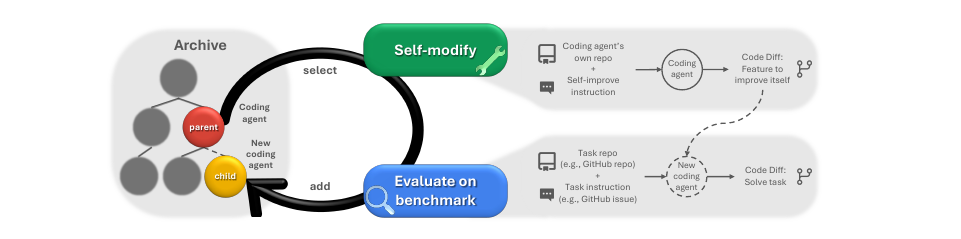
What it teaches: two branches from one loop. The Self-modify branch feeds the coding agent's
own repo plus a self-improve instruction, and emits a code diff that is a "Feature to improve
itself". The Evaluate on benchmark branch feeds a task repo and a task instruction to the new
agent, and emits a code diff that solves the task. Both feed the archive. Corroborated by: §3, p4
(n2, n3).
Read the symmetry between the two branches, because it is the paper's cleverest structural move. The two branches are the same kind of work. Editing your own repository to add a better file-editing tool and editing someone else's repository to fix a bug are both "modify a codebase", so a benchmark that measures the second is also evidence about the first. The paper states it directly: "the empirical evidence must reflect the system's ability to both self-improve and solve downstream tasks", and "an increase in performance on coding benchmarks indicates better coding capabilities, and hence better ability to self-modify and self-improve".
That is a genuine assumption rather than a fact, and the paper flags it as a "key assumption". It is also the thing that makes the loop closable at all - and it is why this works for coding agents and would need re-deriving for any other domain.
So the loop is well-formed. The next question is what shape the search should take, and the answer is derived rather than assumed.
Movement 2 - the search, and its freezes#
flowchart TB
    L["a <b>lineage</b>: keep improving<br/>the latest agent"]
    X["dead ends are permanent, and a<br/>bad step discards everything after it"]
    A["4. an <b>archive</b>: keep every agent ever<br/>produced, and pick parents by score<br/><i>and</i> by how little explored - n3, n4"]
    F["5. and freeze what must not be<br/>modifiable, or the loop edits its<br/>own scoreboard"]

    L --> X --> A --> F

    style X fill:#fee2e2,stroke:#b91c1c,color:#7f1d1d
    style F fill:#dcfce7,stroke:#15803d,color:#14532d
This is a search-design diagram, not a data structure. The crux is that an archive is not a convenience for rollback but the thing that makes exploration possible at all, since a lineage cannot revisit a branch it abandoned. It is drawn with the failing alternative first because the archive reads as obvious bookkeeping otherwise, and it is not: the exploration term is what stops the search collapsing onto the current best. Section 5 is the one to read for your own build, and it is the same freeze discipline this brain records from autoresearch - the components the agent may not edit are what make its results mean anything.
Synthesized from n3, n4 and n5.
4. Why a lineage fails, and an archive works#
The obvious search is hill-climbing. Hold the current best agent, ask it to improve itself, keep the child if it scores better. One agent, one lineage, forward only.
Ask what that does the first time a self-modification is bad. You have damaged your only agent,
and every future improvement now starts from the worse version. Worse, the failure compounds: an agent
degraded at editing code is degraded at the very capability it needs to repair itself. The paper's
phrasing of its own ablation is exact - "only the most recent agent is retained, so a poorly performing
self-modification makes subsequent improvements harder to achieve" (n8).
So keep everything. The DGM maintains an archive of every agent ever produced and selects the next
parent from the whole archive (n3). One bad child costs one iteration rather than the run.
That raises the next question immediately: if you can select any agent, which one? Selecting the best
each time reconstructs hill-climbing with extra steps. The answer is a two-term weighting (n4):
roughly proportional to performance, and inversely proportional to the number of children an
agent already has. High performers get exploited; promising-but-underexplored lineages get tried. And
every agent keeps a non-zero probability, so no branch is ever permanently closed.
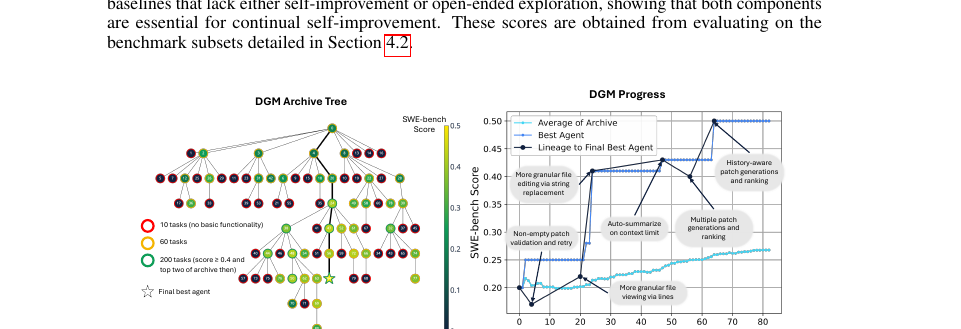
What it teaches: the left panel is the archive as a tree, node colour showing SWE-bench score and
border colour showing how many tasks the agent was evaluated on. It branches widely rather than
forming a chain. The right panel tracks the archive average, the best agent, and the lineage to the
final best agent - which visibly dips twice before rising to 0.50, each step annotated with the
modification that caused it. Corroborated by: §4.4, p7-8 (n4, n9, n10).
The two dips are the argument for the whole design. At iterations 4 and 56 the agent scored below
its parent, and a hill-climber would have discarded that branch. The archive let the search keep going
down it, and it produced an agent that "outperformed all of its predecessors" (n9).
The transferable principle, stated generally: an accept rule that only moves forward cannot cross a valley. S13's loop had exactly that shape -
git reseton any change that did not improve the metric - and this brain recorded rollback-as-discard as one of its four freezes. DGM shows what that freeze costs, and the cost is measured infig2_results_ablations.png.
Keeping everything makes the search robust. What keeps it alive is a different mechanism.
5. What must not be modifiable#
flowchart TB
    A["the agent may edit<br/>its own codebase"]
    Q{"including the parts that<br/>decide whether it improved?"}
    Y["if yes: the loop optimises<br/>its own scoreboard"]
    N["if no: the benchmark, the harness<br/>and the scoring stay <b>frozen</b>"]
    R["freezing is what makes the numbers<br/>mean anything at all"]

    A --> Q
    Q --> Y
    Q --> N --> R

    style Y fill:#fee2e2,stroke:#b91c1c,color:#7f1d1d
    style R fill:#dcfce7,stroke:#15803d,color:#14532d
This is a containment diagram, and it is the section to read if you are building one of these. The crux is that a self-modifying system needs a boundary it cannot cross, and the boundary has to include the measurement or the measurement stops being independent of the thing measured. It is drawn as a single decision with two outcomes because there is no partial answer: any editable component on the scoring path reintroduces the problem in full. This is the same freeze discipline this brain records from autoresearch, arrived at independently by a different team on a different task.
Synthesized from n5; the cross-reference to autoresearch is this brain's.
Two things are frozen, and after S13 this is the first thing to look for in any self-modifying system.
The viability gate. Only agents that compile successfully and retain the ability to edit a
codebase are added to the archive; everything else is discarded (n5). The reasoning is stated
plainly - "only they can continue self-modification".
Notice what kind of check that is. It is not a quality bar, since a viable agent may be much worse than its parent and still be archived. It is a check that the loop can continue, and it is the only thing standing between this system and a self-modification that ends the run by breaking the tool it needs to modify itself. A self-improving system needs a liveness invariant separate from its performance metric, and this is it.
The meta-level. The archive maintenance and parent-selection procedure "is fixed and not modifiable
by the DGM, which we leave as an avenue for future work" (n6).
That is the single most important design fact for anyone reusing this pattern, and it is stated once, in a subordinate clause. The DGM improves the agent; it does not get to improve the search for better agents. Ask what happens if you lift that restriction and the reason becomes clear: a system that can rewrite its own selection criteria can rewrite them to prefer itself, and the empirical evidence that was supposed to discipline the search is now produced under rules the search chose.
This is claim 113 avoided by construction. S13's autoresearch had a protected metric whose value nonetheless reached the decision through code the agent could rewrite - separation at the level of functions did not deliver separation in fact. The DGM's meta-level is outside the modifiable surface entirely, which is the stronger version of the same idea, and it is the design decision this brain should carry forward from both sources: the thing that decides what counts as improvement must not be inside what improves.
The paper's framing calls the search "open-ended", and this is the bound on that word (d4). The
exploration is open-ended within a human-designed search procedure - the same shape S18's authors
conceded, where the optimizer searched within a hand-designed family.
So the design is: evidence instead of proof, an archive instead of a lineage, a liveness gate, and a frozen meta-level. Does it work?
Movement 3 - does it work#
flowchart TB
    R["6. 20.0% -> 50.0% on SWE-bench,<br/>14.2% -> 30.7% on Polyglot - n7"]
    A1["freeze the meta-agent<br/>-> progress plateaus"]
    A2["keep only the latest agent<br/>-> plateaus lower"]
    D["7. and what it discovered is unglamorous:<br/>better file editing, patch ranking,<br/>retry on empty patches - n10"]
    T["8. and it <b>transfers</b> to held-out models,<br/>benchmarks and languages - n11"]

    R --> A1
    R --> A2
    R --> D --> T

    style A1 fill:#dcfce7,stroke:#15803d,color:#14532d
    style A2 fill:#dcfce7,stroke:#15803d,color:#14532d
    style T fill:#dcfce7,stroke:#15803d,color:#14532d
This is an evidence diagram, and the two ablations are why the headline is citable. The crux is that both components were removed individually and progress plateaued each time, which converts a large number into a finding about which parts are load-bearing. It is drawn with the ablations branching off the result rather than following it because they are the result's support rather than its sequel. Note what was actually discovered: file editing, patch ranking and retrying on empty patches. That unglamorousness is worth stating, because a self-improving system finding boring engineering wins is more believable than one reporting insight.
Synthesized from n7, n8, n10 and n11.
6. The ablations#
It does, and the evidence is better than anything else in this brain on the subject.
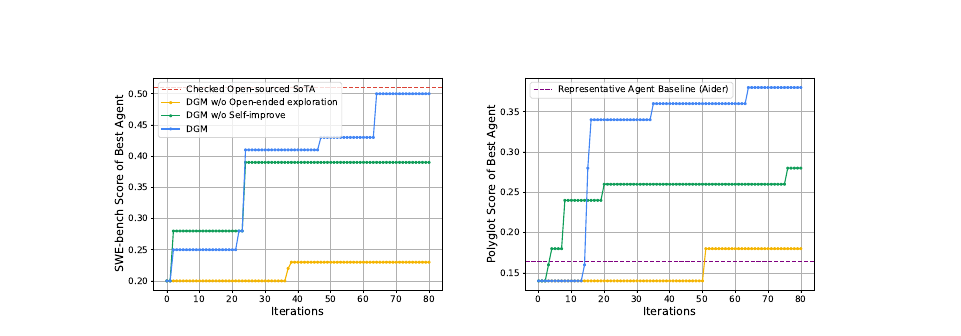
What it teaches: three curves per benchmark. DGM (blue) rises in steps to 0.50 on SWE-bench,
reaching the checked open-source state of the art. DGM without self-improve (green, a fixed
meta-agent) climbs early and plateaus around 0.39. DGM without open-ended exploration (yellow, keep
only the latest agent) plateaus around 0.23. The Polyglot panel shows the same ordering, with the full
DGM passing the Aider baseline that the two ablations do not reach. Corroborated by: §4.4, p6-8
(n7, n8).
Two readings, and the second is the one that makes this source unusual.
The headline: 20.0% to 50.0% on SWE-bench and 14.2% to 30.7% on Polyglot over 80 iterations
(n7), reaching a level comparable to a human-designed state-of-the-art agent on one benchmark and
surpassing a widely-used human-developed agent on the other.
The ablations are what earn the claim, and they separate the two components cleanly (n8). Remove
self-improvement - fix the meta-agent so it never improves at improving, which is the prior ADAS
approach - and gains "taper off quickly". Remove open-ended exploration and it plateaus lower still.
Neither component is decoration, and this is the only ablation-backed claim about self-improving
architecture this brain holds.
Weak evidence, labelled at the point of use. The evaluation is staged: 10 tasks screen, 60 promote, and only the top two agents scoring above 40% reach 200 tasks, with that threshold "chosen based on the noise observed in preliminary runs" (
d1). So the selection pressure that shaped the archive operated on the noisier small sets, while the headline number comes from the large one. Disclosed, reasonable, and it means the search may have discarded agents whose 10-task score was unlucky.
The curves say the loop works. What it actually found is the reassuring part.
7. What it actually discovered#
flowchart TB
    E["what a reader expects:<br/><i>novel reasoning strategies,<br/>architectural insight</i>"]
    A["what it found:<br/><i>better file editing, patch ranking,<br/>retry on empty patches</i> - n10"]
    W["and that is the more<br/>believable result"]

    E -.->|"the deflation worth noticing"| A --> W

    style A fill:#dcfce7,stroke:#15803d,color:#14532d
This is an expectation diagram, and the deflation is the point. The crux is that a self-improving system discovering unglamorous engineering wins is stronger evidence than one reporting insight, because boring improvements are exactly what a real search over a real codebase would find. It is drawn with the expected answer retained because the contrast carries the argument: a paper claiming its loop invented novel reasoning would deserve more scepticism, not less. What this also tells a builder is where the headroom in their own agent probably is, and it is unlikely to be the interesting part.
Synthesized from n10. The reading is this brain's.
Nothing exotic (n10). The annotations on the progress plot name the modifications that caused each
step change, and they read like a competent engineer's backlog: granular file viewing by line number
rather than whole files, editing by string replacement rather than rewriting, generating
multiple candidate patches and ranking them, considering previous attempts when generating the
next, auto-summarising when the context limit is hit, and validating that a patch is non-empty
before submitting, with a retry.
That list is worth dwelling on because of what it says about where the headroom was. The
foundation model never changed - it is frozen throughout (d3). Everything between 20% and 50% came
from tooling and workflow around a fixed model. Two of the discovered features are ones this brain
already holds independently: multiple generations with ranking is S15's repeated sampling with
selection, and auto-summarisation at the context limit is S2's compaction.
So the system rediscovered, by search, several things practitioners arrived at by hand. Read that as a validity check on the loop rather than as a novelty claim: a search that converges on known-good engineering is a search that is working, and the paper is honest that its contribution is the automation of that discovery rather than the discoveries themselves.
The obvious suspicion at this point is that the agent learned the benchmark. The paper tests it.
8. Held-out transfer#

What it teaches: model transfer - swapping the frozen FM after the search, o3-mini goes 23.0% to
33.0% and Claude 3.7 Sonnet 19.0% to 59.5%. Benchmark transfer - the best SWE-bench-evolved
agent reaches 28.9% on Polyglot against a 14.2% baseline, and the best Polyglot-evolved agent reaches
24.5% on SWE-bench against 20.0%. Task transfer - agents evolved on Python tasks improve non-Python
tasks. Corroborated by: §4.4, p8 (n11).
The middle panel is the one that matters, and the paper's framing is right: "since each agent was
optimized without ever accessing the alternate benchmark, these evaluations represent truly held-out
tests" (n11). An agent that had merely memorised SWE-bench's quirks would not double its score on a
benchmark in different programming languages.
The left panel carries a second implication that is easy to miss. The improvements are attached to the scaffolding, not to the model they were discovered against - Claude 3.7 Sonnet, a model the search never used, gains the most of the three. So the artifact this loop produces is portable across model generations, which is a different and more durable kind of asset than a fine-tune.
That is the case for the method. The last section is the paper making the case against itself.
Movement 4 - the builders' own warning#
flowchart TB
    B["the benchmark defines<br/>what counts as better"]
    U["anything you care about that it<br/>does not capture is invisible<br/>to the loop"]
    A["and the loop <b>amplifies</b> whatever<br/>it does not measure - n12"]
    S["which is S19's V-S5, said by the<br/>people running the loop"]

    B --> U --> A --> S

    style A fill:#fee2e2,stroke:#b91c1c,color:#7f1d1d
    style S fill:#e8f0fc,stroke:#4285f4,color:#1a3a6b
This is a warning diagram, and its provenance is what gives it weight. The crux is that this is not an outside criticism but the builders stating the failure mode of their own system, which is the strongest form this claim takes anywhere in this brain. It is drawn as an unbranching consequence because there is no mitigation offered and none implied: the benchmark's blind spots are not a tuning problem. The last box is the cross-reference worth carrying, since S19 derives the same mechanism from an adversarial direction and neither source cites the other.
Synthesized from n12, read against S19.
9. What the loop amplifies#
Section 5 of the paper is a Safety Discussion, and it contains the sentence this note exists to carry into the security track.
"Modifications optimized solely for benchmark performance might inadvertently introduce vulnerabilities or behaviors misaligned with human intentions, even if they improve the target metric. In particular, if evaluation benchmarks do not fully capture all desired agent properties (e.g., safety and robustness), the self-improvement loop could amplify misalignment over successive generations" (
n12).
Read that against what this brain already holds and it completes a three-way convergence on the same mechanism, from three unrelated directions.
| Source | Form | What it says |
|---|---|---|
| S13, claim 114 | Observed | A loop with a real, cheap verifier banked a change of random seed as its final improvement, because the accept rule had no notion of variance |
| S19, claim 162 (V-S5) | Predicted, adversarially | An attacker's step in a skill runs without error, the loop treats "no error" as validation, and the procedure is optimised around the adversarial step |
S22, n12 |
Predicted, by the builders | If the benchmark misses a property, the loop amplifies whatever it does not measure, over successive generations |
All three are the same statement: a self-improving loop optimises what it can measure and compounds what it cannot. S13 saw it happen with nobody attacking. S19 predicted what happens when someone is. And the people who built the most capable such loop say it about their own system, unprompted, in a paper that otherwise argues the method works.
And claim 124 is the frame that explains all three. Verification, not generation, is the rate limit - so a loop improves at exactly the rate its verifier can distinguish good from bad, and compounds error at exactly the rate its verifier is blind. Here the verifier is a coding benchmark, and the properties it does not measure are the ones §5 is worried about.
The safeguards are worth listing precisely because of what they are not (n13). Execution in
isolated sandboxes. A strict time limit per execution. The modifiable scope confined to the agent's own
Python codebase for coding benchmarks. A traceable lineage of every modification in the archive,
for human review. Every one of those is containment, bounding what a bad modification can reach and
making it inspectable afterwards. None of them is a check that a modification is good, which is
consistent - the paper's whole premise is that such a check is impossible, which is why it swapped
proof for evidence in section 2.
Two more things in §5 deserve carrying. The authors report they "have found no evidence of harmful or
malicious behavior in the generated agents" (n14), which is scoped exactly right - an observation
about one run, not a guarantee. And they name the shape of a real answer as future work: incentivising
a self-improving system to retain safety directives is hard, and "an option worth exploring is to
create an unmodifiable part of the system to be able to evaluate at halt the rest" (n15).
That is S13's freeze pattern, proposed for the safety layer, and it is where this brain's two tracks meet. S13 froze four things around an optimising loop; the DGM freezes its meta-level and its liveness gate; and the direction both point is a supervisor that the optimiser cannot reach. Nobody has built it, and it is the most concrete open problem across everything ingested today.
Diagram (mental model)#
flowchart LR
    ARCH[("Archive<br/>every agent ever made")] -->|"select: score x under-exploration"| P["Parent agent"]
    P -->|"reads its own<br/>evaluation logs"| PROP["Proposes a feature"]
    PROP -->|"edits its OWN repo"| C["Child agent"]
    C --> GATE{"Compiles?<br/>Can still edit code?"}
    GATE -->|"no"| X["Discarded"]
    GATE -->|"yes"| EVAL["Evaluate on<br/>coding benchmark"]
    EVAL --> ARCH
    FROZEN["FROZEN: archive maintenance,<br/>parent selection, the benchmark"] -.->|"not modifiable<br/>by the DGM"| ARCH
    EVAL -.->|"measures only what<br/>the benchmark captures"| BLIND["Everything else<br/>compounds unmeasured"]
    style GATE fill:#fff3cd,stroke:#856404
    style FROZEN fill:#d4edda,stroke:#155724,stroke-width:2px
    style BLIND fill:#f8b4b4,stroke:#c1121f,stroke-width:3px
Read it as one iteration of the loop, clockwise from the archive. Green is what the system may not touch. Yellow is the liveness gate. Red is the hazard the builders name themselves.
The crux is that the loop's only feedback is the benchmark, so the frozen green box and the red box are the same design question asked twice: what did you put outside the optimiser's reach, and what did you leave outside its measurement?
The shape is worth contrasting with the intuitive drawing, which is a single arrow from "agent" to "better agent" with a score attached. That drawing hides both boxes. Splitting the loop so the archive, the selection rule and the benchmark sit outside the modifiable surface is what makes the design legible as containment rather than as optimisation - and it is exactly the reading S13 taught, where the four freezes were the transferable object and the ML was not.
Note what the yellow gate is doing, because it is not a quality check. An agent scoring far below its parent is still archived; an agent that cannot compile or cannot edit code is not. It is a liveness invariant, kept separate from the performance metric, and a self-improving system needs both.
And note that the red box has no arrow back into anything. That is the point: unmeasured properties do not degrade visibly, they degrade silently, and the only thing pointing at them in this design is the traceable lineage a human might later read.
Provenance: synthesized from n3, n4, n5, n6, n12, n13. The paper draws the loop
(fig1_dgm_loop.png) without marking what is frozen, and the frozen/blind framing is this brain's
reading of §3 against §5.
💡 Terms#
| Term | Explanation |
|---|---|
| Gödel machine | Schmidhuber's theoretical self-improving program, which rewrites itself only on a proof that the rewrite helps. Safe by construction and impossible in practice (n1). |
| Darwin Gödel Machine | The same loop with empirical benchmark evidence substituted for the proof, plus a Darwinian archive of every agent produced (n1, n3). |
| Archive (vs lineage) | Keeping every agent ever generated and selecting parents from all of them, rather than always modifying the current best. Ablation-confirmed necessary (n8). |
| Under-exploration weighting | Selecting parents inversely to how many children they already have, so promising-but-untried branches get sampled and no branch is ever closed (n4). |
| Viability gate | Admitting only agents that compile and can still edit a codebase. A liveness invariant, deliberately separate from the performance metric (n5). |
| Frozen meta-level | The archive maintenance and parent selection are outside what the DGM may modify (n6). The thing that decides what counts as improvement must not be inside what improves. |
| Amplification of the unmeasured | If the benchmark misses a property, successive generations compound the miss (n12). The builders' statement of the mechanism S13 observed and S19 predicted adversarially. |
What to distrust in this note#
The scope of "self-improvement" is narrower than the framing (d3). The abstract speaks of a
system that iteratively modifies its own code and could in principle rewrite its own training scripts.
§3 concedes "we do not show that in this paper" and that the work "focuses on improving the design of
coding agents with frozen pretrained FMs". The model never changes; the scaffolding around it
does. That is exactly the boundary this brain draws between self-improvement and
autonomous-research-loops, and it puts this source on the artifact side.
The evaluation is staged on a heuristic threshold (d1). Screening happens on 10 and 60 tasks, the
headline on 200, and the 40% promotion cut was "chosen based on the noise observed in preliminary
runs". Selection pressure therefore operated on noisier measurements than the reported ones.
"Open-ended" is bounded by a fixed search procedure (d4). Archive maintenance and parent
selection cannot be modified, so the exploration is open-ended within a human-designed family - the
same concession S18's authors made about their architecture search.
There is a mild commercial position. Three authors are at Sakana AI, a lab whose research programme is self-improving systems and which also published The AI Scientist. No product is sold here and the code is open.
Everything is internal to one paper, and the un-taken second leg is unusually cheap. The code is
open-sourced and the entire claim is about code that rewrites itself. A docs-versus-code pass on
github.com/jennyzzt/dgm would be more informative here than on any other source ingested today, and
it was not done.
The three-way convergence in section 9 is this brain's synthesis. S13, S19 and this paper do not cite one another; the observation that they describe one mechanism from three directions is mine.
Open questions#
- What happens when the meta-level is unfrozen? (
n6,d4) The paper names it as future work and the failure mode is easy to state and hard to test: a system that can rewrite its own selection rule can rewrite it to prefer itself. The most important experiment this paper implies. - Has anyone built the unmodifiable supervisor? (
n15) The authors propose "an unmodifiable part of the system to be able to evaluate at halt the rest", S13 froze four things around its loop, and nobody in this brain's evidence has built the general version. - Does the amplification hazard show up in a longer run? (
n12) 80 iterations found "no evidence of harmful or malicious behavior". The hazard is described as compounding over successive generations, so 80 may simply be short. Nobody has run the long version and reported what happened. - Would V-S5 work against this? S19 predicts that an adversary who lands one step in a self-refining procedure gets it optimised. The DGM is the most realistic target for that attack anyone has published, its code is open, and the experiment is well defined.
- Does the "coding benchmark implies self-improvement ability" assumption hold outside coding?
(
n2) The paper calls it a key assumption and it is what makes the loop closable. Any transfer of this design to another domain has to re-derive it, and it is not obvious what plays that role for, say, a security agent. - How much of the 20-to-50 gain would a competent engineer have found in a week? (
n10) The discovered features are recognisable good practice, and the paper's contribution is automating the search rather than the findings. No human-baseline comparison on discovery time is reported.
Feeds these topics#
brain/topics/autonomous-research-loops.md- the second primary this note has been waiting for, and the source that resolves its merge-back trigger (ADR-0020). The archive-versus-lineage ablation, the viability gate, the frozen meta-level.brain/topics/self-improvement.md- cross-referenced, not re-homed. It answers that note's standing open question - how many turns of the loop has anyone actually run? - with 80, and it does so at the artifact layer, which is why the claims live next door.brain/topics/agent-security.md- the builders' own statement of the amplification hazard, which corroborates S19's V-S5 from the opposite direction, plus four containment safeguards and the unmodifiable-supervisor proposal.
Presentation narrative#
A talk track for a team considering a system that modifies its own code, derived entirely from the gated nodes above. The results are the authors' own on public benchmarks with ablations, which is stronger than most sources here, and the last slide carries the warning the builders themselves supply.
Slide 1 - Swap the proof for evidence, and inherit a completely different problem#
Schmidhuber's Godel machine rewrites its own code only when it can prove the change beneficial, which is why nobody has ever built one [n1]. The DGM's move is one line: replace the proof with empirical evidence on a benchmark.
That substitution is easy to state and it changes what the engineering is about. A proof-gated system needs no recovery mechanism because it never takes a bad step. An evidence-gated one needs nothing else. So the design problem stops being how to be sure and becomes how to survive being wrong, and every subsequent choice in the paper is an answer to that.
This is the loop, and the elegant part is easy to miss. The crux is that self-improvement is the
task it is scored on - the system improves its own coding ability and is measured on coding, so the
benchmark and the subject are one object [n2].
Slide 2 - An archive rather than a lineage, because exploration needs a memory#
Keep every agent ever produced, and select parents by score and by how little explored they are [n3, n4]. That reads as bookkeeping and is the search design.
A lineage - keep improving the latest agent - cannot revisit a branch it abandoned, so every dead end is permanent and a bad step discards everything after it. The archive makes backtracking free, and the exploration term is what stops the search collapsing onto the current best. For anyone who has run a hyperparameter search this is familiar, and the point is that self-modification is a search problem rather than a training problem.
This is the archive doing its job. The crux is that the winning lineage is not a straight line -
the best agent descends from branches a greedy search would have discarded [n3].
Slide 3 - Freeze the scoreboard, or the loop optimises it#
The agent edits its own codebase, and the benchmark, harness and scoring stay frozen [n5]. This is the section to read if you are building one of these, and it is a single decision with no partial answer.
Any editable component on the scoring path reintroduces the problem in full. If the system can touch what decides whether it improved, then it will eventually improve that instead, and the numbers stop meaning anything. This brain records the same freeze discipline from an unrelated project on a different task, arrived at independently, which is about as much corroboration as a design principle gets.
flowchart TB
    A["the agent edits its own repo"]
    F["frozen: the benchmark,<br/>the harness, the scoring"]
    R["so 'it improved' stays a claim<br/>about the world rather than<br/>about the scoreboard"]
    A --> R
    F --> R
    style F fill:#dcfce7,stroke:#15803d,color:#14532d
This is a containment slide, not an architecture. The crux is that the frozen set has to include the
measurement, because a self-modifying system with any editable component on the scoring path will
eventually improve the scoring rather than itself [n5].
Slide 4 - It works, and the ablations are why that is citable#
SWE-bench goes from 20.0% to 50.0% over 80 iterations, and Polyglot from 14.2% to 30.7% [n7]. Large numbers, and on their own they would be an announcement rather than a finding.
What makes them citable is that both components were removed individually. Freeze the meta-agent and progress plateaus. Keep only the latest agent, discarding the archive, and it plateaus lower [n8]. That tells you which parts are load-bearing, which is the thing a headline number never does.
This is the result with its own controls attached. The crux is the separation between the three
curves - that gap is the evidence, not the top line [n7, n8].
Slide 5 - What it discovered is boring, and that is the strongest signal in the paper#
Better file editing, patch ranking, and retrying on empty patches [n10]. No novel reasoning strategy, no architectural insight.
I want to argue that the deflation is the good news. A self-improving system reporting that it invented something clever would deserve more scepticism, not less. Unglamorous engineering wins are exactly what a genuine search over a real codebase would surface, and they also tell a builder where the headroom in their own agent probably is - which is unlikely to be the interesting part.
It transfers, too: to held-out foundation models, zero-shot between benchmarks, and across programming languages [n11]. That is what separates a search that found general improvements from one that overfit its evaluation.
This is the overfitting check. The crux is that improvements survive changing the model underneath
- which is the strongest available evidence that the loop found something real [n11].
Slide 6 - The builders' own warning is the thing to carry out of the room#
If your benchmark does not capture every property you care about, the loop amplifies whatever it does not measure [n12]. That sentence is from the people who built and ran the system.
Its provenance is what gives it weight. This brain holds the same mechanism from a security paper that derives it adversarially, and neither source cites the other - one arrives at it by attacking a self-improving loop and the other by running one. Agreement between a builder and an attacker who never spoke is about as good as corroboration gets here.
So the decision is narrow and it is not about whether the technique works. Before running any self-improving loop, write down what you care about that the benchmark does not score, and treat that list as the thing the loop will erode. The archive, the exploration term and the frozen scoreboard are all worth copying. The warning is what determines whether copying them is safe in your setting.
flowchart TB
    S["what you care about"]
    M["what the benchmark scores"]
    G["the gap"]
    L["the loop optimises M,<br/>and erodes the gap - n12"]
    W["so write the gap down<br/><b>before</b> you start the loop"]
    S --> G
    M --> G --> L --> W
    style L fill:#fee2e2,stroke:#b91c1c,color:#7f1d1d
    style W fill:#dcfce7,stroke:#15803d,color:#14532d
This is the builders' own warning, drawn. The crux is that the gap between what you value and what
you score is not a measurement imperfection but the thing the loop actively works against, so the
mitigation is an inventory written in advance rather than vigilance during [n12].
Key takeaway message#
The Godel machine was never built because proof is unobtainable, and the DGM's whole move is to swap proof for empirical evidence - which relocates the engineering from how to be sure to how to survive being wrong. An archive rather than a lineage makes exploration possible, an exploration term stops the search collapsing onto the current best, and freezing the benchmark and scoring is what keeps the numbers meaningful. It takes SWE-bench from 20% to 50% with ablations showing both components are load-bearing, what it discovers is unglamorous file editing and patch ranking, and it transfers to held-out models and languages. The line to carry is the builders' own: the loop amplifies whatever the benchmark does not measure.