source
autoresearch - AI agents running research on single-GPU nanochat training automatically
Andrej Karpathy (karpathy)
progress.png) and it is the only empirical evidence in the source; kept as a full view plus two teaching cropsAbout this note
Persona: code-explorer + mentor - re-adopt when working this file. Written for a senior engineer who is new to autonomous research loops. Every claim carries a node ID (
n5,d2) fromnodes.md. Blocks marked Background, supplied are mine, not the source's, and are uncited by construction.
On this page
TL;DRThe 1-minute versionKey claimsWhat you will learn, and in what orderMovement A - why unattended changes the problem1. Why "let an agent do research overnight" is not just a for-loopMovement B - the four freezes, derived rather than listed2. The first freeze: what may the agent change?3. The second freeze: hold time constant, not work4. The third freeze: a metric that survives the agent changing everything5. Where the design leaks: the producer prints its own gradeMovement C - the three resources an unattended loop actually runs out of6. Git is the experiment database7. Two lines per experiment: the resource nobody budgets for8. NEVER STOP, and why it has to be written downMovement D - reading the author's own run against the author's own design9. The loop banks noise, and the author's own run shows it10. What the frontier's shape tells you about the method11. What this design deliberately does not buyDiagram (mental model)💡 TermsWhat to distrust in this noteOpen questionsFeeds these topicsPresentation narrativeSlide 1 - Removing the human does not make the work harder, it moves every decision earlierSlide 2 - The design is four freezes, and each one is forced by the lastSlide 3 - The resources an unattended loop runs out of are memory, context and momentum, and none of them is computeSlide 4 - The containment is a declaration, not an enforcement, and the design says soSlide 5 - The loop banked a random seed as its final improvement, and that is the accept rule working correctlySlide 6 - Adopt the shape, do not cite the numbers, and add the one thing it is missingKey takeaway messageTL;DR#
karpathy/autoresearch gives a coding agent one editable Python file, five minutes of GPU time per
experiment, one protected metric, and an instruction never to stop; overnight it runs about a
hundred experiments and keeps the ones that improve the number. The interesting object is not the
language-model training code - it is the containment design, which is ten files, no framework,
and no agent code at all. What the repo actually teaches is which four things you must freeze before
an agent can be trusted to change everything else: the editable surface, the resource budget, the
metric's units, and the holdout (n1-n4). It also teaches, unusually honestly, where that design
leaks: the protected score is printed by the file the agent rewrites (n5), and the accept rule is a
bare comparison with no notion of run-to-run variance - which is why the fifteenth and final
"improvement" in the author's own published run is a change of random seed (n11). Read it as a
worked example of building an unattended optimizer, and read the results chart as a warning about
what such a loop will confidently bank.
flowchart TB
    subgraph FR["Frozen before the loop starts, and it holds"]
        direction TB
        A["the editable surface<br/>one file, train.py"]
        B["the budget<br/>wall-clock seconds, not steps or tokens"]
        C["the metric's units<br/>bits per byte, at a fixed sequence length"]
        D["the holdout<br/>pinned inside the read-only file"]
        A ~~~ B ~~~ C ~~~ D
    end

    subgraph OP["Never frozen, and both failures are here"]
        direction TB
        E["who prints the score<br/>the file the agent rewrites - n5"]
        G["what counts as an improvement<br/>a bare comparison, no variance - n11"]
        E ~~~ G
    end

    FR --> R["~100 experiments overnight,<br/>ten files, no framework, no agent code"]
    OP --> R
    R --> S["15 kept improvements, and the last<br/>one is a change of random seed"]

    style FR fill:#e8f4ea,stroke:#28a745,color:#14532d
    style OP fill:#fdeaea,stroke:#dc3545,color:#7f1d1d
    style S fill:#fdeaea,stroke:#dc3545,color:#7f1d1d
This is a containment diagram, not an architecture diagram, and it sorts the repository by one
question: was this decided before the agent started running? The crux is that every property this
design gets right is something frozen in advance, and both places it fails are places where nothing
was frozen at all, which is why the failures are not bugs and cannot be patched without adding a
fifth freeze. The two columns are drawn as peers rather than as a design and its caveats because they
are the same kind of object, and the closing box is the author's own published result rather than a
criticism of it: a loop with no variance model banked a random seed as an improvement, exactly as the
right-hand column predicts. Synthesized from n1-n5 and n11.
The 1-minute version#
This article covers a ten-file repository that lets a coding agent run its own research programme overnight. The agent edits a training script, runs it, keeps the change if the score improved, and repeats about a hundred times before you wake up. The interesting object here is not the training code, which is ordinary. It is the containment design built around it, and the first question worth asking is why an overnight loop needs containment at all.
The answer is that unattended work removes the only check most systems actually rely on. When nobody is watching the loop, nobody is asking whether any individual result is meaningful, and there is no point later at which someone will. Every guarantee you want therefore has to be built into the setup before the loop starts. That would still be manageable if the agent were merely running experiments, but it is doing something more awkward than that.
The agent is allowed to change the very thing being measured. It rewrites the code that trains the model, times the run, computes the score and then prints it. In an ordinary review loop a human sits between getting a good number and putting that number into the record, and here nothing does. Given that, the obvious first attempt looks reasonable enough.
That attempt is simply to let the agent edit the code and keep whatever scores better, and it collapses in three separate ways. Results stop being comparable, because an agent free to shrink the model will win by shrinking the model rather than by improving it. The scorer sits inside the editable surface, which means the thing being protected is also being rewritten. And a hundred iterations is a long time, so the loop has to survive on a couple of hundred tokens per experiment rather than a full training log. Each of those three failures points at something that was never held still, which is exactly what the design fixes.
It freezes four things and lets everything else move. The first is the editable surface, which is a
single file called train.py. The second is the resource budget, which is wall-clock time rather
than a fixed number of steps or tokens, so that a faster kernel and a better optimizer compete on one
axis. The third is the metric's units, which are bytes rather than tokens, evaluated always at a
fixed sequence length so a larger vocabulary cannot flatter the score. The fourth is the holdout,
which is a validation shard pinned inside a file the agent has been told not to edit (n1-n4).
Freezing is only half the problem, though, because something still has to remember what each of the
hundred experiments did.
That job is handled far more plainly than you would expect. A 115-line markdown file written by the
human, program.md, is the entire research organisation, holding the setup ritual, the rules, the
ledger schema and a nine-step instruction to loop forever. Git serves as the experiment database,
with one branch per run, one commit per experiment, and git reset standing in for discard (n6).
The results ledger deliberately lives outside git, because the loop rewinds the tree and would
otherwise erase the record of what just failed (n7). Each five-minute run is then compressed to
roughly two grepped lines before it re-enters the agent's context (n8). All of this is elegant,
which makes it worth being precise about where it does not hold.
The freeze is a declaration rather than an enforcement, because there is no sandbox and no checksum
anywhere in the repository (n1). The protected metric still reaches the scoreboard through code the
agent is allowed to rewrite (n5). Results do not transfer between machines, which the author states
openly. Most consequentially, the accept rule carries no notion of run-to-run variance, so the loop
banks noise (n11, n12). Those limits fall into two very different categories, and the distinction
decides how you should read the repository.
The mechanism is fully inspectable and the documentation matches the code almost everywhere, so the
design itself is trustworthy and worth borrowing. The results are a single unreproducible chart from
one author on one GPU, with the underlying ledger untracked by design (n12, n14). Trust the
shape, and do not cite the numbers.
The same argument, compressed for reference rather than for reading:
| The problem | You want an agent to do real experimental work unattended for hours. Unattended means no one is checking whether each result is meaningful, so every guarantee has to be built into the setup before the loop starts. |
| Why the obvious answer fails | "Let the agent edit the code and keep what scores better" collapses immediately: if the agent can change model size, batch size and architecture, two runs are not comparable; if it can change the code, it can change the scorer; and if it runs a hundred times, the loop needs to survive on a couple of hundred tokens per iteration, not a training log. |
| The idea | Freeze four things and let everything else move. One editable file (train.py); a fixed wall-clock budget rather than fixed steps or tokens; a byte-normalised metric evaluated at a fixed sequence length; and a validation shard pinned inside the read-only file (n1-n4). |
| How it works | program.md - 115 lines of markdown, edited by the human - is the entire research organisation: setup ritual, the rules, the ledger schema, and a nine-step LOOP FOREVER. Git is the experiment database: branch per run, commit per experiment, git reset as discard (n6). The ledger sits outside git because the loop rewinds the tree (n7). Each 5-minute run is compressed to roughly two grepped lines before it re-enters the agent's context (n8). |
| What it costs | The freeze is a declaration, not an enforcement - no sandbox, no checksum (n1). The protected metric is printed by editable code (n5). Results are not comparable across machines, which the author states plainly. And the accept rule has no variance handling, so the loop banks noise (n11, n12). |
| How far to trust it | The mechanism is fully inspectable and the docs-versus-code check passes almost everywhere, so the design is trustworthy. The results are one unreproducible PNG from one author on one H100, with the underlying ledger untracked by design (n12, n14). Trust the shape; do not cite the numbers. |
Key claims#
- The editable surface is exactly one file, and everything defining the experiment is read-only - as a declaration, not an enforced boundary. No sandbox, import hook or checksum exists; the separation lives in a banner comment and a markdown instruction (
n1). - The held-constant resource is wall-clock time, not steps or tokens - 300 seconds, with the first 10 steps excluded so compilation is not billed to the budget. This is what makes an architecture change comparable to a learning-rate change (
n3). - The metric is engineered to be invariant to what the agent may change: bits-per-byte normalises by bytes rather than tokens, and evaluation always runs at the fixed sequence length whatever the model trained at (
n4). - Train/validation separation is the one rule the agent structurally cannot break, because the pinned validation shard is excluded from both the tokenizer corpus and the training dataloader inside the read-only file (
n2). - The protected metric reaches the scoreboard through agent-editable code.
evaluate_bpbis frozen; the file that calls it, formats it and prints it is the file the agent rewrites, and the agent's score is read from that print (n5). - Version control is a sufficient experiment database for a single-agent loop - branch per run, commit per experiment,
git resetas discard - and the ledger must live outside the tree, because the loop rewinds it (n6,n7). - The per-iteration context budget is a first-class design parameter, engineered down to about two lines by three separate mechanisms (
n8). - A bare improve-or-regress accept rule will bank noise, and the source's own run proves it: the last of 15 kept improvements is a change of random seed (
n11). That result also gives a rough noise floor which at least three other accepted changes sit at or below (n12, needs-check - read off a chart). - Yield is low and front-loaded: 83 experiments, 15 keeps (~18%), most of the gain in the first eight, then a plateau of ~22 experiments with nothing (
n14, needs-check). - The human writes the loop and the agent writes the code. The author states the inversion as the point, and calls
program.md"essentially a super lightweight 'skill'" (n16).
What you will learn, and in what order#
flowchart TD
    S1["1. Why unattended research<br/>is not just a for-loop"]

    subgraph MB["MOVEMENT B - the four freezes (the payload)"]
        S2["2. What may the agent change?<br/>One file"]
        S3["3. What is held constant?<br/>Wall-clock time"]
        S4["4. What is measured?<br/>A unit-proof metric"]
        S5["5. Where the design leaks:<br/>who prints the score"]
    end

    subgraph MC["MOVEMENT C - making the loop survivable"]
        S6["6. Git as the experiment database"]
        S7["7. Two lines per experiment:<br/>the context budget"]
        S8["8. NEVER STOP, and why<br/>it has to be written down"]
    end

    subgraph MD["MOVEMENT D - reading the results honestly"]
        S9["9. The loop banks noise,<br/>and the run shows it"]
        S10["10. What the frontier's shape<br/>tells you about the method"]
        S11["11. What this design<br/>deliberately does not buy"]
    end

    S1 --> S2 --> S3 --> S4 --> S5 --> S6 --> S7 --> S8 --> S9 --> S10 --> S11

    style MB fill:#e8f4ea,stroke:#28a745,stroke-width:2px
    style MD fill:#fdeaea,stroke:#dc3545,stroke-width:2px
This is a reading-order diagram about the note rather than about the repository, and every box is a numbered section below, gathered into four movements. Green marks the movement carrying the core technique and red marks the movement that undercuts it. The crux is that sections 2 to 5 are the reusable design, and section 9 is the reason to stay sceptical of anything that design produces.
The note opens with a single section that does no design work at all. Its only job is to show that running experiments unattended hides three systems problems rather than one machine-learning problem, because that framing is what makes everything after it feel necessary rather than arbitrary. If you already believe an overnight loop is harder than a for-loop, you can move straight on.
Movement B is the payload, and it is written as a derivation rather than a list. Section 2 fixes what the agent may edit, which immediately forces section 3 to ask what is being held constant. Answering that forces section 4 to ask what a comparable measurement even is once the model itself keeps changing. Section 5 then turns back on the three freezes that came before it and finds the seam they left open. Skimming these four out of order will still tell you what the design is, but it costs you the derivation, and the derivation is the part that transfers to a problem that is not this one.
Movement C stops asking whether the design is sound and starts asking how a loop like this survives a hundred iterations without a human. If you have built unattended batch jobs before, this is the most skimmable stretch of the note. Section 7 is the exception worth slowing down for, because the resource it protects is context rather than compute, and batch-job experience does not teach you to budget it.
Movement D is where the note stops describing and starts judging. It reads the author's own published run against the design that produced it, which is the only place a claim here is tested by anything other than the repository's own consistency. If you read only two sections, read section 5 and section 9. They are the two places where a design that looks airtight turns out not to be, and both were found by reading the source's own code and figure against its own prose rather than by taking its word.
Generated from the structure of this note - a diagram the repo does not contain.
Movement A - why unattended changes the problem#
flowchart TB
    U["Nobody is watching the loop"]
    P1["no one asks whether any single<br/>result is meaningful"]
    P2["the agent may rewrite the very<br/>thing being measured"]
    P3["a hundred iterations must fit<br/>through one context window"]
    B["So every guarantee has to exist<br/>in the setup, before the loop starts"]

    U --> P1 --> B
    U --> P2 --> B
    U --> P3 --> B

    style B fill:#e8f4ea,stroke:#28a745,color:#14532d
This is a problem-decomposition diagram, not a design, and nothing in it is specific to machine learning. The crux is that removing the human does not make the work harder, it moves every decision earlier, converting three ongoing judgement calls into three things that must be settled in advance and then cannot be revisited. It is drawn as one cause fanning into three because the three problems are usually met separately and solved separately, and meeting them as consequences of a single choice is what makes the four freezes in the next movement feel inevitable rather than arbitrary. Notice that only one of the three is about the model at all.
Synthesized from n1 and the section below.
1. Why "let an agent do research overnight" is not just a for-loop#
Start with the pitch, because it is genuinely simple. You have a training script. An agent edits it,
runs it, looks at the score, keeps the edit if the score improved, and repeats. Five minutes per
experiment means about twelve an hour, so a night's sleep buys you a hundred
(README.md:64,
n14). You wake up to a log of experiments and a better model.
Every part of that sentence hides a problem, and they are not ML problems - they are systems problems, and they are the reason this repo is worth reading even if you will never train a model.
First, comparability. The agent is allowed to change the model's size and shape. A bigger model takes longer per step. So if you give each experiment a fixed number of steps, you have secretly made "use a smaller model" a winning strategy, because a smaller model gets through more data. Whatever you hold constant becomes the rules of the game, and the agent will play the rules you actually wrote rather than the ones you meant.
Second, honesty. Nobody is watching. The agent is editing code, running it, and reading its own result. In a normal review loop a human sits between "I got a good number" and "the number goes in the record". Here nothing does.
Third, endurance. A hundred iterations is a long time for an agent to stay coherent, and the default behaviour of every well-trained coding assistant is to stop and check in. That default is correct nearly everywhere and fatal here.
The repository's answer to all three fits in ten files with no framework and, notably, no agent
code whatsoever - the agent is whatever coding harness you point at program.md
(README.md:44, n16).
One thing to hold onto before we start. The author ran this himself and published the result: 83 experiments, 15 kept improvements. The fifteenth and last one is the most instructive thing in the repository, and we will not look at it until §9. For now, just note that it exists, and that it survived a design built specifically to prevent bad results from surviving.
So: if the agent may change almost anything, the first question is what "almost" means.
Movement B - the four freezes, derived rather than listed#
flowchart TB
    Q2{"2. What may<br/>the agent change?"} --> A2["one file: train.py"]
    A2 --> Q3{"3. Then what is held<br/>constant while it changes?"}
    Q3 --> A3["wall-clock time, so a faster kernel,<br/>a better optimizer and a longer<br/>schedule compete on one axis"]
    A3 --> Q4{"4. Then what is a comparable<br/>measurement, once the<br/>model itself keeps moving?"}
    Q4 --> A4["bits per byte, at a fixed sequence<br/>length, so a bigger vocabulary<br/>cannot flatter the score"]
    A4 --> Q5{"5. Then is anything<br/>still open?"}
    Q5 --> A5["yes. The protected score reaches the<br/>scoreboard through the editable file"]

    style A5 fill:#fdeaea,stroke:#dc3545,color:#7f1d1d
This is a derivation diagram, not a feature list, and the questions are load-bearing while the answers are almost incidental. The crux is that each freeze is forced by the residue the previous one left, so the design has no arbitrary choices in it until section 5 finds the residue nobody closed. It is drawn as an alternating question-and-answer chain because a plain list of four freezes reads as taste, and taste does not transfer; the questions do, and they are the part you can ask about a system that has nothing to do with language models. The red box is where the chain stops rather than terminates, and it is the reason this movement is the payload and section 5 is one of the two sections to read if you read only two.
Synthesized from n1, n2, n3, n4 and n5.
2. The first freeze: what may the agent change?#
One file. train.py. Everything in it is fair game - architecture, optimizer, hyperparameters,
batch size, model size - and nothing outside it may be touched
(program.md:25-31, n1).
Two design choices are worth separating here, because they are usually conflated.
The scope choice is that the editable surface is a single file, stated as keeping "the scope
manageable and diffs reviewable"
(README.md:63).
There is a second consequence the source does not name, and it is the one I find more interesting:
train.py has no main() and no CLI. Hyperparameters are module-level constants at
train.py:432-451,
edited in place. That means an experiment is not a command line - an experiment is a diff. Which
in turn is what makes the next three sections possible, because a diff is something git can keep or
throw away. (That reading is mine; the source states the reviewability benefit and stops there.)
The enforcement choice is the one to be clear-eyed about: there isn't one. The read-only status
of prepare.py is a banner comment
(prepare.py:26-32)
and a line of markdown. There is no sandbox, no import hook, no checksum, no file-permission bit
(n1). The agent is told to run with "all permissions disabled"
(README.md:44),
meaning the agent's own confirmation prompts are off - which removes the last human checkpoint
rather than adding a guard.
This is worth sitting with rather than filing as a flaw. The boundary is real in the sense that matters for this project - a non-adversarial agent following its instructions will respect it - and building an enforced version would have cost a container, a syscall filter or a git hook, none of which the repo has room for. The lesson is not "add a sandbox". It is that you should know which of your invariants are enforced and which are merely written down, because under this design they look identical in the source tree. We will find one place where the difference matters in §5.
There is exactly one invariant here that is structurally protected rather than declared, and it is
the most important one. One data shard is pinned as validation and excluded both from the tokenizer's
training corpus and from the training dataloader, inside the read-only file
(prepare.py:42-44,
prepare.py:259-263, n2).
The agent cannot train on its own test set without editing a file it has been told not to edit - so
the single most damaging way to cheat this benchmark requires an unmistakable, greppable violation
rather than a subtle one.
Now the residual question. The agent can change the model's size, its shape, and how much data it sees per step. Two experiments are therefore not naturally comparable at all. What do you hold constant so that they are?
3. The second freeze: hold time constant, not work#
flowchart TB
    Q["What should an experiment<br/>be allowed to spend?"]
    S["fixed steps<br/><i>rewards shrinking the model</i>"]
    T["fixed tokens<br/><i>makes efficiency invisible</i>"]
    W["fixed wall-clock seconds<br/><i>puts a faster kernel, a better optimizer<br/>and a longer schedule on one axis</i>"]
    R["efficiency becomes part of the objective<br/>without being part of the metric"]

    Q --> S
    Q --> T
    Q --> W --> R

    classDef bad fill:#fdeaea,stroke:#dc3545,color:#7f1d1d
    classDef good fill:#e8f4ea,stroke:#28a745,color:#14532d
    class S,T bad
    class W good
This is a choice diagram, not a mechanism, and the two rejected branches carry the teaching. The
crux is that the budget's unit silently decides what the agent is rewarded for, so choosing seconds
rather than steps or tokens is not an implementation detail but the point at which optimizing the
kernel and optimizing the architecture become the same competition. It is drawn as three siblings
because the alternatives are genuinely available and each looks reasonable in isolation, which is what
makes the failure modes worth naming: a step budget quietly pays an agent to build a smaller model,
and a token budget quietly refuses to pay it for going faster. Synthesized from n3.
Every run trains for exactly five minutes
(prepare.py:31,
train.py:603-604, n3).
Not a fixed number of steps, not a fixed number of tokens. Wall clock.
Work through the alternatives and the choice stops looking arbitrary:
| Hold constant | What the agent learns to do |
|---|---|
| Steps | Shrink the model. Smaller model, same number of steps, more data seen per unit of your patience. The comparison silently becomes "which model is small". |
| Tokens | Ignore efficiency entirely. A model half as fast per token is not penalised, so kernel-level and memory-layout improvements score zero. |
| Wall-clock time | Everything competes on the same axis: a faster kernel, a better optimizer, a smaller model and a longer schedule are all just different ways to spend 300 seconds. |
The third row is the design. And notice what it buys that the first two cannot: efficiency becomes part of the objective without being part of the metric. The agent never optimises throughput directly, but a change that makes each step 10% faster shows up as more steps in the same budget, which shows up as a better score. That is a genuinely elegant piece of incentive design, and it is the reason several of the author's kept improvements are about shape rather than learning - the "short window 1/4 context" and "1/8 context" wins in §10 are attention-cost reductions that buy more steps.
The accounting is careful in a way that corroborates the claim rather than just asserting it. The
README promises the budget excludes startup and compilation
(README.md:17),
and the loop delivers it: if step > 10: total_training_time += dt
(train.py:578-579).
The first ten steps, where torch.compile is still warming up, are run but not billed. This is the
docs-versus-code gate passing on the detail that would have been easiest to fudge (n3).
Background, supplied. Skip this if you have run GPU training jobs. The first few steps of a PyTorch training run are much slower than the rest, because compilation and kernel autotuning happen on first execution. If you time a short run naively, that startup cost dominates and swamps the thing you are trying to measure. Excluding a fixed number of warmup steps is the standard fix, and "how many to exclude" is a judgement call - here, ten.
The honest cost is stated by the author and worth repeating because it bites anyone who wants to
compare notes with a colleague: results are not comparable across compute platforms
(README.md:64).
Your five minutes on an H100 and someone else's five minutes on a 4090 are different amounts of
work, so the numbers do not travel. The trade the author names is that in exchange, the loop finds
the best model for your hardware, which is the more useful thing to know if you are actually
running it.
With time fixed, each experiment produces exactly one output: a score. Which raises the question that fills the rest of Movement B - what makes a score comparable when the thing producing it is being rewritten?
4. The third freeze: a metric that survives the agent changing everything#
flowchart TB
    A["The agent may change<br/>the tokenizer, the vocabulary<br/>and the sequence length"]
    L["loss per token<br/><i>a bigger vocabulary flatters it</i>"]
    B["bits per <b>byte</b><br/><i>the denominator is the raw text,<br/>which the agent cannot redefine</i>"]
    F["evaluated always at one fixed<br/>sequence length, whatever<br/>the model trained at"]
    C["the score means the same thing<br/>in experiment 1 and experiment 83"]

    A --> L
    A --> B --> F --> C

    classDef bad fill:#fdeaea,stroke:#dc3545,color:#7f1d1d
    classDef good fill:#e8f4ea,stroke:#28a745,color:#14532d
    class L bad
    class B,F,C good
This is an invariance diagram, not a metric definition. The crux is that a metric is only protected
if its denominator sits outside everything the agent may edit, and bytes qualify because raw text is
the one quantity in the experiment the agent has no way to redefine. It is drawn with the threat on
top rather than the metric on top because the design is a response, not a preference: each element
exists to close one specific route by which a rewrite could move the number without improving the
model. Notice this is the same move as the wall-clock budget one section earlier, applied to the
measurement rather than the resource. Synthesized from n4.
The metric is val_bpb - validation bits per byte, lower is better
(README.md:17, n4).
Background, supplied. Skip if you know why loss is not comparable across tokenizers. A language model is scored by how surprised it is by text it has not seen. The natural unit is per-token: average how much probability mass the model failed to put on each correct next token. The problem is that "a token" is not a fixed quantity - it is whatever the tokenizer decided, so a model with a bigger vocabulary packs more text into each token and gets a flattering per-token score for free. Bits per byte fixes the denominator to something physical: divide the total surprise by the number of bytes of text, and the number means the same thing regardless of how the text was chopped up. It is the standard defence against comparing models across tokenizers.
The implementation makes three separate moves, and each one closes a specific hole:
- Normalise by bytes, not tokens, with special tokens contributing zero bytes and excluded from
both sums
(
prepare.py:343-365). Changing the vocabulary cannot move the score by itself. - Always evaluate at the fixed
MAX_SEQ_LEN, whatever length the model trained at - the docstring says exactly why: "so results are comparable across configs" (prepare.py:350). A model trained on short sequences does not get an easier exam. - Pin the holdout in read-only code (
n2, from §2).
Put together, these are anti-Goodhart engineering, and the thing to take away is where the work happens.
Background, supplied. Goodhart's law: when a measure becomes a target, it stops being a good measure. The usual framing is about incentives and people. The version that matters for agent loops is mechanical: any degree of freedom that changes the units of your metric is a way to improve the number without improving the thing, and an optimizer will find it without any intention to cheat.
You do not defend against this in the prompt. You defend against it in the code layout. None of the three moves above is an instruction to the agent; all three are properties of a file the agent has been told not to open. That is the transferable pattern, and it generalises well past ML: if you are pointing an agent at a scored artifact, the score's definition, its input data, and its units belong in a module the agent has no reason to import and every reason to leave alone.
Which is a nice principle, and it has a hole in it. The metric's computation is protected. Hold onto the question of whether its reporting is - we settle it in the next section, and it is the one place where §2's distinction between an enforced invariant and a written-down one does real damage.
Before that, one small crack found by reading the code against its own docstring, recorded because
the principle matters even though the magnitude does not. evaluate_bpb computes its number of
evaluation steps by integer division: steps = EVAL_TOKENS // (batch_size * MAX_SEQ_LEN)
(prepare.py:354),
and it is called with DEVICE_BATCH_SIZE - an agent-editable constant
(train.py:613).
At the default 128 the division is exact. At 96 it truncates, and the model is evaluated on 0.6%
fewer tokens (d2). So the size of the exam moves slightly with a knob the agent tunes for unrelated
reasons, against a docstring that promises comparability across configs. It is far too small to
explain anything in §9 - but it is a reminder that "fixed" is a property you have to check hop by
hop, not a property you declare at the top of a file.
5. Where the design leaks: the producer prints its own grade#
Here is the trace, and it is four lines of code (n5):
flowchart LR
    P["prepare.py<br/>evaluate_bpb()<br/>FROZEN"] -->|"returns a float<br/>train.py:613"| T["train.py<br/>formats and prints<br/>EDITABLE BY THE AGENT"]
    T -->|"train.py:622"| L["run.log"]
    L -->|"grep, program.md:100"| A["the agent's<br/>context"]
    A -->|"program.md:103-104"| D{"keep or<br/>git reset"}

    style P fill:#d4edda,stroke:#28a745
    style T fill:#f8d7da,stroke:#dc3545,stroke-width:3px
    style D fill:#fff3cd,stroke:#856404
How to read it: left to right is the journey of a single number, from the function that computes it to the decision it drives. Green is frozen, red is agent-editable, amber is the decision.
The crux: exactly one hop in this chain is protected, and it is not the hop that decides anything.
Why it is shaped this way: it is not a deliberate shape - it is what you get when the metric
lives in the frozen module and the program lives in the editable one, which is the natural
factoring and the one almost everybody would choose. evaluate_bpb is imported at
train.py:26,
called at train.py:613,
and its result is printed by an f-string at
train.py:622
- inside the file the agent rewrites every iteration. The agent then reads its own score by grepping
that print
(program.md:100).
Nothing anywhere compares the number in run.log to what evaluate_bpb returned. The design is
safe because the agent is not trying to win, not because the topology stops it.
Generated from train.py:26, train.py:613, train.py:621-630, program.md:100-104 @ 228791f.
I want to be careful about what this is and is not, because it is easy to over-read.
It is not an accusation. There is no evidence anywhere in this repo of an agent gaming the
metric, the design is explicitly a "bare bones baseline"
(README.md:7),
and reward hacking is not a thing a well-behaved coding agent does spontaneously in a five-minute
training script.
It is a structural observation that this brain already holds in a stronger form from a completely different direction. Claim 34 - from Anthropic's own harness-design work - is that you should not let the producer grade its own work, because a generator has no independent vantage point on itself. That claim was derived from long-horizon code generation. Here it appears as a plumbing fact rather than a prompting one, which is the more useful version: you can obey "separate the generator from the evaluator" perfectly at the level of functions and still have the evaluator's output pass through the generator's hands on the way to the decision.
The fix, for anyone building this, is boring and cheap, and its cheapness is the point: have the
frozen module write the score itself - to a file the editable code does not name - and have the loop
read that. One extra open() in prepare.py, and the chain has no red box in it. (That is my
suggestion, not the source's; the source does not raise the issue.)
Note also what §2 predicted and this section pays off: prepare.py being read-only is a
declaration, and here it turns out that even a perfectly honoured declaration does not protect
the thing you assumed it protected. The invariant "the score is computed by frozen code" holds. The
invariant you actually wanted - "the score the loop acts on is the score that was computed" - was
never stated and is not enforced.
That is the last of the freezes. The experiment is now bounded and scored. Where does the result live?
Movement C - the three resources an unattended loop actually runs out of#
flowchart TB
    N["A hundred iterations,<br/>nobody present"]
    R1["6. memory<br/>git is the database: branch per run,<br/>commit per experiment, reset as discard"]
    R2["7. context<br/>each 5-minute run compressed to<br/>about two grepped lines"]
    R3["8. momentum<br/>NEVER STOP, written into program.md<br/>because stopping is the default"]
    X["and the ledger lives OUTSIDE git,<br/>because the loop rewinds the tree<br/>and would erase the failure - n7"]

    N --> R1 --> X
    N --> R2
    N --> R3

    style X fill:#e8f4ea,stroke:#28a745,color:#14532d
This is a resource diagram, not a workflow, and the choice of which three resources to draw is the whole content. The crux is that none of the scarce resources in an unattended loop is compute, and a team that has built overnight batch jobs will have solved memory before and will not have met the other two. The three are drawn as siblings rather than as a sequence because they are not stages and you cannot trade one against another. The green box is the movement's best single idea and it is a consequence rather than a component: in any loop whose failure mode is rollback, the audit trail must not itself be rollback-able, which is a rule that leaves this repository entirely.
Synthesized from n6, n7, n8 and n16.
6. Git is the experiment database#
There is no experiment tracker. No database, no MLflow, no run registry. The mechanism is
(program.md:96-104, n6):
- a branch per run -
autoresearch/<tag>, which must not already exist, so a run is a fresh namespace (program.md:9-10); - a commit per experiment, made before the run, so the code that produced a number is captured whatever happens next;
git resetas the discard operation - a rejected experiment does not get reverted or branched around, it is erased from the tree;- the branch tip as the current best, so every subsequent experiment is implicitly measured against the best-so-far rather than against the original baseline.
This is more than a cost-saving. Recall from §2 that an experiment is a diff, because the hyperparameters are module constants rather than CLI flags. Given that, git is not a substitute for an experiment tracker - it is exactly the right data structure, because the thing being tracked is a sequence of diffs and the operation you need most is "undo the last one". The commit history of the branch is a readable record of the search, which is also what makes the whole thing reviewable by a human in the morning.
Then there is the detail I find the sharpest small idea in the repository. The ledger - results.tsv,
one row per experiment - is explicitly not to be committed: "leave it untracked by git"
(program.md:102, n7).
The source gives no reason. The reason is forced by the design, and it is worth deriving rather than
being told: discard is git reset, so anything tracked by git is inside the thing that gets
rewound. A committed ledger would lose the row describing the very experiment that just failed,
which is the row you most want to keep - the whole point of a research log is to record what did
not work. So the log of the search has to live outside the state the search rewinds. (The
instruction is the source's; this derivation is mine - n7 records the split.)
That is a general shape, and it is the kind of thing that only shows up when you build one of these:
in any loop whose failure mode is rollback, the audit trail must not be rollback-able. It shows
up in this brain's own conventions, where sources/<id>/ is the working state and brain/log.md is
append-only.
The corroborating evidence is quiet but real: there is no results.tsv at the pinned commit, while
analysis.ipynb opens one from the working directory. The analysis tooling ships; the data does
not, by design (n7). Note the price, which we will pay in §9 - the author's published results
cannot be reproduced from this repository, because the ledger behind the chart was never in it.
The experiment is bounded, scored and recorded. Can the loop actually run a hundred times?
7. Two lines per experiment: the resource nobody budgets for#
flowchart TB
    R["one 5-minute run<br/>a full training log"]
    M1["print only what the ledger needs"]
    M2["grep the run down to its last lines"]
    M3["keep the ledger outside the context,<br/>re-read on demand"]
    O["about two lines re-enter<br/>the agent's context"]
    W["x 100 experiments, inside<br/>one context window"]

    R --> M1 --> M2 --> M3 --> O --> W

    style O fill:#e8f4ea,stroke:#28a745,color:#14532d
This is a budget diagram, not a data flow, and the number at the end is the design parameter. The crux is that context, not compute, is what caps how long an unattended loop can run, so the compression is not tidiness but the thing that makes a hundred iterations possible at all. It is drawn as a funnel because the mechanisms are cumulative rather than alternative, and each one alone would leave the loop short of the horizon it needs. This is the section that batch-job experience does not prepare you for, which is why the roadmap singles it out of an otherwise skimmable movement.
Synthesized from n8.
A five-minute training run produces a lot of text. A hundred of them produce a lot more. The scarce
resource in this system is not the GPU - the GPU is busy exactly 300 seconds per iteration
whatever happens. It is the agent's context window, and this repo treats it as a budget line with
three separate mechanisms all pointing the same way (n8):
- The training log is one line. Progress is printed with a carriage return and no newline, so
the entire run collapses to a single rewritten line rather than one line per step
(
train.py:590). - The agent is forbidden from streaming it. "redirect everything - do NOT use tee or let output
flood your context"
(
program.md:99). Note that this is an instruction against a convenience:teeis what you would naturally reach for to watch a job while capturing it. - The result is grepped, not read.
grep "^val_bpb:\|^peak_vram_mb:" run.log(program.md:100) - two lines. The full log is opened only on failure, and only its last fifty lines (program.md:101).
The design that makes this work is the summary block at
train.py:621-630:
nine key: value lines, one per line, stable prefixes. It exists to be grepped. The artifact under
optimization has been given a machine-readable reporting interface so that the agent driving it
never has to parse prose.
Two things follow that are worth carrying to any long-running agent loop.
The cost is per-iteration and therefore multiplied. An extra 500 tokens of log per experiment is 50,000 tokens across a night's run - and unlike a one-off cost, it competes directly with the thing you actually want in context, which is the history of what has already been tried. This brain already holds the general claim (limiting context beats filling it, claim 22, measured externally); what autoresearch adds is that in a loop the multiplier is the iteration count, so the per-iteration figure is the number to design against.
Empty output is the error signal. Step 6 of the loop is "if the grep output is empty, the run
crashed"
(program.md:101).
There is no exit-code check and no structured error. The absence of the expected line is the
exception handler, which costs zero tokens in the common case. Paired with it, the artifact
fails fast rather than burning budget: a run whose loss goes NaN or above 100 kills itself
immediately
(train.py:570-572, n17),
and the agent applies a wall-clock kill at ten minutes for anything that hangs
(program.md:108).
The loop can now run a hundred times cheaply. Will it?
8. NEVER STOP, and why it has to be written down#
This is the instruction, in capitals in the original
(program.md:112, n9):
NEVER STOP: Once the experiment loop has begun (after the initial setup), do NOT pause to ask the human if you should continue. Do NOT ask "should I keep going?" or "is this a good stopping point?". The human might be asleep, or gone from a computer and expects you to continue working indefinitely until you are manually stopped.
Before reading on, notice what kind of instruction this is. It is not a capability being added. It is a default being suppressed - and specifically the default that most agent-design guidance, including several sources in this brain, works hard to install. Checking in with a human at decision points is normally the good behaviour.
So why is it wrong here, and what makes this a legitimate exception rather than a reckless one? Two properties of this particular loop, and both are worth using as the test for your own:
- The check-in has no information to offer. The decision at each iteration is a scalar comparison against a protected metric (§5). A human woken at 3am to be asked "val_bpb went from 0.9834 to 0.9821, keep it?" adds nothing the rule does not already encode. Contrast a loop where the accept decision is a judgement call - there, stopping to ask is the whole value.
- The blast radius is a branch. The worst outcome of a hundred bad experiments is a branch you
delete, on a machine you own, with a pinned holdout the loop cannot touch (
n2). Nothing is deployed, nothing is sent, nothing is irreversible. The freezes in Movement B are what earn the autonomy in this section - which is the real relationship between the two, and the reason "disable all permissions" (README.md:44) is a defensible instruction here and would be an alarming one almost anywhere else.
There is a second half to the instruction that is easy to skim past and is doing real work: what to
do when the agent runs out of ideas. "think harder, read papers referenced in the code, re-read the
in-scope files for new angles, try combining previous near-misses, try more radical architectural
changes"
(program.md:112).
That is an idea-generation fallback ladder, and it exists because "never stop" without it
degrades into an agent re-trying variations of its last success. We will see in §10 that this is
precisely what the published run looks like for about twenty experiments in the middle. Whether the
ladder helped is not something this source can tell us - the reasoning behind each experiment was
never recorded (g1).
The loop now runs all night and comes back with fifteen improvements. Are they real?
Movement D - reading the author's own run against the author's own design#
flowchart TB
    D["The design from Movement B"]
    RUN["The author's published run<br/>83 experiments, 15 keeps"]
    N9["9. the 15th and final kept improvement<br/>is a change of random seed - n11"]
    N10["10. ~18% yield, front-loaded, then a<br/>plateau of ~22 experiments - n14"]
    V["The accept rule is a bare scalar comparison<br/>with no notion of run-to-run variance"]
    N11["11. so what the design does not buy<br/>is confidence in any individual keep"]

    D --> RUN
    RUN --> N9 --> V
    RUN --> N10 --> V
    V --> N11

    style V fill:#fdeaea,stroke:#dc3545,color:#7f1d1d
This is an audit diagram, not a results summary, and it runs in the opposite direction to the rest of the note. The crux is that the published run is not a demonstration of the design, it is the only available test of it, and the design fails that test at exactly one point. It is shaped as two independent observations converging on one cause because either alone would be an anecdote: a seed counted as an improvement could be bad luck, and a long plateau could be a hard problem, while both together identify a missing variance model rather than a missing idea. The finding is also free, which is worth saying plainly. The seed experiment measures the loop's own noise floor at no extra cost, and by that floor at least three other accepted changes are unresolved.
Synthesized from n11, n12 and n14, read against n1-n4.
9. The loop banks noise, and the author's own run shows it#
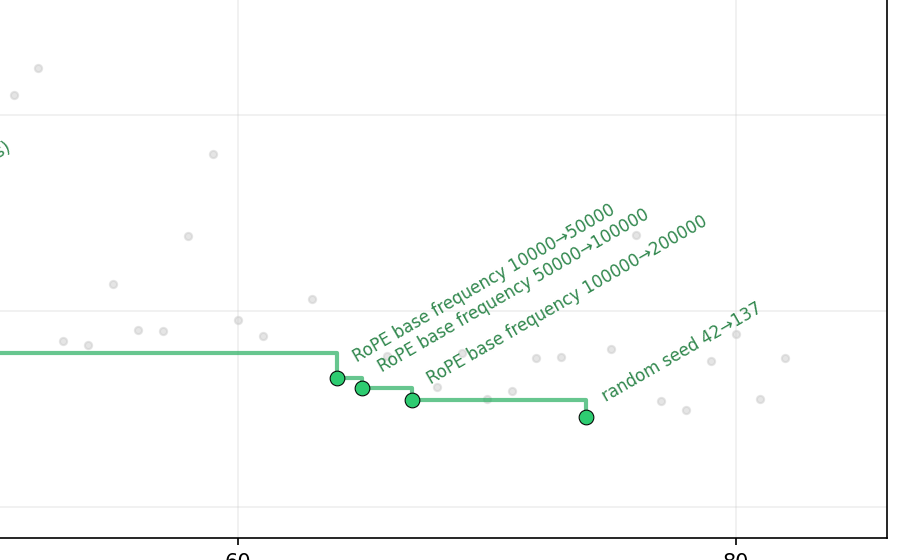
visuals/progress_endgame.png - the right-hand end of the author's 83-experiment run, cropped from
the repo's progress.png. Green dots are kept improvements, grey dots discarded experiments, the
green step line is the running best. Absolute bpb values are cropped out here; see
visuals/progress_full.png. What it teaches: the last accepted improvement of the entire run is
labelled random seed 42->137. Corroborated by the accept rule at
program.md:103-104,
which keeps any change that lowers val_bpb (n11).
Sit with that annotation for a moment. The agent changed the random seed from 42 to 137, the validation score came out lower, and the loop did what it was told: kept it, committed it, advanced the branch.
Background, supplied. Skip if you train models. Neural network training is stochastic. The random seed controls weight initialisation and data ordering, so running the identical configuration twice with different seeds gives two different final scores. The spread between them is run-to-run variance, and it is a property of the setup, not of any change you made. In careful empirical work this is why results are reported over several seeds with an error bar; a single-seed comparison cannot distinguish a small real effect from the setup's own jitter.
The accept rule is a bare comparison: "If val_bpb improved (lower), you advance the branch. If
val_bpb is equal or worse, you git reset back"
(program.md:103-104).
There is no repetition, no seed averaging, no threshold and no error bar anywhere in the design
(n11). Given that, keeping a reseed is not a bug in the agent's judgement - it is the rule
executing exactly as written on an input the rule has no way to recognise.
And here is why it is the most valuable single result in the repository, rather than a funny
footnote. That experiment accidentally measured the loop's own noise floor. Reseeding changes
nothing real, so whatever improvement it produced is a lower bound on how much this setup's score
moves for no reason at all. Reading the chart, it bought roughly 0.0005 bpb (n12).
Now look back along the same crop at the three steps immediately before it - RoPE base frequency
10000 to 50000, then to 100000, then to 200000 - and at "short window 1/8 context" earlier in the
run. Read off the axis, those accepted improvements are in the range of roughly 0.0002 to 0.0003
(n12).
Label this evidence honestly, because it is the weakest link in an otherwise well-supported note. These deltas are read off a rendered PNG by eye, at a scale where 0.0002 is about a pixel. The underlying
results.tsvis untracked by design (n7) and is not in the repo, so they cannot be checked. And the noise floor itself is a single seed change, n=1 - a proper estimate needs several reruns of an identical config.n12is gatedsingle-leg / needs-checkfor exactly these reasons.
With that caveat fully in view, the qualitative conclusion still stands and does not depend on the precise numbers: the run contains at least one accepted change that is definitionally noise, and several accepted changes of comparable or smaller magnitude. Which means the branch tip at the end of the night is not "baseline plus fifteen improvements". It is baseline plus some real improvements plus an unknown number of coin flips that landed heads, and nothing in the design can tell you which are which.
The consequence compounds, which is the part that would worry me if I were running this for
anything that mattered. Every accepted change permanently moves the baseline that all later
experiments are measured against (§6). Nothing ever re-tests a kept change (g3). So a lucky reseed
does not just add a spurious entry to the log - it raises the bar for every subsequent real
improvement, because later experiments must now beat a number that was partly luck. A run can
therefore reject genuine wins because a coin flip forty experiments ago set the bar too high.
None of this is hidden by the author, and the framing of the repo as "intentionally kept as a bare
bones baseline"
(README.md:7)
covers it. But the plot is the project's teaser image, and the seed annotation is right there in it
- which I read as the author leaving the evidence in plain view rather than tidying it away.
The transferable lesson is not "add error bars". It is that an autonomous accept/reject loop inherits the statistical properties of its metric whether or not you thought about them, and that the cheapest possible probe - run the same config twice - tells you the size of the effect you are allowed to believe in. If you build one of these, the noise floor is the first thing to measure and the last thing you will think to.
That is the accept rule. What about the search it drives?
10. What the frontier's shape tells you about the method#
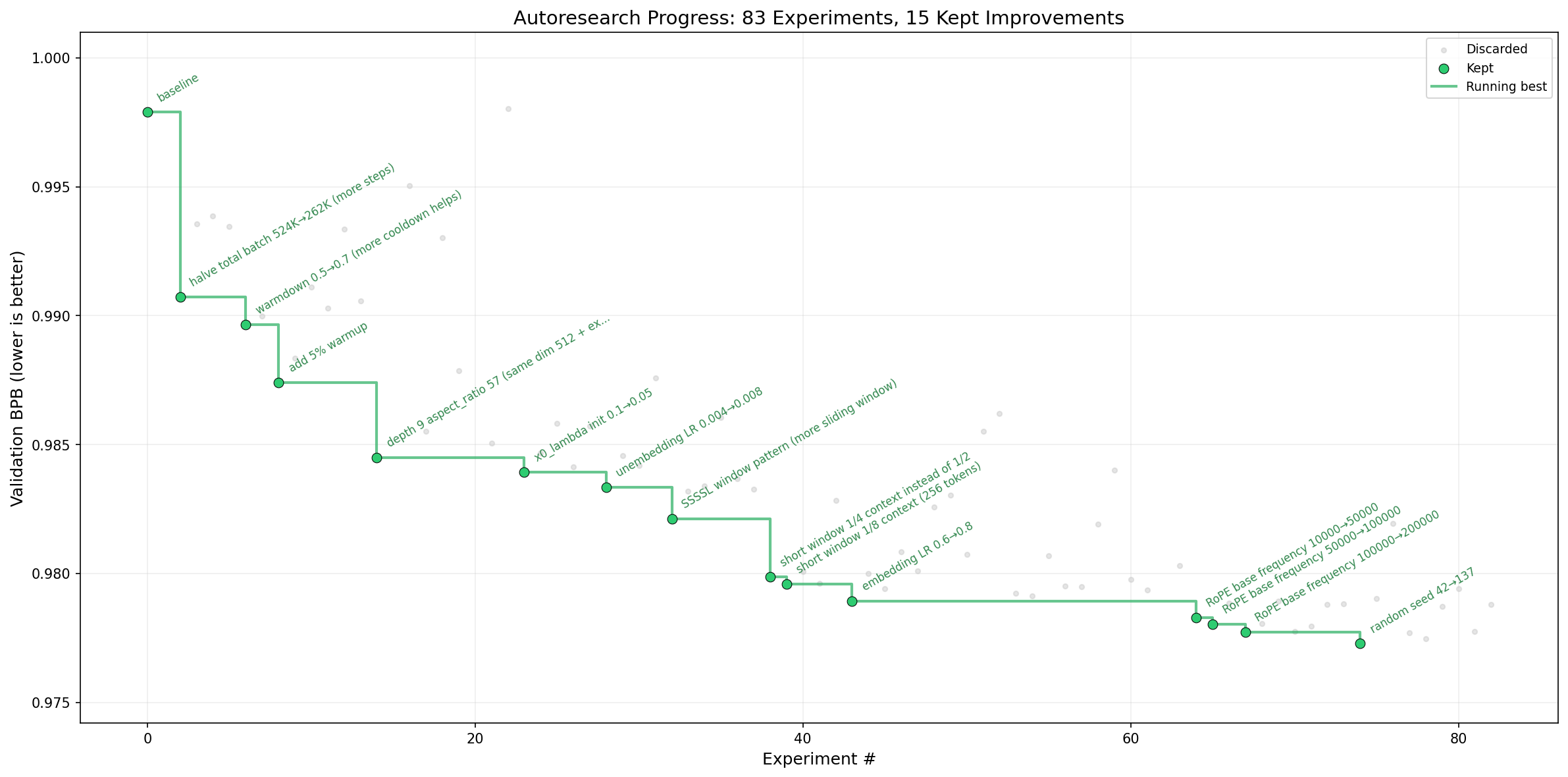
visuals/progress_full.png - the complete figure shipped as the repo's teaser. X axis is experiment
number, Y is validation bpb, lower is better. What it teaches: the whole search in one view - 83
experiments, 15 kept, a steep early descent, a long plateau, and a final cluster. Corroborated by
the chart title and by the loop rule that only accepted experiments advance the running-best line
(program.md:103-104)
(n13, n14).
Four things are legible in that curve, and each says something about the method rather than about language models.
Yield is low, and that is fine. 15 keeps in 83 experiments is roughly an 18% hit rate (n14).
For a human researcher that would be a demoralising week. For a loop that costs five minutes an
experiment and runs while you sleep, an 82% discard rate is simply the price of the search, and it is
the clearest argument for automating this particular activity at all: the loop's advantage is not
that it is smarter, it is that it is indifferent to rejection.
The gains are front-loaded.
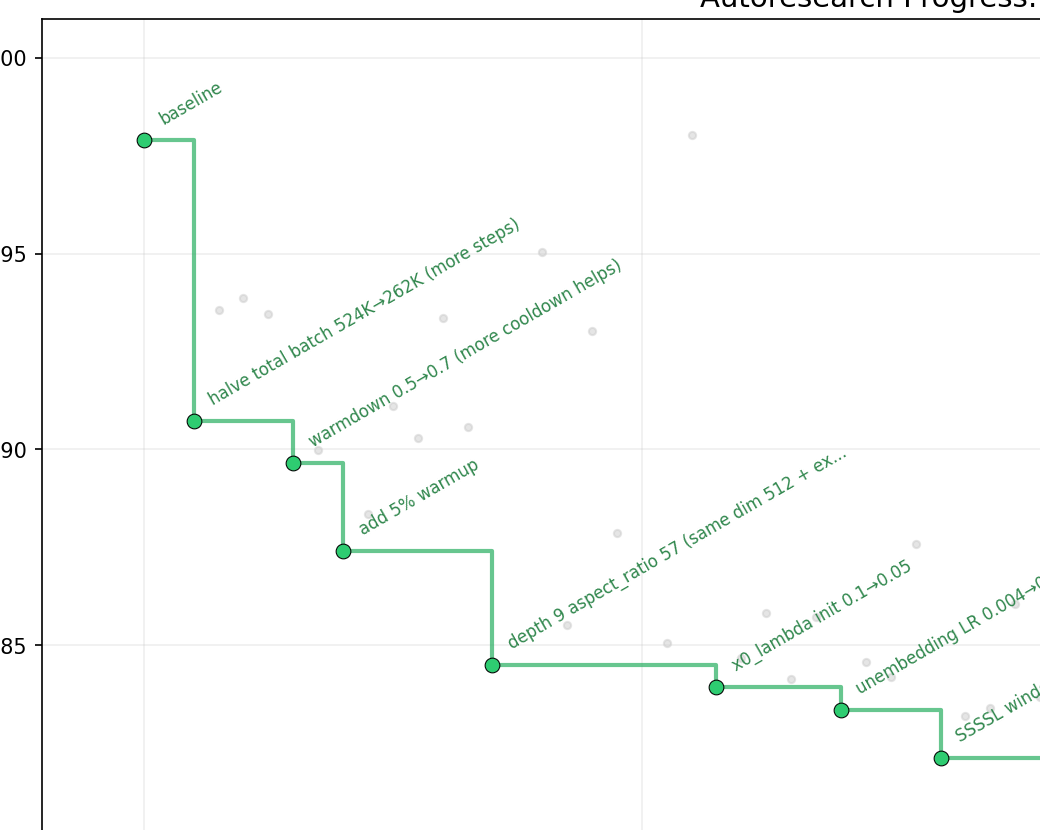
visuals/progress_early.png - the left end of the same figure, showing the first ~10 experiments at
readable scale. What it teaches: four of the fifteen kept improvements land in the first eight
experiments, and the first one alone (halve total batch 524K->262K) is a bigger drop than the whole
rest of the run's final third. Corroborated by the baseline-first mandate at
program.md:39,
which is why experiment #0 is the annotated baseline point (n18, n14).
Note what those early wins are: batch size, warmdown ratio, warmup, depth. These are schedule and sizing knobs, and the reason they pay so well is §3 - because the budget is wall-clock, "halve the batch size" means "take twice as many optimizer steps in the same 300 seconds", which is a real change in how the budget is spent. The design's central choice is visible directly in the shape of its results.
The search is greedy coordinate descent, and nothing else was available to it. Look again at the
endgame crop in §9: three consecutive kept experiments walk one hyperparameter monotonically -
RoPE base frequency 10000, 50000, 100000, 200000 - one experiment per step (n13). That is a 1-D
line search costing three iterations, and it happened because the loop structure permits nothing
else: each experiment is judged against the current branch tip, so the only move available is "change
something from where we are now". There is no mechanism for evaluating a combination, no way to
explore two directions and compare, and no way to back out of a local optimum other than the
"rewind, very very sparingly" escape hatch at
program.md:106,
which is given no criterion for when to use it.
Background, supplied. Coordinate descent optimises a multi-dimensional function by improving one variable at a time, holding the others fixed. It is simple and needs no gradient, and it works well when variables are roughly independent. It stalls where they interact - if two settings are only good together, no single-variable step reaches them, because each one alone makes things worse. That is a local optimum a one-at-a-time search cannot escape.
The plateau is the interesting failure. Between roughly experiment 43 and 65 the running-best
line is flat: about 22 consecutive experiments, nearly two hours of wall clock, with nothing
accepted (n14). This is exactly the situation §8's fallback ladder was written for, and the run
did eventually escape into the RoPE cluster. But we cannot tell from this source whether the
ladder caused the escape, because the loop never records why an experiment was tried - the ledger
has five columns and the richest is a free-text description (g1). The reasoning behind 83
experiments was in the agent's context and is gone. For a project whose output is supposed to be
research, that is the most consequential absence in the design, and it is the one I would close
first.
One last thing about this chart, which is a lesson about reading evidence rather than about
research loops. It is filtered, and the filter is in the notebook that draws it: crashes are
dropped, and only experiments scoring at or below baseline + 0.0005 are plotted, while the title
counts all 83 (n15, from analysis.ipynb cell 5). So the visible grey cloud of near-misses is not
the failure population - it is the near-failure population, and the experiments that went badly
wrong are not on the page at all. The chart is honest about what it plots if you read the code that
made it; nobody reading only the image would know.
11. What this design deliberately does not buy#
It is worth ending on scope rather than on a to-do list, because the repo's minimalism is a position
and not an oversight - "the repo is deliberately kept small"
(README.md:11).
Four things are absent, and knowing which absences are principled and which are simply unbuilt is
most of what you need to adapt this shape to your own domain.
| Absent | Principled or unbuilt? | What it would cost |
|---|---|---|
Any handling of run-to-run variance (n11, n12) |
Unbuilt, and the most consequential. The accept rule is one comparison against one run. | Cheap and expensive at once: a threshold costs nothing but needs a noise estimate; a proper two-seed confirmation of every candidate halves the experiment rate. That trade is the real reason it is absent, and it is a defensible call for a baseline. |
A record of reasoning (g1) |
Unbuilt. Five TSV columns, one of them free text; no hypothesis, no rationale, nothing about what a result ruled out. | Almost nothing to add - a sixth column or an append-only markdown log - which is what makes the absence notable. Without it, the search cannot learn from its own failures across a run, only from its successes, because only successes survive in the branch. |
Parallel search (g2) |
Hinted, not designed. A branch name autoresearch/mar5-gpu0 appears exactly once (program.md:92) implying one agent per GPU, with no mechanism anywhere for merging findings between branches. |
This is where the git-as-database choice stops being free: two agents hill-climbing independent branches produce two tips that cannot be combined by a merge, because their diffs are edits to the same constants. Parallelism here needs a real design, not more GPUs. |
Any check that a kept change is still good (g3) |
Principled, arguably. Re-testing costs budget that could buy new experiments. | But combined with the noise finding in §9, this is what makes a lucky accept permanent and compounding. A cheap version - re-run the current tip occasionally and watch its score move - would also produce the noise estimate the first row needs, which is a satisfying way for two of these gaps to close each other. |
The deeper point is the one the author makes explicitly and I would underline: the thing you iterate
on is program.md, not the Python
(README.md:7,
n16). Every gap in the table above is a markdown edit, not an engineering project. That inversion -
the human writing the loop in prose while the agent writes the code - is what the repo is actually
demonstrating, and it is why 115 lines of markdown is a reasonable place to put a research
organisation.
Diagram (mental model)#
flowchart TB
    subgraph FROZEN["FROZEN before the loop starts - the four freezes"]
        F1["SURFACE<br/>one editable file<br/>n1"]
        F2["BUDGET<br/>300s wall clock<br/>n3"]
        F3["UNITS<br/>bits per byte,<br/>fixed eval length<br/>n4"]
        F4["HOLDOUT<br/>pinned val shard,<br/>structurally enforced<br/>n2"]
    end

    subgraph LOOP["THE LOOP - runs unattended, ~12 per hour"]
        L1["edit"] --> L2["commit"] --> L3["run 5 min"] --> L4["grep 2 lines<br/>n8"] --> L5{"lower?"}
        L5 -->|yes| L6["advance branch"]
        L5 -->|no| L7["git reset"]
        L6 --> L1
        L7 --> L1
    end

    subgraph OUTSIDE["OUTSIDE the rewindable state"]
        O1["results.tsv<br/>untracked<br/>n7"]
    end

    FROZEN ==>|"earns the autonomy"| LOOP
    L5 -.->|"append either way"| O1
    L5 -.->|"NO VARIANCE CHECK<br/>this is where noise enters<br/>n11"| GAP(["a reseed scores<br/>as an improvement"])

    style FROZEN fill:#e8f4ea,stroke:#28a745,stroke-width:2px
    style GAP fill:#f8d7da,stroke:#dc3545,stroke-width:2px
    style O1 fill:#cce5ff,stroke:#004085
How to read it: three regions. Green (top) is everything decided before the agent starts and never changed again. The middle is the repeating loop. Blue (right) is the one piece of state deliberately kept outside git. The thick arrow is a dependency, the dotted arrows are writes, and the red node is not a component - it is the failure the design admits.
The crux: the four freezes are what make unattended autonomy safe, and the accept rule is the one place the design spends no effort at all.
Why it is shaped this way: the green box is heavy and the loop is light, which is the whole thesis - the engineering happens before the loop starts, not inside it. Once the surface, budget, units and holdout are fixed, the loop itself is nine steps of shell commands and needs no framework, which is why this repo has no agent code in it. The blue box hangs outside the loop rather than inside because the loop's discard operation rewinds the tree (§6). And the red node hangs off the decision diamond rather than off any component, because the gap is not a missing part - it is a property of a comparison that has one sample on each side. Compare the shape against §5's leak: both weaknesses live on the decision path rather than the computation path, which is where this design consistently spends the least.
Synthesized from n1-n11, n17 - a diagram the repo does not contain.
💡 Terms#
val_bpb(validation bits per byte) - a language-model score that divides total prediction surprise by the number of bytes of text rather than tokens, so models built on different tokenizers are comparable. Lower is better. (prepare.py:343-365)- Wall-clock budget - holding elapsed time constant across experiments rather than steps or
tokens, so that any change - architecture, model size, kernel efficiency - competes on how well it
spends a fixed slice of time (
n3). - Noise floor - the amount a metric moves between identical runs for reasons unrelated to any
change. Any accepted improvement smaller than it is unresolved. Measured for free by re-running one
configuration with a different random seed (
n12). - Greedy hill climbing / coordinate descent - a search that accepts any single change improving
the current best and then continues from there, one variable at a time. Needs no gradient, cannot
escape a local optimum that requires two changes at once (
n13). - Baseline-first - mandating that the first experiment of a run is the unmodified code, so every
later result has a control to be measured against (
n18,program.md:39). - The rollback-safe ledger - the rule that in a loop whose discard operation is a rollback, the
audit trail must live outside the rolled-back state. Here:
results.tsvuntracked while the code is committed (n7). (Name is this brain's, not the source's.)
What to distrust in this note#
Tier and conflict. This is T4 - a personal repository from a well-known practitioner, with nothing being sold and no institutional position to defend. That is the favourable end of T4, and it is still one person's experiment rather than a study.
The evidence splits cleanly in two, and the halves deserve very different confidence.
- The design claims (
n1-n8,n16-n18) are read directly off code you can open, checked against the author's own prose, and the docs-versus-code gate passes on every one of them - it even passes on the detail easiest to fudge (§3's warmup exclusion). Treat these as solid. The two divergences found (d1,d2) are both minor and are recorded with their magnitudes. - The results claims (
n12,n14, and the deltas in §9-10) rest on one PNG. There is no data behind it in the repo, because the ledger is untracked by design (n7), so the author's published result cannot be reproduced from the repository at all. Every number I quote from it was read off a rendered chart by eye, sometimes at a scale where the quantity of interest is about a pixel wide. They are gatedsingle-leg / needs-checkand should be cited as "roughly" or not at all.
A caveat on the note's most reusable claim. The noise finding in §9 is the thing most worth carrying to another project, and it is also the claim whose quantification is weakest: the qualitative fact (a reseed was accepted as one of fifteen improvements) is plainly visible in the figure and follows necessarily from the stated accept rule, but the size of the noise floor rests on n=1 and on my reading of a chart. Carry the mechanism confidently; carry the magnitude not at all.
What this brain did not do. No code here was executed - the repo needs an NVIDIA GPU and the
owner has none - so nothing is a reproduction. The model internals of train.py were deliberately
not traced (owner-set scope), so this note says nothing about whether the research the loop
produced is any good, only about how the loop is built. And no deep-research pass was run, so
there is no external evidence in this note whatsoever; every citation points inside one
repository.
Open questions#
- What is this setup's actual noise floor? The cheapest experiment in the repo and nobody has
published it: run the unmodified baseline five times with different seeds and report the spread.
It would immediately tell you how many of the 15 kept improvements are real (
n12). - Does a reasoning log change the yield? Adding a rationale field costs one TSV column (
g1). Whether recording why an experiment was tried improves the next 80 experiments is testable and, as far as this brain knows, untested. - How do you parallelise a git-as-database loop? Two agents on two GPUs produce two branch tips
editing the same constants, which do not merge (
g2). Is there a design that keeps the elegance ofgit resetas discard while allowing more than one searcher? - Would moving the score-write into the frozen module change any observed behaviour? §5's leak is cheap to close. It is an open question whether it matters empirically with today's coding agents, or whether it only matters as a design principle (claim 34).
- Does the fallback ladder in
program.md:112actually break plateaus? The run shows a ~22-experiment flat stretch followed by an escape (n14); the mechanism of the escape is unrecorded. - What does this shape look like when the metric is not a scalar? Everything here works because "better" is one number that a frozen function computes. Most research questions worth automating do not have that.
Feeds these topics#
brain/topics/autonomous-research-loops.md- the primary destination: the four freezes, the accept rule, git-as-database, the noise finding. Created for this source by ADR-0017, which also records why it is not called "research agents".brain/topics/evals.md- holding a resource constant for comparability, metric invariance as a code-layout problem, and the producer-prints-its-own-grade leak as a plumbing-level instance of claim 34.brain/topics/agents.md- autonomy as an explicitly suppressed default, the conditions that earn it, and specifying exchange rates when a loop carries two objectives.brain/topics/context-engineering.md- the per-iteration context budget, and empty output as a zero-cost error signal.brain/topics/skills.md-program.mdas a 115-line markdown artifact the author himself calls "a super lightweight skill" (n16).
Presentation narrative#
A talk track for a room deciding whether to let agents run unattended work, derived entirely from the gated nodes above. The containment design transfers; the training code does not. The mechanism is inspectable and the results are one unreproducible chart from one author on one GPU.
Slide 1 - Removing the human does not make the work harder, it moves every decision earlier#
The moment nobody is watching a loop, three separate systems problems appear at once, and only one of them is about the model. Nobody is asking whether an individual result is meaningful, and there is no later point at which anybody will. The agent is permitted to rewrite the very thing being measured, which in an ordinary review loop is exactly where a human sits. And a hundred iterations have to survive inside one context window, which is a constraint that simply does not exist when a person is reading the output.
The question for this room is therefore not whether the agent is capable enough. It is whether every guarantee you care about has been written into the setup before the loop starts, because after it starts there is no mechanism to add one. What engineers should take from this is that unattended execution converts ongoing judgement into advance specification. The leadership significance is that the review cost does not disappear when you remove the reviewer, it gets paid up front in design.
flowchart TB
    U["nobody is watching"]
    A["no one asks if a result<br/>is meaningful"]
    B["the agent may rewrite<br/>what is measured"]
    C["100 iterations must fit<br/>one context window"]
    G["every guarantee must exist<br/><b>before</b> the loop starts"]
    U --> A --> G
    U --> B --> G
    U --> C --> G
    style G fill:#e8f4ea,stroke:#28a745,color:#14532d
This is a problem slide, not a design. The crux is that removing the human does not make the work harder, it moves every decision earlier, converting three ongoing judgement calls into three things that must be settled up front and cannot be revisited.
Synthesized from n1.
Slide 2 - The design is four freezes, and each one is forced by the last#
This repository contains no agent code at all, and what it actually teaches is which four things you must hold still before an agent can be trusted to change everything else. Start by asking what the agent may edit: one file. That forces the next question, what is held constant while that file changes, and the answer is wall-clock seconds rather than steps or tokens. Seconds put a faster kernel, a better optimizer and a longer schedule on a single axis, so efficiency becomes part of the objective without becoming part of the metric.
That in turn forces a harder question: what is a comparable measurement once the model itself keeps moving? The answer is bits per byte, evaluated always at a fixed sequence length, because bytes are the one denominator the agent cannot redefine. The fourth freeze is the holdout, pinned inside the read-only file so that train and validation separation is the single rule the agent structurally cannot break [n1, n2, n3, n4].
flowchart LR
    A["1. what may<br/>it change?<br/><i>one file</i>"] --> B["2. what is held<br/>constant?<br/><i>wall-clock time</i>"]
    B --> C["3. what is<br/>comparable?<br/><i>bits per byte</i>"]
    C --> D["4. what is<br/>protected?<br/><i>the pinned holdout</i>"]
    style D fill:#e8f4ea,stroke:#28a745,color:#14532d
This is a derivation slide, not a settings list. The crux is that each freeze is forced by the residue the previous one left, so the four questions transfer to a system that has nothing to do with language models even though the four answers do not.
Synthesized from n1 through n4.
Slide 3 - The resources an unattended loop runs out of are memory, context and momentum, and none of them is compute#
A team that has built overnight batch jobs has solved exactly one of the three problems this loop
faces. Memory is handled with git and nothing else: one branch per run, one commit per experiment,
and git reset standing in for discard [n6]. Context is handled by compressing each five-minute run
down to roughly two grepped lines before it re-enters the agent's window, which is what makes a
hundred iterations fit at all [n8]. Momentum is handled by writing "never stop" into a markdown file,
because an agent's default behaviour is to finish and report.
The best idea in this movement is a consequence rather than a component, and it generalises well past this repository. The results ledger is deliberately kept outside git, because the loop rewinds the tree and would otherwise erase the record of the experiment that just failed [n7]. Stated generally: in any loop whose failure mode is rollback, the audit trail must not itself be rollback-able. The source gives the instruction and never gives that reason, so the generalisation is this brain's.
flowchart TB
    N["a hundred unattended iterations"]
    M["<b>memory</b><br/>git: branch per run,<br/>commit per experiment"]
    C["<b>context</b><br/>~2 grepped lines<br/>per experiment"]
    D["<b>momentum</b><br/>NEVER STOP, written down"]
    N --> M
    N --> C
    N --> D
    X["the ledger sits <b>outside</b> git,<br/>because the loop rewinds the tree"]
    M --> X
    style X fill:#e8f4ea,stroke:#28a745,color:#14532d
This is a resource slide. The crux is that none of the three scarce resources is compute, and a team with overnight batch-job experience will have solved the first and never met the other two.
Synthesized from n6, n7, n8.
Slide 4 - The containment is a declaration, not an enforcement, and the design says so#
There is no sandbox, no import hook and no checksum anywhere in this repository, so the boundary between editable and protected exists in a banner comment and a markdown instruction [n1]. That is worth stating without softening, and it is also not obviously wrong: for a single-agent loop on your own hardware, a declared boundary the agent respects is cheap and sufficient, and the alternative costs real engineering.
The sharper problem is one level in. The protected metric is computed by a frozen function, and then the file that calls it, formats it and prints it is the file the agent rewrites, with the agent's score read from that print [n5]. Generator and evaluator can be perfectly separated at the function level while the evaluator's output still travels through the generator's hands, and nothing compares the two. This is the seam the first three freezes leave open.
flowchart TB
    F["evaluate_bpb is frozen"]
    P["but the file that calls it,<br/>formats it and <b>prints</b> it<br/>is the file the agent rewrites"]
    R["and the score is read<br/>from that print - n5"]
    N["nothing compares the two"]
    F --> P --> R --> N
    style N fill:#fdeaea,stroke:#dc3545,color:#7f1d1d
This is a seam slide, not an architecture. The crux is that generator and evaluator can be perfectly
separated at the function level while the evaluator's output still travels through the generator's
hands. No sandbox and no checksum exist anywhere in the repository [n1].
Synthesized from n1, n5.
Slide 5 - The loop banked a random seed as its final improvement, and that is the accept rule working correctly#
The fifteenth and last kept improvement in the author's own published eighty-three-experiment run is a change of random seed [n11]. That is not a failure of the agent's judgement. The accept rule is a bare scalar comparison with no repetition, no seed averaging, no threshold and no error bar, and it executed correctly on an input it has no way to recognise.
What makes this the most useful result in the source is that it is free: the seed experiment measures the loop's noise floor at no extra cost, and by that floor at least three other accepted changes are unresolved [n12]. There is a compounding consequence: every accept permanently moves the baseline and nothing re-tests a kept change, so a lucky accept raises the bar for every real improvement after it.
I should label this evidence honestly. The noise floor rests on a single experiment, and the deltas
behind it were read off a rendered chart by eye at a scale where the quantity of interest is roughly
one pixel. It is gated needs-check and deliberately not promoted harder.
This is the author's own published run, not a criticism of it. The crux is the final step, which
is the accept rule executing correctly on an input it has no way to recognise [n11, n12].
Slide 6 - Adopt the shape, do not cite the numbers, and add the one thing it is missing#
The decision this supports is to borrow the containment design and to treat the published results as an illustration rather than as evidence. The mechanism is fully inspectable and the documentation matches the code almost everywhere, which is why the four freezes are safe to reuse. The results are one unreproducible chart from one author on one H100, with the underlying ledger untracked by design, and the author's published results cannot be reproduced from the repository at all [n12, n14].
If you build on this, the missing piece is named precisely and it is small: an accept rule that knows about variance. Repetition, or seed averaging, or a threshold set from a measured noise floor. That single addition is what separates a loop that compounds real improvements from one that compounds whatever its benchmark cannot see, and the source hands you the measurement you would need to set the threshold without ever using it itself.
This is the whole programme in one image, and the shape is the argument. The crux is that yield is
low and front-loaded: 83 experiments, 15 keeps, most of the gain early, then a plateau of roughly 22
experiments with nothing. Read off a rendered chart by eye, so gated needs-check [n12, n14].
Key takeaway message#
The transferable object here is not an agent and not a training script, it is a containment design: four things frozen in advance, after which an agent can be trusted to change everything else. The four questions transfer to any unattended loop; the answers do not. Both failures are places where nothing was frozen, and the consequential one is an accept rule with no notion of variance, which the author's own run demonstrates by banking a random seed. Adopt the freezes, add a variance-aware accept rule before running anything overnight, and quote no number from the chart.