source
Inside the Microsoft Agent Framework: How we designed a layered SDK
Shawn Henry, Principal Group Product Manager (the commandline engineering blog)
About this note
Persona: curator + mentor, always. Re-adopt when working this file.
The distilled document you learn from - text anchored by a few curated visuals. Built from the corroborated nodes in
nodes.md. Every claim is cited. Signal, not archive. SeeSOURCE.mdfor metadata.Two kinds of material, kept visually distinct. Claims from the article carry a node ID (
n9) and a section. Blocks marked "Background, supplied" are context I am adding - established prior art the article assumes or never names. They are uncited by construction.An unusual evidence direction, worth flagging up front. In this source the diagrams are the richer leg. They are authored architecture figures with named boxes, and in four places they name things the prose is entirely silent on. Normally text is primary and the visual confirms it; here it runs the other way, and those figure-only items are marked
needs-checkthroughout.
On this page
TL;DRThe 1-minute versionKey claimsWhat you will learn, and in what orderMovement A - three things wearing one word1. Three different things wearing one wordMovement B - the shape is the argument2. The shape is the argument: not a stack3. The loop is drawn small, and that is deliberateMovement C - the two optional layers, enumerated4. Workflows: the answer to "what if I do not want autonomy?"5. The harness, enumerated - which nothing else here doesMovement D - what a catalog cannot tell you6. What the catalog will never tell you: what to remove7. The conflict it never acknowledgesCommentary: the three layers as a Formula 1 teamWhere the analogy breaks, which is the part worth keepingDiagram (mental model)💡 TermsWhat to distrust in this noteOpen questionsFeeds these topicsPresentation narrativeSlide 1 - Three different things are wearing one word, and that is why the argument never endsSlide 2 - The loop is small on purpose, and the substrate around it is most of the pictureSlide 3 - Workflows are the answer to "what if I do not want autonomy?"Slide 4 - This is the brain's only enumerated harness inventorySlide 5 - A catalog cannot tell you what to remove, and that is the question that mattersSlide 6 - It takes a side on loop ownership and never says soKey takeaway messageTL;DR#
A vendor design post worth reading for one factoring, not for its product: the agent loop,
workflows, and the harness are three separable concerns, and the summary figure shows they
are not a stack - the loop is the only mandatory layer (n1, n9). It supplies the brain's only
enumerated harness inventory (n7), five named orchestration patterns including Author/Critic
(n6), and the sentence that justifies the whole layering: "a strong model with poor tools, weak
context and no controls will still produce a poor result" (n8). It also contradicts claim 12 head
on - S2 says own your loop, this says let the SDK own it - and never acknowledges the position
exists (d1).
flowchart TB
    L["<b>agent loop</b><br/>the only mandatory layer - n1"]
    W["<b>workflows</b><br/>for when you do not want autonomy"]
    H["<b>harness</b><br/>tools, context, planning, middleware"]
    N["<b>not a stack</b> - you may take the loop<br/>without either of the others - n9"]
    C["and it contradicts claim 12 head on,<br/>without ever acknowledging<br/>the position exists - d1"]

    L --> N
    W --> N
    H --> N
    N --> C

    style N fill:#dcfce7,stroke:#15803d,color:#14532d
    style C fill:#fbf1dc,stroke:#b45309,color:#78350f
This is a factoring diagram, not a product diagram, and the negative claim in the green box is the whole reason to read the post. The crux is that three things routinely sold as one are separable, and the summary figure says so by not stacking them - the loop is mandatory and the other two are optional in either order. It is drawn with all three feeding the separability claim rather than layered, because drawing them as a stack would reproduce exactly the error the note exists to correct. The amber box is the note's own finding rather than the source's: S2 says own your loop and this says let the SDK own it, and the post never acknowledges that anybody disagrees.
Synthesized from n1, n9 and divergence d1.
The 1-minute version#
This note covers a design post written by the team behind the Microsoft Agent Framework, and what is
worth taking from it is a factoring rather than a product. The post pulls the word "agent" apart into
three separable concerns and then draws them, and the drawing turns out to carry more of the argument
than the prose does (n1, n9). Everything below hangs on the one confusion that factoring exists to
dissolve, so it is worth naming that confusion before anything else.
The problem is that "agent" names three different things at the same time. It names an execution cycle, the loop that takes input, reasons over context, calls a tool and continues. It names an orchestration topology, the arrangement of steps or of several agents working together. And it names a pile of runtime capabilities surrounding both, the tools, context, memory and controls an agent is given. Because one word covers all three, arguments about agent design are usually people talking about different layers without either side noticing.
At first glance that sounds like a vocabulary complaint rather than a design problem, and the reason it is more than that is arrangement. Naming the three parts is the easy half. The hard half is knowing which of them you are allowed to decline, and a name says nothing about that. Two engineers can agree perfectly on all three words and still disagree about whether adopting orchestration commits them to a whole runtime, which is the question that actually decides whether a framework is adoptable at all.
The obvious way to answer that question is the one most SDK diagrams reach for, which is to draw the three parts as a three-tier stack. Suppose you did. A stack asserts containment, so each layer rests on the one beneath it and cannot be had without it. Adopting workflows would then drag the harness in behind them, and the framework becomes all-or-nothing at precisely the moment a reader is deciding how much of it to buy. Worse, the drawing hides which single layer is genuinely mandatory, and that is the one fact a newcomer most needs to know.
The post's answer is to separate the three concerns and then refuse the stack. The agent loop is the
execution cycle over models, conversations, tools and state. Workflows are structured orchestration
for multi-step or multi-agent processes. The harness is the reusable runtime capability layer around
the agent (n1). In the summary figure, Workflows and Harness sit side by side above Agent
Loop inside one container, and the two peers do not touch. In other words there are two optional
surrounds over a single mandatory base, and each surround can be declined without the other (n9).
Working out what each surround is actually for is where the post pays. Workflows exist because many
real processes, support triage or bug-to-PR or research-with-review, need predictable steps rather
than more autonomy (n5), and the figure names five patterns for them, Sequential, Handoff,
Author/Critic, Magentic and Custom (n6). The harness is enumerated as four named columns, Common
Tools, Context, Planning and Middleware, sitting above a row of preset harnesses by task archetype
(n7), and that inventory is the only one of its kind anywhere in this brain. The justification for
the whole layering is a single sentence: "a strong model with poor tools, weak context and no
controls will still produce a poor result" (n8).
What the post costs you is subtraction, and that omission is structural rather than careless. It lists
what a harness may contain and never once suggests taking something out, which is what a catalog is
for, and an SDK vendor has no reason to write the other half. Claim 31 supplies it from outside,
holding that every harness component encodes an assumption about what the model cannot do alone and
that those assumptions expire. There is a second cost, and it is sharper. The post contradicts claim
12 head-on, because S2 says own all four parts of your loop while this says let the SDK own it, and it
never acknowledges that a serious opposing position exists (d1).
That leaves how far any of it may be trusted, and the honest answer is narrower than the post's
confidence suggests. This is a T2 vendor design post about its own SDK, with nothing measured, nothing
compared and no baseline of any kind. Four of the harness items appear only in a figure and in no
prose at all, and the most architecturally interesting claim in the source, that an agent-provider
slot can accept a whole third-party agent, rests on a single diagram tile (n4). Read it for
vocabulary and taxonomy, and never for efficacy.
The same argument, compressed for reference rather than for reading:
| The problem | "Agent" names three different things at once - an execution cycle, an orchestration topology, and a pile of runtime capabilities - so arguments about agent design are usually people talking about different layers. |
| The idea | Separate them. Agent loop (the cycle over models, conversations, tools and state), workflows (structured orchestration), harness (reusable runtime capabilities) (n1). |
| The shape is the argument | In the summary figure Workflows and Harness sit side by side above Agent Loop, and the two peers do not touch - two optional surrounds over a mandatory base, not a three-tier stack (n9). A stack would imply containment: adopt orchestration and you drag in the runtime. |
| What it gives you | The only enumerated harness inventory in this brain - Common Tools / Context / Planning / Middleware, over presets by task archetype (n7). Five orchestration patterns worth having names for, including Author/Critic drawn as worker and reviewer in a cycle (n6). |
| The best sentence | "A strong model with poor tools, weak context and no controls will still produce a poor result" (n8). The figure makes the same point structurally: the model appears in none of the boxes. |
| What is missing | Subtraction. A catalog invites you to take the whole shelf, and an SDK vendor has a structural reason never to suggest removing anything. Pair it with claim 31 - every harness component is an expiring bet. |
| The conflict | It contradicts claim 12 (own all four parts of your loop) directly, and never mentions that anyone holds that view (d1). Both sides are unmeasured assertions by non-disinterested authors. |
| How far to trust it | T2 vendor design post about its own SDK. Nothing measured, nothing compared, no baseline. Read it for vocabulary and taxonomy, never for efficacy. Four harness items exist only in a figure. |
Key claims#
- Loop, workflows and harness are three separable purchases, not a three-tier stack.
n1n9 - Five orchestration patterns: Sequential, Handoff, Author/Critic, Magentic, Custom.
n6 - A harness is an inventory: Common Tools / Context / Planning / Middleware, plus presets.
n7⚠️ four items figure-only - Environment quality bounds agent quality regardless of model strength.
n8 - Workflows exist because many processes need predictable steps, not more autonomy.
n5 - An agent-provider slot can accept a whole third-party agent product.
n4⚠️single-leg, figure-only - ⚠️ The SDK should own the loop's structure - this contradicts claim 12.
n2d1
What you will learn, and in what order#
flowchart TB
    subgraph A["A. Why the word 'agent' causes arguments"]
        S1["1 - Three things<br/>with one name"]
    end
    subgraph B["B. The factoring, and why the SHAPE is the claim"]
        S2["2 - Not a stack:<br/>two optional surrounds"]
        S3["3 - The loop is small,<br/>and that is deliberate"]
    end
    subgraph C["C. The two surrounds"]
        S4["4 - Workflows: predictable<br/>steps, not autonomy"]
        S5["5 - The harness,<br/>enumerated"]
    end
    subgraph D["D. What it will not tell you"]
        S6["6 - No subtraction"]
        S7["7 - The conflict with<br/>claim 12"]
    end
    A --> B --> C --> D
    S2 --- S3
    S4 --- S5
    S6 --- S7

    style B fill:#e8f0fc
    style D fill:#fbf1dc
This is a reading-order diagram about the note rather than about the SDK, gathered into four movements, and every box below a movement is a numbered section further down this note. Blue marks the block carrying the contribution, which is the taxonomy and specifically the claim that its three parts are independently declinable. Amber marks the block you have to supply yourself, because this source has a structural reason not to supply it for you. The crux is that this is a vocabulary rather than a finding, and the vocabulary is worth having precisely because the arguments it settles are ones people currently have by accident.
Movement A is deliberately short, because the problem it describes is definitional rather than technical, and a reader who already hears three separate questions inside the word "agent" can move straight past it. Movement B is the payload, and it is the one stretch where the figure carries more of the argument than the prose does. If you skim it you will still learn the three names, but you will miss the claim that the arrangement is making, which is the part that transfers to reading any other SDK diagram.
Movement C is a tour rather than a derivation, and it is where the concrete inventory lives. Read it for the names, since names are what this source is genuinely good for. Movement D then stops describing the source and starts judging it, and it exists because reading a vendor catalog without a subtraction discipline is how harnesses get bloated. Both of its sections import their argument from elsewhere in this brain, which is exactly the point being made about the missing half.
Synthesized roadmap of this note - not from the source.
Movement A - three things wearing one word#
flowchart TB
    W["'agent framework'"]
    A["the <b>loop</b> that calls a model<br/>and dispatches tools"]
    B["the <b>workflow</b> engine that runs<br/>a fixed sequence"]
    C["the <b>harness</b> of tools, context,<br/>planning and middleware"]
    D["three separable concerns, and most<br/>arguments about frameworks are<br/>people meaning different ones"]

    W --> A --> D
    W --> B --> D
    W --> C --> D

    style D fill:#dcfce7,stroke:#15803d,color:#14532d
This is a vocabulary diagram, not an architecture, and it is a movement of one section for a reason. The crux is that the word is overloaded, so a team can hold a long disagreement about whether to use a framework while meaning three different things by it. It is drawn as one word fanning into three because that is the disambiguation the rest of the note depends on: every later claim is about one of these boxes and is false about the others. Read this movement even if you skip the rest, because the distinction is what makes the vendor's own figure interesting.
Synthesized from n1.
1. Three different things wearing one word#
Most disagreements about "agent design" turn out to be people arguing about different layers without
noticing that they are. The article's contribution is to name those layers apart, and the three names
are worth stating plainly before anything is done with them (n1, §intro). The first is the agent
loop, the execution cycle over models, conversations, tools and state. The second is workflows,
structured orchestration for multi-step or multi-agent processes. The third is the harness, the
reusable runtime capabilities that surround the agent.
At first glance that is a taxonomy rather than a finding, and it is worth being clear about which one you are getting. But a taxonomy that dissolves a recurring confusion is genuinely useful, and this one does. "Should agents be autonomous?" is a question about the loop. "How do I make this repeatable?" is a question about workflows. "Why is my agent bad despite a good model?" is a question about the harness. Three questions that sounded like one now have three separate answers, and each answer lives somewhere different.
The interesting part is not the three names, though, since a list of three concerns is the sort of thing any vendor could have written. It is how they are arranged.
Movement B - the shape is the argument#
flowchart TB
    S["what you expect:<br/>a <b>stack</b>, each layer<br/>resting on the one below"]
    F["what the figure draws:<br/>workflows and harness <b>side by side</b><br/>above the loop alone - n9"]
    M["so the loop is the only mandatory part,<br/>and you may take either of the<br/>others without the other"]
    D["3. and the loop is drawn small<br/>deliberately - the substrate around it<br/>is most of the picture"]

    S -.->|"the reading to discard"| F --> M --> D

    style F fill:#dcfce7,stroke:#15803d,color:#14532d
This is a shape diagram, and the argument is carried by a layout rather than by a sentence. The crux is that the vendor's own summary figure makes a claim the prose never states: these are not layers, so adopting one commits you to none of the others. It is drawn with the stack reading retained and struck because that is the default assumption a reader brings, and the whole value of the figure is that it contradicts it. Section 3 then makes the second point of the same kind - the loop box is small and the substrate around it is large, which is an argument about where the engineering actually goes.
Synthesized from n9 and n2.
2. The shape is the argument: not a stack#
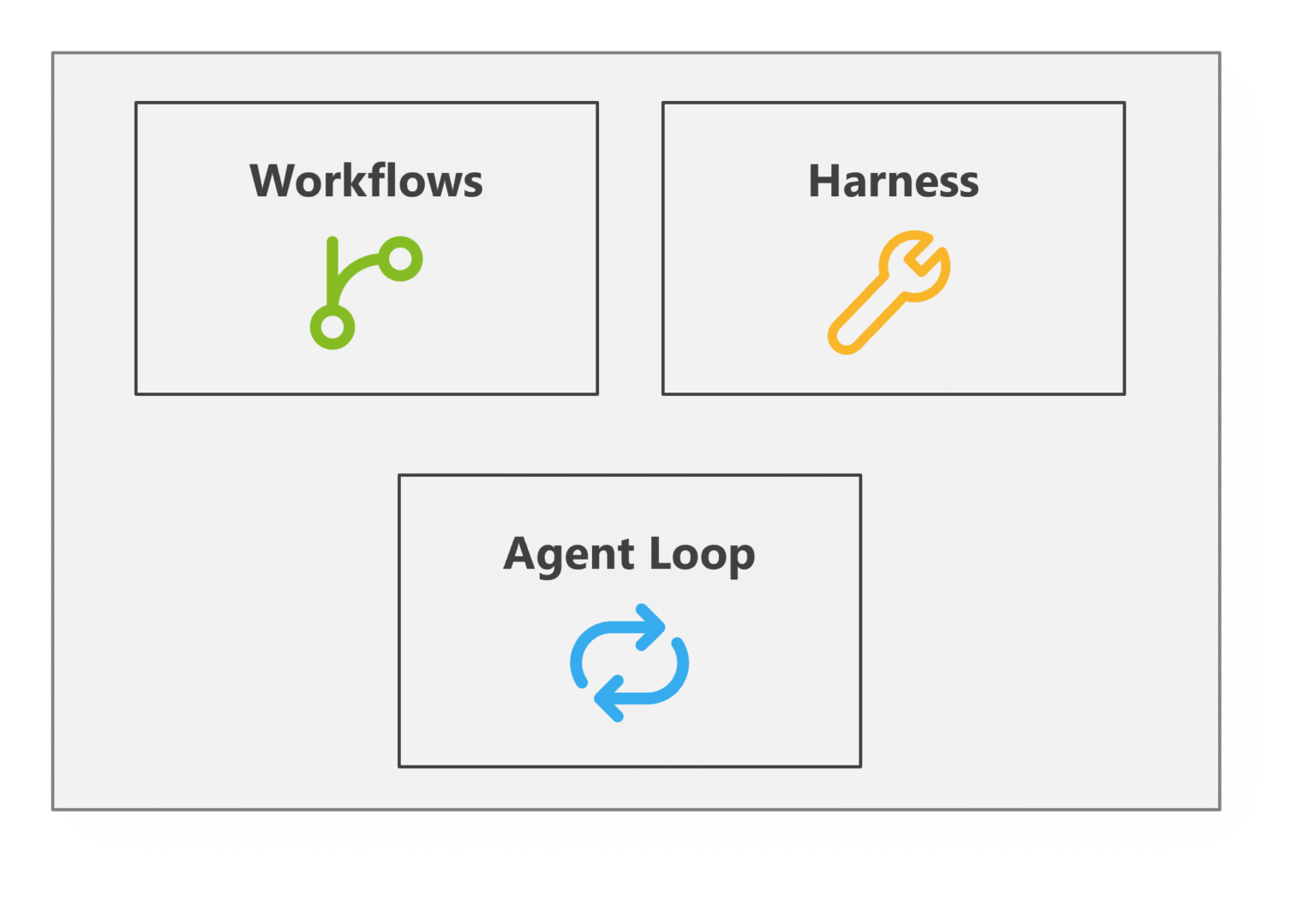
- What it teaches:
WorkflowsandHarnesssit side by side aboveAgent Loop, inside one container - and the two peers do not touch. Two optional surrounds over a mandatory base, not a three-tier stack.n9fig_AgentFramework - Corroborated by: §Why this matters states the choice explicitly - "Not every agent needs a complex workflow. Not every workflow needs a highly autonomous agent."
Spend a moment on why the drawing matters, because this is the whole payload. To see why, consider what the alternative drawing would have asserted. A stack implies containment, so if workflows sat on the harness, adopting orchestration would drag the entire runtime in with it. Drawn instead as peers that do not touch, each surround becomes separately declinable. You can take the loop alone, the loop plus a harness, or the loop plus workflows, and nothing in the picture obliges you to take all three.
That is claim 17 one level up. S2 says not every problem needs an agent; S9 says not every agent needs orchestration. Same discipline, applied to the layer above - and the fact that a different vendor arrives at it independently is worth more than either statement alone.
Background, supplied. "Layered but not stacked" has a precise name in software design: optional composition over mandatory layering. A layered architecture buys you coherence and costs you the ability to opt out of a layer; composition buys the opposite. The reason this figure earns a paragraph is that most SDK diagrams draw stacks by default, and the stack is what makes a framework all-or-nothing. When you next read an architecture diagram, check whether the boxes touch - it usually tells you more about what you can decline than the prose does.
That accounts for the two boxes you may decline. It says nothing yet about the one you may not, and the figure for that box has a second argument hidden in its proportions.
3. The loop is drawn small, and that is deliberate#
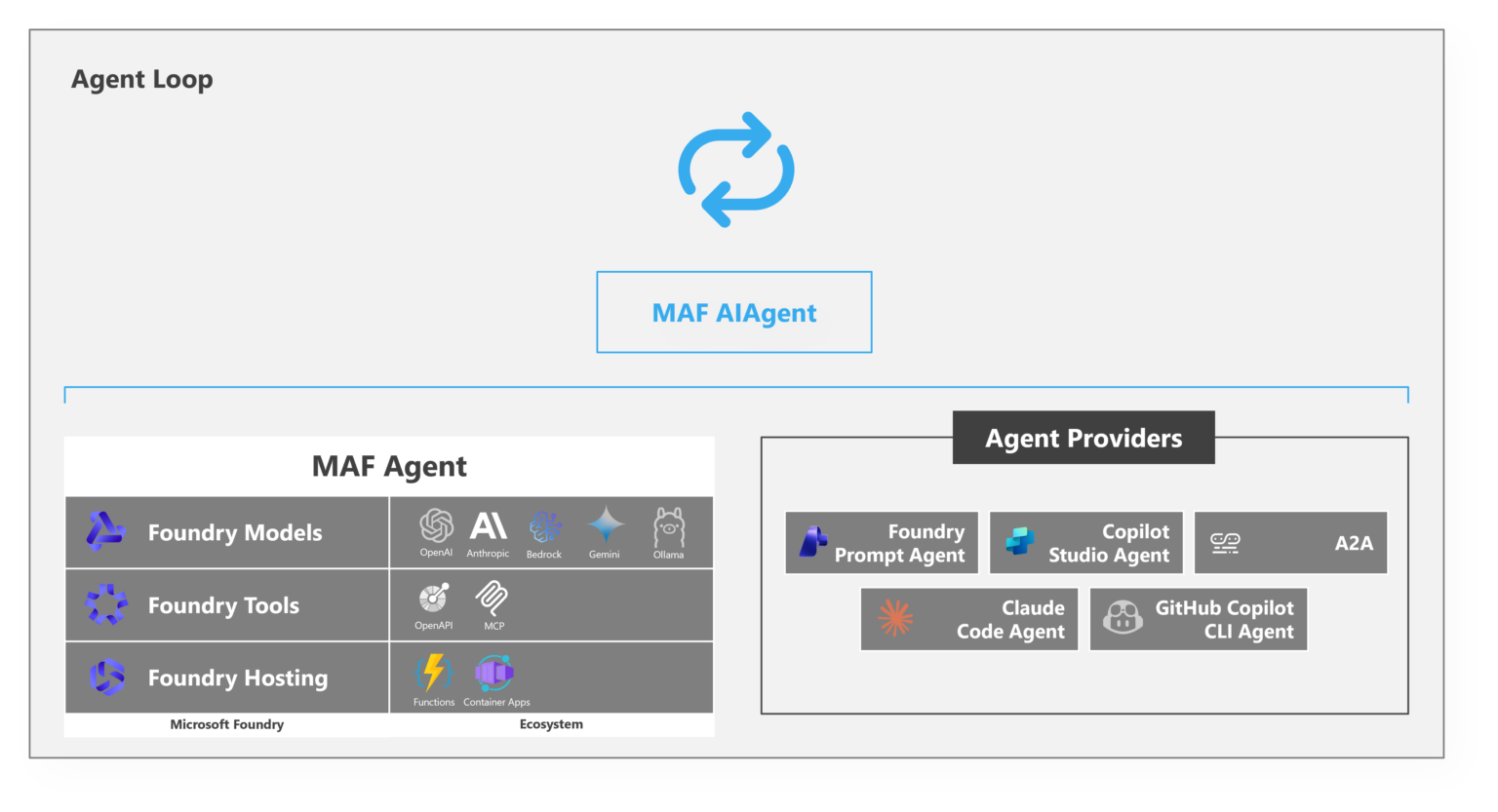
- What it teaches: the
MAF AIAgentbox is small; the substrate beneath it - models (OpenAI, Anthropic, Bedrock, Gemini, Ollama), tools (OpenAPI, MCP), hosting (Functions, Container Apps), agent providers - occupies most of the frame.n2n3fig_AgentLoop - Corroborated by: §Agent loops gives a six-line while-loop as pseudocode, then argues that the difficulty is everything around it - messages, tool schemas, results, errors, streaming, permissions, state.
The article draws a conclusion from that observation, and it is a strong one. Because the loop itself
is trivial and everything surrounding it is not, the SDK should own the structure, leaving you to
work on agent behaviour instead of plumbing (n2). Hold that conclusion, because section 7 is where
it collides with something this brain already believes.
⚠️ One tile in this figure is at once the most conceptually interesting thing in the source and its
weakest evidence (n4). The Agent Providers box carries five peer tiles. Two of them are
Claude Code Agent and GitHub Copilot CLI Agent, which are whole third-party agent
products, and they sit beside a prompt-configured first-party agent and beside A2A, a wire
protocol.
If that tile means what it appears to mean, the unit of composition has moved up a level: from which model does this agent call to which finished agent does this system delegate to. But the prose never says it. It claims only that the framework can "interact with agents hosted elsewhere", never names Claude Code, and "interact with" is considerably weaker than a peer slot.
single-legon a diagram tile - treat it as a direction of travel, not a capability. A tile in a vendor architecture diagram is exactly what this kit must not read as a capability statement.
So much for the mandatory base. The two optional surrounds are the rest of the source's substance, and the first of them answers a question the loop cannot.
Movement C - the two optional layers, enumerated#
flowchart TB
    W["4. <b>workflows</b>: five named orchestration<br/>patterns, including Author/Critic - n6"]
    H["5. <b>the harness</b>, enumerated - common tools,<br/>context, planning, middleware - n7"]
    V["and this is the brain's only enumerated<br/>harness inventory, which is why a<br/>catalog post earns a note at all"]

    W --> V
    H --> V

    style V fill:#e8f0fc,stroke:#4338ca,color:#312e81
This is an inventory diagram, not a design. The crux is that the value here is taxonomic rather than architectural: nothing in this movement is measured or compared, and it is still the most complete naming of harness components this brain holds. It is drawn as two catalogs converging on that observation because it is the honest reason to keep the source - a vendor listing what its own product contains is weak evidence about what works and strong evidence about what the category contains. Author/Critic is the pattern worth carrying, since it is the same generator-evaluator separation this brain records from three other directions.
Synthesized from n6 and n7.
4. Workflows: the answer to "what if I do not want autonomy?"#
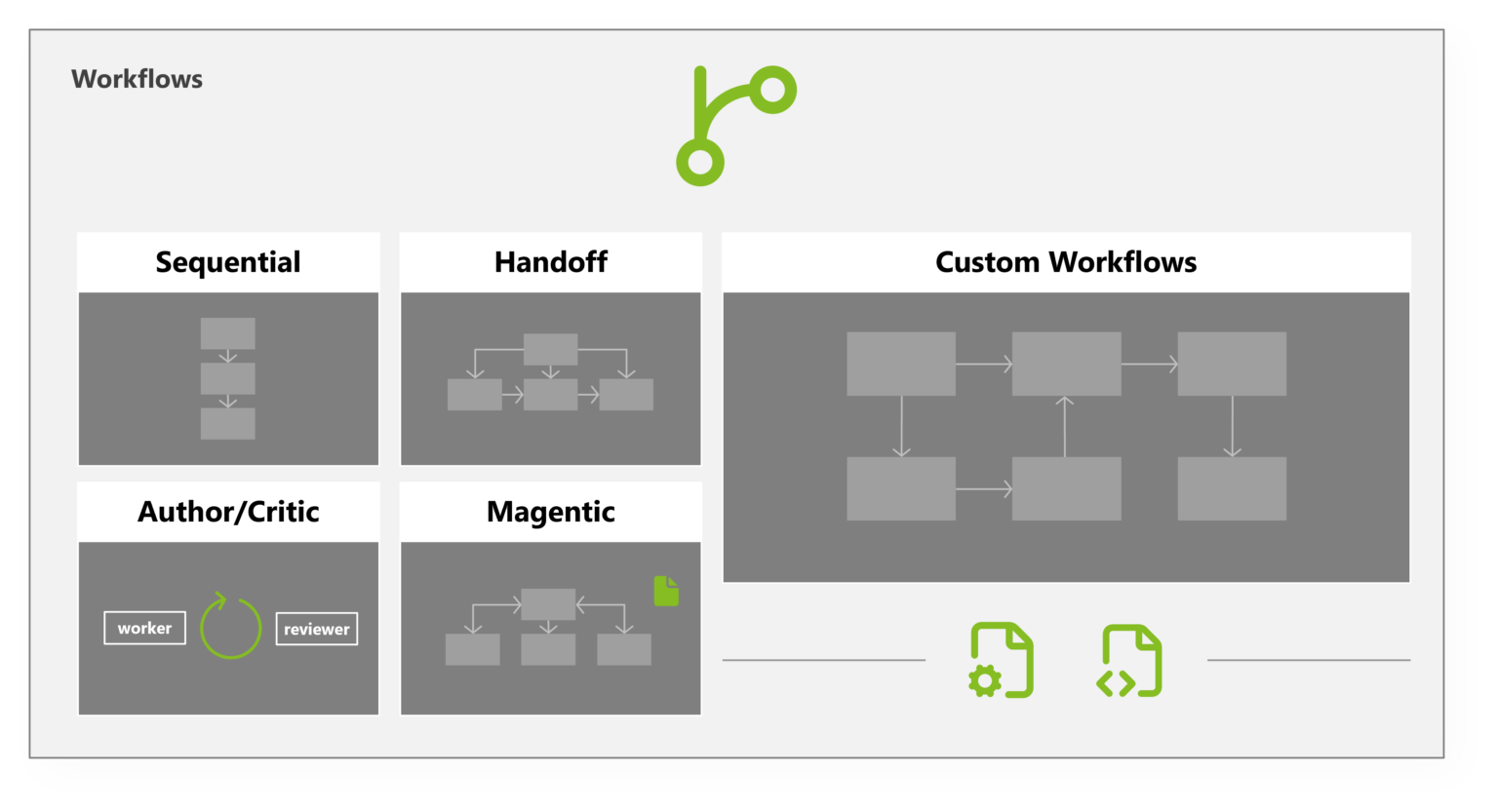
- What it teaches: five named patterns - Sequential, Handoff, Author/Critic (drawn as
workerandreviewerwith a cycle arrow between them), Magentic (a coordinator plans and supervises subagents and tools), and Custom.n6fig_Workflows - Corroborated by: §Workflows defines all five in prose, and argues that many real processes -
support triage, bug-to-PR, research-with-review - need predictable steps rather than more
autonomy (
n5).
The framing is the useful part, and it inverts what the word usually implies. Workflows are not a lesser form of agency. They are the correct answer whenever the topology is known in advance, which describes a large share of the processes anyone actually wants automated. Notice that the panels are drawn as fixed-topology graphs, boxes and arrows rather than cycles. That is the same statement made visually.
Author/Criticdeserves its own note, because this brain has met it twice already. It is claim 34 (S4: a separate evaluator beats a self-critical generator, because of self-evaluation bias) and claim 59 (S7: split a loop before it holds two objectives) shipped as a named, reusable SDK primitive by a third vendor. Treat that as corroboration of the pattern's currency, not its efficacy: S9 measures nothing, and S4 remains the only source here that measured anything about the split.
Workflows are one of the two surrounds, and the one this brain already had vocabulary for. The other surround is where the source supplies something nothing else here does.
5. The harness, enumerated - which nothing else here does#
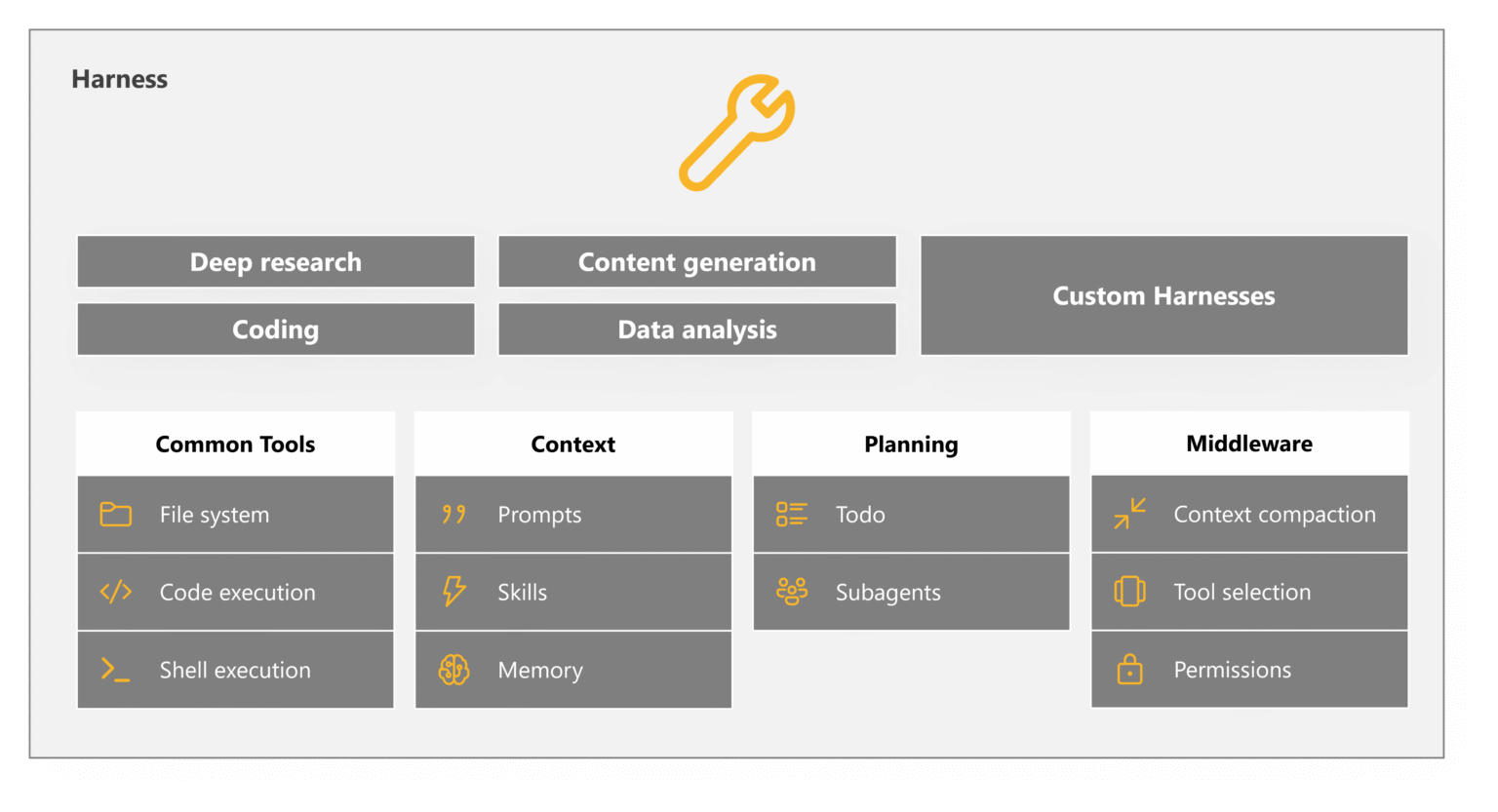
- What it teaches: the harness as four named columns - Common Tools (file system, code
execution, shell execution), Context (prompts, skills, memory), Planning (todo,
subagents), Middleware (context compaction, tool selection, permissions) - above a row of
preset harnesses by task archetype (deep research, coding, content generation, data analysis,
custom).
n7fig_AgentHarness - Corroborated by: §Harnesses covers most of it in prose. ⚠️ But it is silent on four items -
skills,todo,tool selectionand the presets - which are figure-only andneeds-check.
This is the source's most useful contribution to this brain, and the reason is scarcity rather
than depth. Nothing else here enumerates a harness. Every other source gestures at one and moves on.
Two of the figure-only items have since become load-bearing elsewhere. skills filed under Context
beside prompts and memory is independent support for a skill being procedural memory. tool
selection is the box S10 later built and measured.
The justification for the inventory is the strongest sentence in the article, and the one place it
agrees with S4 outright (n8, §Harnesses):
"A strong model with poor tools, weak context and no controls will still produce a poor result."
The figure makes the same point structurally, and it is worth noticing: the model appears in none of the boxes. Every element of a harness is something the developer supplies, which is exactly why the sentence lands as a design constraint rather than as a platitude.
An inventory tells you what may go in. It does not tell you what to take out, and that second question is where this source stops being useful.
Movement D - what a catalog cannot tell you#
flowchart TB
    C["6. a catalog lists what you may add,<br/>and never what to <b>remove</b>"]
    A["which is the question that decides<br/>whether a harness helps"]
    D["7. and the post carries a conflict it<br/>never acknowledges: S2 says own your<br/>loop, this says let the SDK own it - d1"]
    R["so read it for vocabulary,<br/>never for a decision"]

    C --> A --> R
    D --> R

    style A fill:#fbf1dc,stroke:#b45309,color:#78350f
    style R fill:#dcfce7,stroke:#15803d,color:#14532d
This is a limits diagram, and both sections here are about what the format cannot do. The crux is that a catalog is structurally incapable of answering the only question that matters when assembling a harness, which is what to leave out. It is drawn with two independent limitations reaching one reading instruction because they compound: a post that cannot tell you what to remove and does not know it is taking a side on loop ownership is a vocabulary source and nothing more. That is not a criticism of the post so much as a statement of what genre it belongs to.
Synthesized from n8 and divergence d1.
6. What the catalog will never tell you: what to remove#
Here is the gap, and it is structural rather than an oversight.
Claim 31 - every harness component encodes an assumption about what the model cannot do alone, and those assumptions expire - has no counterpart anywhere in S9. The article lists what a harness may contain and never once suggests taking something out.
A catalog invites you to take the whole shelf, and an SDK vendor has a structural reason never to suggest subtraction. That is not dishonesty; it is what the genre is for. But it means the inventory is only half a discipline.
The practical reading follows from that. Treat S9's inventory as a menu of things you might need, and treat claim 31 as the standing instruction to keep re-asking which ones you still do. S4 supplies the procedure, which is to remove one component at a time. S5 supplies the instrument, which is ablation, running the eval with and without. Together those three make a complete practice that no single one of them contains.
Background, supplied. This is the difference between a capability catalog and a design discipline, and the distinction shows up whenever a vendor documents a platform. A catalog optimises for discoverability - here is everything available. A discipline optimises for fit - here is how to decide. They are not in conflict, but a catalog read as a discipline produces exactly the bloat the catalog's author benefits from.
Subtraction is the half this source omits quietly. There is a second half it omits loudly, and that one is a direct disagreement with something this brain already holds.
7. The conflict it never acknowledges#
flowchart TB
    A["<b>S2</b>: an agent is a prompt, a switch<br/>statement, a context builder and a loop -<br/><b>own all four</b>"]
    B["<b>this post</b>: the loop is the layer<br/>the SDK provides - <b>let it</b>"]
    C["both are arguing about the same object"]
    D["and neither acknowledges the other<br/>exists - d1"]

    A --> C
    B --> C --> D

    style D fill:#fbf1dc,stroke:#b45309,color:#78350f
This is a conflict diagram, and it is this brain's finding rather than the source's. The crux is that two credible sources give opposite advice about the single most consequential decision in agent architecture, and the disagreement is invisible because neither names the other. It is drawn converging before the divergence because the first thing to establish is that they are talking about the same thing - a reader could otherwise assume the two use "loop" differently and reconcile them falsely. The conflict is kept rather than resolved, which is what this brain's gate asks for when two sources disagree and both are unmeasured.
Synthesized from divergence d1, against S2's claim 12. Neither source states this.
This is the sharpest reason to read the post alongside S2 rather than instead of it (d1).
Start with S2, which is the 12-factor agents talk, a T4 practitioner source. Its position is that implementing the loop well is the whole job, and that the 70-80% wall teams hit comes precisely from having let a framework own one of its parts. The prescription follows directly, which is to own all four parts yourself.
Now take S9, this source, a T2 vendor post. Its position is that implementing the loop is difficult, repetitive plumbing, six lines of real logic buried under messages, schemas, errors and state. The prescription follows just as directly, which is to let the SDK own it so that you work on agent behaviour instead.
Both start from a near-identical premise - the loop is six lines and the surrounding management is hard - and land on opposite conclusions. The same two positions, compressed:
| S2 (12-factor agents, T4) | S9 (Agent Framework, T2) | |
|---|---|---|
| Implementing the loop well is | the whole job | difficult, repetitive plumbing |
| Therefore | own all four parts - the 70-80% wall comes from a framework owning one | let the SDK own it, so you work on agent behaviour |
The conflict is kept, not resolved, and the reason is that both sides are weak in the same way. Each is an unmeasured assertion by a non-disinterested author. S2's author sells an agent framework, and S9 is a product post for an SDK.
They may also be answering different questions, which is the most useful reading. S2 is about where the debuggable seam sits when quality stalls at 80%. S9 is about how much plumbing you write before reaching 80% at all. A framework whose loop is inspectable and overridable satisfies both; one that hides it satisfies only S9. And what would settle it - what happens at the 80% wall with this SDK - is exactly what S9 never discusses.
Commentary: the three layers as a Formula 1 team#
Labelled commentary - my analogy, not the source's. Skip it if the figure already landed.
The agent loop is the driver, the thing that actually makes decisions lap after lap, and the only component you cannot remove and still have a race. The harness is the car and the pit crew, the tyres and telemetry and fuel strategy and radio. The workflow is the race plan, which says pit on lap 22 and hold position until the safety car clears.
The analogy earns its place because it carries two of the source's claims without needing them
restated. A superb driver in a bad car finishes nowhere, which is n8 exactly. And a race plan is
worth having because it constrains the driver, since you do not want improvisation on the pit
timing, which is n5.
Where the analogy breaks, which is the part worth keeping#
It breaks in two places, and the second matters more than the first. A driver cannot be swapped
mid-race, and an agent provider can (n4). More importantly, the car does not expire. A harness
component is a bet on a model limitation, and models improve underneath you, so the closer analogy for
claim 31 would be a car that quietly becomes slower every season you do not re-examine it. No
motorsport metaphor carries that, which is precisely why section 6 needs an outside source.
Diagram (mental model)#
flowchart TB
    subgraph OPT["optional - declinable independently"]
        W["WORKFLOWS<br/>fixed topology<br/>Sequential / Handoff<br/>Author-Critic / Magentic"]
        H["HARNESS<br/>tools / context<br/>planning / middleware"]
    end
    L["AGENT LOOP<br/>the only mandatory layer"]
    W -.->|"orchestrates"| L
    H -.->|"equips"| L
    L --> M["Model"]
    C31["claim 31: every component<br/>is an expiring bet"] -.->|"the discipline<br/>S9 does not supply"| H

    style L fill:#cfe8cf
    style OPT fill:#e8f0fc
    style C31 fill:#fbf1dc
Read the colours first, because they carry the whole legend. Green is mandatory, blue is optional, and amber comes from outside this source entirely. The dotted arrows leaving the optional box are deliberate, since they attach to the loop without containing it. The crux is that only one box is green, and the two blue ones do not touch each other.
The shape follows from what is most likely to be lost in retelling. Workflows and harness are drawn as
siblings inside one container rather than as layers, because siblings are the source's actual claim
and a stack would mean adopting orchestration drags in the runtime. The model sits below the
loop rather than inside the harness, because n8's argument is that the model is the one thing the
developer does not supply. And claim 31 enters from outside with its provenance labelled, because
the single most important thing about this inventory is that the article contains no instruction to
prune it. A diagram that quietly folded subtraction in would be crediting S9 with a discipline it
does not have.
Synthesized from n1, n7, n8, n9 + claim 31 (S4) - a redrawing of fig_AgentFramework.png
with the missing discipline added and marked.
💡 Terms#
| Term | Explanation |
|---|---|
| Agent loop | The repeated cycle where an agent takes input, reasons over context, decides an action, optionally calls tools, observes and continues. Six lines of pseudocode; the difficulty is the surrounding management. Whether you or your framework should own it is an open conflict - claim 12 versus n2. |
| Workflows | Structured orchestration for multi-step or multi-agent processes. Exists because many real processes need predictable steps rather than more autonomy. |
| Harness (as an inventory) | The runtime layer around an agent - tools, context, memory, planning, middleware, permissions. S9's contribution is enumerating it in four named columns; S4's is the discipline for pruning it. |
| Agent provider | A pluggable implementation that is the agent, rather than a model the agent calls - bringing its own loop, tools and context strategy. Whole third-party products occupy this slot in the figure. |
| Author/Critic | A workflow where one agent produces and a separate one reviews, drawn as worker and reviewer in a cycle. The generator/evaluator split (claims 34, 59) as a named SDK primitive. |
| Magentic orchestration | A vendor's name for the supervisor pattern: a coordinating agent plans and supervises subagents and tools rather than performing the work. |
| Tool selection (as middleware) | Choosing which subset of available tools reaches the model on a given call, as cross-cutting policy rather than per-call authoring. Figure-only in S9; built and measured in S10. |
What to distrust in this note#
- T2 vendor design post about its own SDK. No benchmarks, no measurements, no baseline, no
comparison to any other framework. No claim here may exceed
emergingon an efficacy question. Read it for vocabulary and taxonomy. - Internal corroboration is the ceiling this source can reach. Both legs - prose and figure - were authored by the same team, about the same product, in the same post. Agreement proves the article is self-consistent and nothing more.
- The diagrams are the richer leg, which is unusual and cuts both ways. Four harness items -
skills,todo,tool selection, the presets - and the entire agent-provider claim (n4) exist only in a figure. A named box in a vendor architecture diagram is a design intention, not a shipped capability. n4is the most interesting claim and the weakest-evidenced, and those two facts together are the trap. Five tiles in one diagram; the prose declines to make the claim.- It contradicts claim 12 head-on and never acknowledges the position exists (
d1). A reader taking this post alone would not learn that a serious opposing view is widely held. - It is silent on subtraction, and that silence is structural rather than accidental.
- The Formula 1 section is my analogy, labelled as commentary. It is not the source's framing and carries no evidential weight.
Open questions#
- What happens at the 80% wall with this SDK? The question that would settle the claim 12 conflict is exactly the one the post never discusses. Checkable from outside both vendors, and the best research target here.
- Are the figure-only harness items shipped, planned, or aspirational?
skills,todo,tool selectionand the presets appear in no prose. S10 has since built one of them, which is mild evidence for the rest. - Does the agent-provider slot really accept a whole third-party agent (
n4), and what does the integration surface actually look like? The claim is architecturally significant and rests on a diagram tile. - How do you decide which harness components to adopt? The inventory answers "what exists" and nothing answers "what for this task" - the gap claim 31 and ablation fill from outside.
- Is "not a stack" a design property or a drawing choice? The figure is the primary evidence for the note's central claim, and no API surface is shown to confirm the layers are independently usable.
Feeds these topics#
../../brain/topics/agents.md- the loop/workflows/harness vocabulary, five orchestration patterns, the enumerated harness inventory, environment quality bounding agent quality.../../brain/topics/context-engineering.md- context management as middleware rather than per-call authoring.../../brain/topics/skills.md-skillsfiled under Context beside prompts and memory, by an independent vendor.
Presentation narrative#
A talk track for a team arguing about whether to adopt an agent framework, derived entirely from the gated nodes above. This is a vendor design post about its own SDK with nothing measured, nothing compared and no baseline, so it is a source of vocabulary and taxonomy and never of efficacy.
Slide 1 - Three different things are wearing one word, and that is why the argument never ends#
"Agent framework" names the loop that calls a model and dispatches tools, the workflow engine that runs a fixed sequence, and the harness of tools, context, planning and middleware [n1]. Those are separable concerns.
Most disagreements about whether to adopt a framework are people meaning different ones of these. Somebody objecting to ceding control of the loop and somebody advocating for prebuilt middleware are not disagreeing, and they will argue for an hour before finding that out. Getting the three names on a whiteboard is the cheapest thing this post offers.
This is the summary figure, and the layout is the claim. The crux is that these are drawn side by
side rather than stacked - so adopting one commits you to none of the others [n9].
Slide 2 - The loop is small on purpose, and the substrate around it is most of the picture#
The agent loop is drawn as a small box above a much larger substrate of models, tools, hosting and agent protocols. That proportion is an argument, and it is the one that justifies the whole layering.
The sentence the post rests on is worth quoting exactly: a strong model with poor tools, weak context and no controls will still produce a poor result [n8]. For leadership that reframes where the engineering investment goes. The model is a procurement decision and the substrate is a build decision, and the second is larger than the first.
This is where the work is. The crux is the size ratio - the box everyone argues about is the small
one [n2, n8].
Slide 3 - Workflows are the answer to "what if I do not want autonomy?"#
Five named orchestration patterns, of which Author/Critic is the one to carry [n6]. A workflow engine is what you use when the sequence is known and you want determinism rather than judgement.
Author/Critic deserves attention because this brain reaches the same shape from three unrelated directions - a generator and a separate evaluator, because a generator has no independent vantage point on its own work. Seeing it arrive here as a named orchestration pattern in a vendor SDK is weak evidence that it works and good evidence that it has become standard vocabulary.
This is the pattern catalog. The crux is that these are named rather than measured - useful as
shared vocabulary, and not as a ranking [n6].
Slide 4 - This is the brain's only enumerated harness inventory#
Common tools, context, planning, middleware - the post lists what a harness contains, which nothing else here does [n7]. That is the reason a catalog post earns a note at all.
I want to be precise about what that is worth. A vendor listing its own product's components is weak evidence about what works and strong evidence about what the category contains. If you are assembling a harness and want a checklist of the slots to consider filling, this is the best list available. If you want to know which slots matter, nothing in this post addresses that.
This is the inventory. The crux is that four of these items exist only in this figure and are
never discussed in the prose, which is worth knowing before citing them [n7].
Slide 5 - A catalog cannot tell you what to remove, and that is the question that matters#
Every item here is something you may add, and assembling a harness is decided by what you leave out. A catalog is structurally incapable of answering that.
This connects to something this brain holds from elsewhere: every harness component encodes an assumption about what the model cannot do, and those assumptions expire. So the useful discipline is a deletion practice rather than an addition practice, and a vendor catalog is exactly the wrong artifact to build one from - it has no incentive to tell you which of its components you have outgrown.
flowchart LR
    C["a catalog: what you may <b>add</b>"]
    Q["the real question:<br/>what to <b>remove</b>"]
    C -.->|"cannot answer"| Q
    style Q fill:#fbf1dc,stroke:#b45309,color:#78350f
This is a genre limitation, not a criticism. The crux is that the format determines what the post
can possibly tell you, and additions are the only direction a catalog runs [n8].
Slide 6 - It takes a side on loop ownership and never says so#
This post says the loop is the layer the SDK provides. Another source in this brain says an agent is a prompt, a switch statement, a context builder and a loop, and that you should own all four [d1].
Both are credible, both are unmeasured, and neither acknowledges the other exists. That is the single most consequential decision in agent architecture, and the disagreement is invisible unless you have read both - which is precisely the kind of thing this brain exists to surface.
So the verdict is narrow. Take the three-way factoring, take the harness inventory, take Author/Critic as vocabulary. Do not take the loop-ownership position, because the post does not argue for it - it assumes it. And do not take any efficacy claim, because there are none: nothing here is measured, compared or baselined.
This is the figure again, read for what it concedes. The crux is that the loop being mandatory is a
claim about the SDK's design and not about yours [n1, d1].
Key takeaway message#
Three separable things wear the phrase "agent framework": the loop, the workflow engine and the harness. The vendor's own summary figure says they are not a stack, so the loop is the only mandatory part and adopting one commits you to none of the others. The loop is drawn small deliberately, because a strong model with poor tools, weak context and no controls still produces a poor result, which is where the engineering investment goes. This is the brain's only enumerated harness inventory and that is its real value, since a catalog can tell you what to add and never what to remove. It also takes a side on whether you should own your loop, opposite to another source here, and never acknowledges the question exists. Read it for vocabulary and taxonomy, never for efficacy.