source
Dreaming: Better memory for a more helpful ChatGPT
OpenAI (no individual byline - the article credits "OpenAI")
About this note
Persona: curator + mentor, always. Re-adopt when working this file.
The distilled document you learn from - text anchored by a few curated visuals. Built from the gated nodes in
nodes.md. Every claim is cited. SeeSOURCE.mdfor metadata.Two kinds of material, kept visually distinct. Claims from the post carry a node ID (
n5) and a section. Blocks marked "Background, supplied" are context I am adding - established prior art the post assumes or never names. They are uncited by construction.
On this page
TL;DRThe 1-minute versionKey claimsWhat you will learn, and in what orderMovement A - the failure, which is not the one you expect1. The failure is staleness, and staleness is not irrelevance2. Capturing more does not fix it, because of what cues cannot catchMovement B - the architectural answer3. Move the write off the conversation, onto its own clock4. Representation is a maintenance decision, not a storage one5. Revise, do not expireMovement C - where the human sits6. Correction goes on the summary, not the recordsMovement D - measuring a fuzzy quality7. Three objectives, because "good memory" is not one thing8. What the numbers say, and what they hideDiagram (mental model)💡 TermsWhat to distrust in this noteOpen questionsFeeds these topicsPresentation narrativeSlide 1 - The failure is staleness, and staleness is not irrelevanceSlide 2 - Capturing more cannot fix it, because the extractor was never the bottleneckSlide 3 - The fix is a second clock, not a better extractorSlide 4 - Correction goes on the summary, and that leaves a real question openSlide 5 - "Good memory" is three objectives, and a single number hides which one movedSlide 6 - The one number does real work and supports no comparison at allKey takeaway messageTL;DR#
Memory written during a conversation is written in that conversation's tense. Nothing revisits it,
so it decays into confident wrongness rather than into uselessness (n1). The fix OpenAI ships is
architectural rather than a better extractor. It moves the write off the turn into a background
synthesis pass, it stores a maintained narrative in place of an append-only fact list, and it
revises stale entries instead of expiring them (n3, n4, n5). Correction is then offered on
the synthesized summary rather than on the raw records (n6). Its own evals put staleness at a
9.4% baseline, which is a system wrong nine times in ten, and that number is what makes the
diagnosis more than rhetoric (n13).
flowchart TB
    W["memory is written <b>during</b> a conversation,<br/>in that conversation's tense"]
    N["and nothing ever revisits it"]
    D["so it decays into <b>confident wrongness</b><br/>rather than into uselessness - n1"]
    F["which is a property of <b>when you write</b>,<br/>not of <b>what you store</b>"]
    A["so the fix is a second clock, not a<br/>better extractor - n3, n4, n5"]

    W --> N --> D --> F --> A

    style D fill:#fee2e2,stroke:#b91c1c,color:#7f1d1d
    style A fill:#e8f0fc,stroke:#4285f4,color:#1a3a6b
This is a diagnosis diagram, not an architecture diagram, and the fourth box is the note's whole contribution. The crux is that staleness is a timing failure rather than a storage failure, which is why every response aimed at capturing better information leaves it exactly where it was. It is drawn as one unbranching descent because the diagnosis admits no alternative reading once stated, and the design in Movement B is downstream of it rather than beside it. Notice that the failure is confident wrongness rather than irrelevance: a stale memory does not stop being used, it keeps being used and is now wrong, which is the property that makes this worth engineering against.
Synthesized from n1, n3, n4 and n5.
The 1-minute version#
This article covers a vendor post announcing a consumer memory feature, and the feature is the less interesting half of it. What earns the read is the diagnosis that comes first, because it names a failure mode that every cross-session memory design inherits regardless of who builds it or what they store. So the place to start is not with dreaming at all. It is with the question of what is actually wrong with memory as it is normally built.
The problem is that a memory written in the middle of a conversation records that conversation's
present tense, and nothing ever comes back to it (n1). The consequence is easy to state and easy to
underrate. Such a memory does not become irrelevant as it ages, which would be a mild and self-limiting
kind of decay. It becomes confidently wrong, and it stays that way until something rewrites it. At
first glance this sounds like a hygiene complaint that a periodic cleanup would settle, so it is worth
being precise about why it is harder than that.
The reason is that a stale fact is indistinguishable from a fresh one at the moment it is read. The
system has no way to tell that "going to Singapore in July" was recorded in June, because the stored
row carries no timestamp, no expiry and no way to express a revision (n1). A missing fact merely
degrades an answer, and it degrades it visibly. A stale fact poisons the answer while looking exactly
like a good one. Given that the damage is done at read time and the record itself carries no signal,
the obvious place to intervene is at write time.
That is precisely what the predecessor design tried, and it collapses in two separate ways. The old
system relied on strong cues, so it captured what a user thought to dictate and nothing else (n2).
The category it missed is the one that matters most, namely the implicit preference that is never
uttered as an instruction at all (n8). But suppose you fixed that and captured perfectly. You would
still have written every one of those memories in the present tense of the conversation that produced
it, and no amount of better extraction during a conversation rewrites a fact recorded three months
earlier. Both failures point at the same thing, which is not the trigger but the turn.
The idea is therefore to decouple the write from the conversation entirely. A background process reads
across many past sessions and synthesizes the memory state, rather than appending to it during any
one of them (n3). That is a single architectural move and it sounds almost too simple to be the
contribution, so the question is what has to change around it before it can work.
Three things do. First the representation changes, from fourteen flat assertions to a maintained
narrative, because you cannot rewrite one row of an append-only list that nothing owns (n4). Second
the handling of age changes, from expiry to revision, so that "you're going to Singapore in July"
becomes "you went to Singapore in July 2026" rather than being deleted (n5). Third the human's point
of contact changes, moving onto the synthesized summary instead of the raw records underneath it
(n6). Each of those follows from the decoupling rather than sitting beside it, and together they are
the transferable part of the post.
None of it is free. The direct cost is compute, and the post is unusually candid that serving cost
rather than answer quality gated the universal rollout, with a claimed roughly fivefold reduction
being what unlocked Free users (n9). There is also an unpriced cost that the post never addresses.
Nothing states whether a user's correction is a durable override or simply another input to the next
synthesis pass, and that difference decides whether the correction button is control or the appearance
of it. Which leaves the question of how far any of this should be believed.
The measured case is stronger than most vendor posts and weaker than it looks. Staleness started at a
9.4% baseline and gained the most of any objective, introducing dreaming beat refining it on every
objective, and the 2026 ceiling still sits at only 71-83%, so memory fails roughly one task in five
on the vendor's own measure (n12-n14). Those figures were recovered exactly from the page's own
chart specifications, so there is no transcription risk in them at all. The catch is that "task
success" is never defined anywhere, and no sample size, eval set, method or confidence interval is
published, which makes exactness a poor proxy for evidence. In short, trust the diagnosis, borrow the
architecture, and treat the numbers as directional self-report.
The same argument, compressed for reference rather than for reading:
| The problem | A memory written mid-conversation records that conversation's present tense and is never revisited. It does not become irrelevant - it becomes confidently wrong (n1). |
| Why the obvious answer fails | Capturing more, on explicit cues, does not help. Cue-triggered capture collects what a user thinks to dictate and misses implicit preferences entirely - the category that governs relevance rather than any single answer (n2, n8). |
| The idea | Decouple the write from the turn. A background process reads across many past sessions and synthesizes the memory state, rather than appending during one (n3). |
| How it works | Change the representation from 14 flat assertions to a maintained narrative, because you cannot rewrite a row of an append-only list that nothing owns (n4). Handle staleness by revision, not expiry - "going to Singapore in July" becomes "went to Singapore in July 2026" (n5). Put the human's correction on the synthesized summary (n6). |
| What it costs | Compute. Serving cost, not answer quality, gated universal rollout - a claimed ~5x reduction is what unlocked Free users (n9). And it leaves unstated whether a user's correction is a durable override or just another input to the next pass. |
| What the numbers say | Three objectives, three generations. Staleness started at 9.4% and gained most (+65.7 pts). Introducing dreaming beat improving it on every objective. The ceiling is low: 71-83%, so memory still fails ~1 task in 5 (n12-n14). |
| How far to trust it | T2 vendor evaluating its own consumer product. Figures are exactly extracted from the page's own chart specs - and "task success" is never defined, with no sample size, eval set, method or confidence interval published anywhere. |
Key claims#
- Write-once memory goes stale structurally, decaying into confident wrongness.
n1 - Explicit-cue capture under-collects; implicit preferences are what it structurally misses.
n2n8 - Decouple the memory write from the conversation turn - synthesis on its own clock.
n3 - Revision, not expiry: rewrite a stale memory into a new tense.
n5 - Representation is a maintenance decision - pick the shape whose edits you can express.
n4 - Offer correction on the synthesized artifact, not the raw records.
n6 - "Good memory" decomposes into three separately-evaluable objectives.
n7 - ⚠️ Staleness baseline 9.4%; ceiling 71-83%; introducing dreaming beat refining it.
n12-n14- vendor self-report, no method published.
What you will learn, and in what order#
flowchart TB
    subgraph A["A. The failure, which is not the one you expect"]
        S1["1 - Staleness is not<br/>irrelevance"]
        S2["2 - And capturing more<br/>does not fix it"]
    end
    subgraph B["B. The architectural answer"]
        S3["3 - Move the write<br/>off the turn"]
        S4["4 - Change the SHAPE<br/>of the stored thing"]
        S5["5 - Revise, do not expire"]
    end
    subgraph C["C. Where the human sits"]
        S6["6 - Correct the summary,<br/>not the records"]
    end
    subgraph D["D. Measuring a fuzzy quality"]
        S7["7 - Three objectives,<br/>not one metric"]
        S8["8 - What the numbers say,<br/>and what they hide"]
    end
    A --> B --> C --> D
    S1 --- S2
    S3 --- S4 --- S5
    S7 --- S8

    style B fill:#e8f0fc
    style D fill:#fbf1dc
This is a reading-order diagram about the note rather than about the product, and every box below it is a numbered section, gathered into four movements of which two carry a colour. Blue marks the transferable design, which is the three decisions that hold for any cross-session memory whoever builds it. Amber marks the movement to read most carefully, because there the figures are exact while the methodology behind them is entirely undisclosed, and that is an unusual pairing that needs handling rather than a caveat. The crux is that staleness is a property of when you write, not of what you store, so the fix is a second clock rather than a better extractor.
Movement A has to come first, and it is worth saying why, because a reader who skips it will still understand the feature and will not understand the argument. The diagnosis is the contribution here, and the feature is downstream of it. Section 1 establishes that the failure is confident wrongness rather than irrelevance, and section 2 closes off the response that everyone reaches for first. Only once both of those are settled does the design look inevitable instead of arbitrary.
Movements B, C and D are then three different kinds of consequence, and each is useful without the others. B is architectural and it is the payload, written as a derivation in which each decision forces the next. C is an interface consequence, and it is short, but it is the one place the design admits an unresolved question rather than answering it. D is evaluative, and it is where the note stops describing the post and starts reading its numbers against what they can actually support.
If you already build memory systems and want the shortest useful path, read sections 3 to 5 and then section 8. The first three carry the design and the last one carries the only quantitative support the topic has anywhere, along with the reasons to hold it loosely.
Synthesized roadmap of this note - not from the source.
Movement A - the failure, which is not the one you expect#
flowchart TB
    E["the expected failure:<br/><b>irrelevance</b> - the system<br/>remembers things that do not matter"]
    A["the actual failure:<br/><b>staleness</b> - the system remembers<br/>something that was true and is not"]
    C["and a stale memory is not ignored.<br/>It is used, confidently - n1"]
    R["2. so capturing <i>more</i> cannot help,<br/>because the problem is not what<br/>was missed"]

    E -.->|"what everyone assumes"| A --> C --> R

    style C fill:#fee2e2,stroke:#b91c1c,color:#7f1d1d
This is a diagnosis diagram, and the dashed edge marks the correction the movement exists to make. The crux is that irrelevance degrades gracefully and staleness does not, because a wrong memory is retrieved with exactly the same confidence as a right one. It is drawn with the wrong expectation retained because the argument only lands as a correction: a reader shown only the right-hand path will think it obvious, and section 2 exists precisely because the first instinct is to capture more. This movement has to come first, and a reader who skips it will understand the feature and miss the argument entirely.
Synthesized from n1 and n2.
1. The failure is staleness, and staleness is not irrelevance#
Start with the diagnosis rather than with the feature, because the diagnosis is the better half of the post and it holds independently of the product.
Memory written during a conversation is written in that conversation's tense. Nothing ever
revisits it, so saved memories "tend to go stale over time and eventually become incorrect or
irrelevant" (n1, §How memory has evolved). At first glance that reads as a hygiene complaint, the
sort of thing a periodic cleanup job would settle. The screenshot of the representation it describes
shows why it is not.
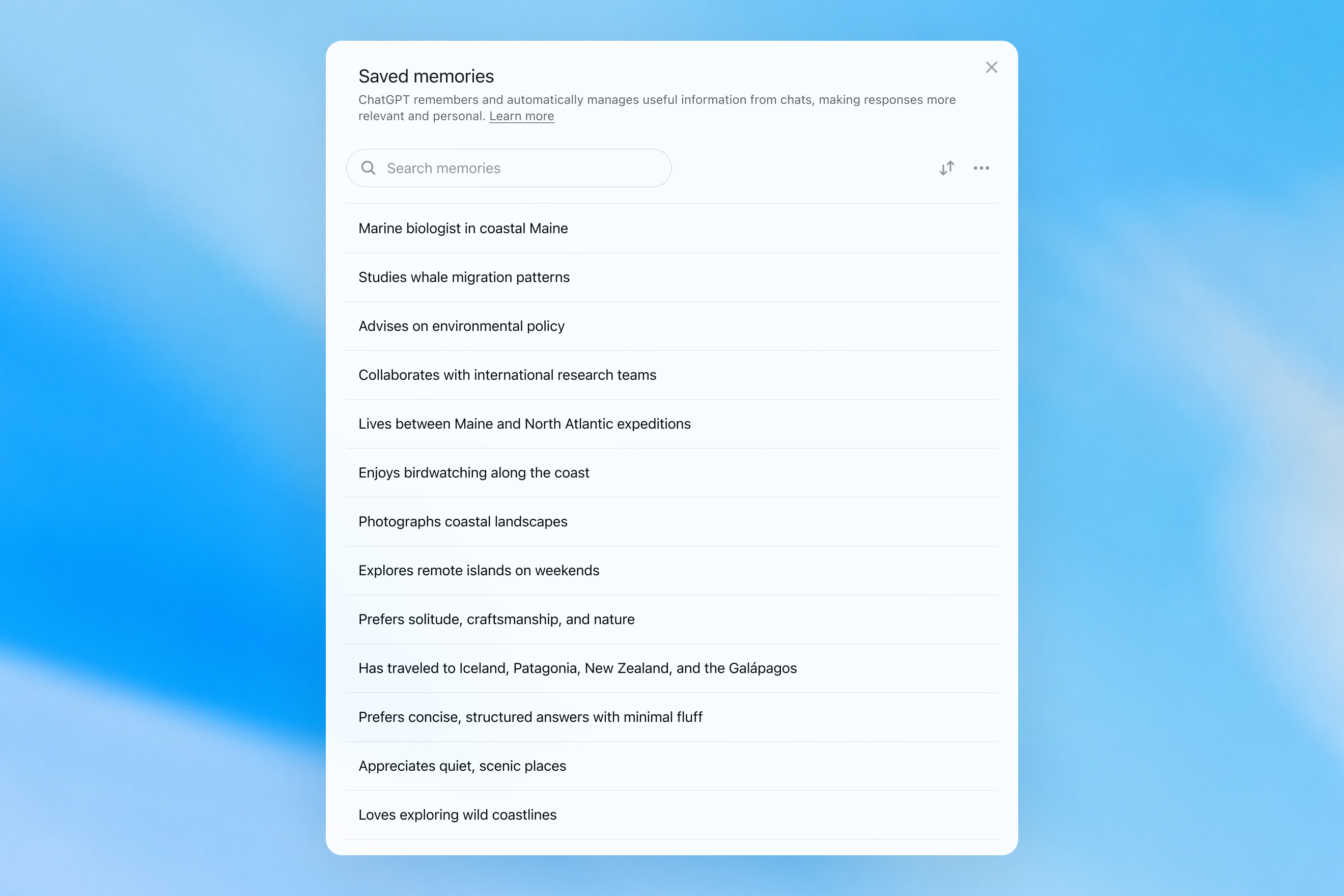
- What it teaches: the old representation, and why the failure is structural. Fourteen flat rows -
"Marine biologist in coastal Maine", "Studies whale migration patterns" - with no timestamp, no
expiry and no revision affordance on any row.
n1§How memory has evolved - Corroborated by: the prose describing exactly this decay.
Read that screenshot for what is absent rather than for what is present. No row carries a time. No row carries an expiry. No row offers any way to say that it used to be true. The data model has nowhere to put the information that a fact has aged. That is what makes this structural rather than a bug somebody forgot to fix, and it also determines what kind of damage the aging does.
A missing fact degrades an answer. A stale fact poisons it. The system acts on a stale fact with full confidence, because it has no way to know the difference. "I'm going to Singapore in July" is true in June and actively harmful in August.
In other words the two failures are not the same size and should not be traded off against each other. The system that has forgotten something answers worse and does so visibly, which gives the user a signal and a chance to repeat themselves. The system holding a stale fact answers fluently and plausibly about the wrong world. This asymmetry is not new, and the field that has thought hardest about it is not this one.
Background, supplied. This is the distinction between a cache miss and a stale cache hit, and every caching system treats them differently for the same reason. A miss is cheap and visible, because you simply go and fetch. A stale hit is silent. It returns confidently, it looks identical to a fresh hit, and the caller gets no signal at all. Caches answer this with invalidation, a TTL, or a version. This design is doing that same work, which is why section 5's choice between expiry and revision turns out to be the load-bearing one.
If the trouble starts at write time, the obvious remedy is to write better and to write more often. That is the first thing to try, and it is also the first thing that fails.
2. Capturing more does not fix it, because of what cues cannot catch#
flowchart TB
    M["capture more of the conversation"]
    C["cues improve: the system knows<br/>more about what was said"]
    S["staleness is untouched: everything<br/>captured is still captured<br/><i>at the moment it was said</i>"]
    R["so the extractor was never<br/>the bottleneck - n2"]

    M --> C
    M --> S --> R

    style S fill:#fee2e2,stroke:#b91c1c,color:#7f1d1d
This is an elimination diagram, not a critique of extraction. The crux is that capture quality and staleness are orthogonal, so improving the first moves the second not at all - a perfectly captured fact about your job in March is exactly as wrong in September as a poorly captured one. It is drawn with both consequences branching from the same action because the left branch is real: capturing more genuinely does improve cues, which is why the response feels productive and why the movement needs a section rather than a sentence to close it off.
Synthesized from n2.
The predecessor design tried exactly that remedy. Saved memories "relied on strong cues to decide when
to trigger memory, such as an instruction to 'remember I'm traveling to Singapore in July'", which felt
"like talking to someone who took a few notes, but still forgot everything that wasn't written down"
(n2, §How memory has evolved).
Look back at the screenshot in section 1 and the shape of the failure is visible in it. Every row reads as a discrete, dictatable fact. Not one of them reads as ambient context picked up in passing, and that absence is the tell, because ambient context is most of what a person actually reveals.
To see why a better trigger cannot close that gap, consider the three ways a preference reaches the
system at all. The post names the taxonomy, and naming it is the genuinely useful part
(n8, §Following preferences). ⚠️ This one is single-leg, because no figure corroborates it. First
there is the response instruction, such as "don't bring up Stan again", which arrives explicitly and in
the imperative, and which any cue-triggered capture will catch. Second there is the stated constraint,
such as "I'm vegetarian", which arrives explicitly and declaratively, and which is equally easy. The
third kind is different in nature rather than in degree. "I live near San Francisco" is never stated as
a preference at all. It is a fact about the world, mentioned once in passing, from which a preference
has to be inferred by whatever reads it later.
Compressed as a recap:
| Kind of preference | Example | How it is stated |
|---|---|---|
| Response instruction | "don't bring up Stan again" | Explicit, imperative - easy |
| Stated constraint | "I'm vegetarian" | Explicit, declarative - easy |
| Implicit preference | "I live near San Francisco" | Never stated as a preference at all |
The third row is where explicit capture structurally fails, and it is also the row doing the most work, because it governs relevance rather than any single answer. Nobody says "remember that I live near San Francisco, and therefore prefer local options". They mention where they live once, in passing, and then expect everything downstream to account for it.
So writing more aggressively during the turn does not help, because the problem was never the trigger. It is the turn.
Movement B - the architectural answer#
flowchart TB
    Q1{"when is memory written?"} --> A1["3. off the turn, on a<br/>background synthesis pass - n3"]
    A1 --> Q2{"then what shape should<br/>the stored thing take?"}
    Q2 --> A2["4. a <b>maintained narrative</b>, not an<br/>append-only list of facts - n4"]
    A2 --> Q3{"and what happens to an<br/>entry that goes stale?"}
    Q3 --> A3["5. <b>revise</b> it, rather than<br/>expire it - n5"]

    style A3 fill:#e8f0fc,stroke:#4285f4,color:#1a3a6b
This is a derivation diagram, not a feature list, and the three decisions hold for any cross-session memory whoever builds it. The crux is that each answer forces the next question: moving the write off the turn only helps if something can be rewritten, which rules out an append-only store, which in turn makes revision rather than expiry the natural handling of staleness. It is drawn as an alternating chain because presented as three features they look like independent product choices, and the dependency between them is what makes them transferable. This is the payload of the note.
Synthesized from n3, n4 and n5.
3. Move the write off the conversation, onto its own clock#
Dreaming is "a background process that allows ChatGPT to learn from many conversations and synthesize ChatGPT's memory state" (
n3, §How memory has evolved).
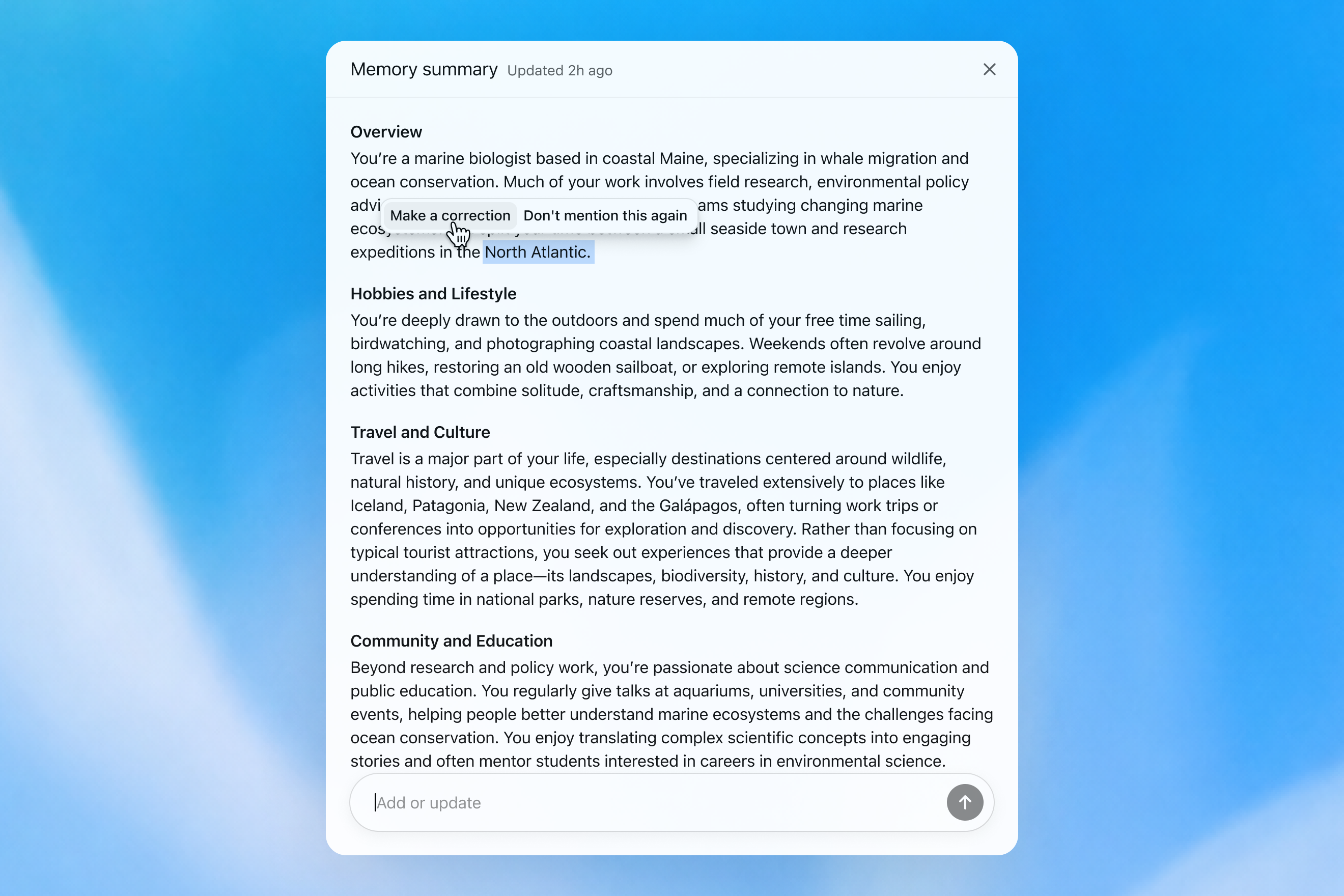
- What it teaches: the shipped result, and the detail that proves the decoupling. The header reads
"Memory summary - Updated 2h ago" - an update timestamp with no user action attached to it.
Something wrote to memory while nobody was talking.
n3n4§How memory has evolved - Corroborated by: the prose describing a background process synthesizing across many conversations.
That header is a small detail carrying a large amount of weight, so it is worth pausing on. An update time is only meaningful if some process updates. In the previous design there was no such process, and a timestamp would have had nothing to report except the moment a user dictated a fact. Here it reports work done while nobody was in the conversation at all.
💡 Dreaming - memory maintenance as a scheduled process between sessions, decoupled from the conversation turn. Named for sleep-time memory consolidation; the source cites none of that literature, so the analogy is framing rather than evidence.
The transferable claim is the decoupling, not the name. A write that only happens while the user is talking can only ever record the present tense of that talk. Giving some process the standing job of revisiting is therefore the only way that revision happens at all. There is no version of "extract better during the conversation" that produces an update to a fact recorded three months ago, which is why this is an architectural change rather than a tuning one.
Background, supplied. The general form here is a batch reconciliation process, and it buys the three things that batch reconciliation always buys. It sees across records that no single transaction can see. It sits off the latency path, so it can afford to be expensive in a way that a turn-time write never can. And the third one, which most people miss, is that it has exactly one objective. A process curating during the conversation is asked to serve the user and to maintain the store at the same time, and it will trade the second against the first silently, because only the first has a visible finish line. That third reason is not in this post. It is S7's contribution (
brain/claims.mdclaim 59), and it is the sharper argument.
A background process can now rewrite memory. But it can only rewrite what the storage shape allows it to express.
4. Representation is a maintenance decision, not a storage one#
flowchart TB
    L["<b>append-only fact list</b><br/><i>14 atomic assertions</i>"]
    X["nothing can be rewritten,<br/>only added to or deleted"]
    N["<b>maintained narrative</b><br/><i>a few sections, kept current</i>"]
    Y["a section can be <b>revised in place</b><br/>by a later pass - n4"]

    L --> X
    N --> Y

    style X fill:#fee2e2,stroke:#b91c1c,color:#7f1d1d
    style Y fill:#e8f0fc,stroke:#4285f4,color:#1a3a6b
This is a representation diagram, and the section title is the argument. The crux is that the shape of the stored thing decides what maintenance is possible on it, so choosing a list rather than a narrative silently rules out the fix before anyone reaches it. It is drawn as two parallel tracks because these are alternatives rather than stages, and the consequence rather than the structure is what distinguishes them. This generalises past memory: any store you intend to keep current has to be shaped so that revision is expressible, which an append-only log is not.
Synthesized from n4. The generalisation is this brain's.
The post supplies an unusually clean comparison for this, because it renders the same persona twice
(n4, §How memory has evolved). Walk the two renderings against each other on the three questions that
matter for maintenance.
The first question is what shape the memory takes. In the old design it is fourteen flat atomic assertions, and in the new one it is four sections of narrative prose about the same person. The second question is who wrote it and when. The old rows were written during a conversation, on an explicit cue from the user. The new sections were written by a background pass on its own clock, which is what section 3 established. The third question is the one the first two exist to set up, and it is whether either shape can be revised. The list has no revision affordance at all, whereas the narrative is rewritten in full on every pass, so revising it is not a special operation but the only operation there is.
Compressed as a recap:
| Saved memories | Memory summary | |
|---|---|---|
| Shape | 14 flat atomic assertions | 4 narrative prose sections |
| Written | during the conversation, on explicit cue | by a background pass, on its own clock |
| Revisable | no affordance exists | the whole artifact is rewritten each pass |
The generalisable rule is to pick the representation whose edits you can express. You cannot rewrite row 7 of an append-only list into the past tense when nothing owns that list, because there is no process whose job it is and nowhere for the qualification to go. You can rewrite a clause in a paragraph that some process is responsible for maintaining.
Notice how much stronger that is than the aesthetic version of the same observation. The list form is not merely less readable. It makes the required operation inexpressible, which is a claim about capability rather than taste. The lesson to carry off is to choose a data model for the writes you will need to make, and not only for the reads.
Which leaves the question of what the rewrite should actually do once it is possible.
5. Revise, do not expire#
flowchart TB
    S["an entry has gone stale"]
    E["<b>expire it</b><br/><i>you lose that the fact was<br/>ever true, and when</i>"]
    R["<b>revise it</b><br/><i>the entry carries its own history<br/>and stays usable</i> - n5"]
    T["expiry treats staleness as an error.<br/>Revision treats it as a change."]

    S --> E --> T
    S --> R --> T

    style R fill:#e8f0fc,stroke:#4285f4,color:#1a3a6b
    style T fill:#dcfce7,stroke:#15803d,color:#14532d
This is a policy diagram, not a mechanism. The crux is that expiry and revision encode different beliefs about what a stale memory is: an expiring store treats the old value as wrong, and a revising store treats it as previously right. It is drawn as one condition with two handlings because the choice is genuinely available and most systems take the first without noticing they chose. The consequence worth carrying is that a person's history is often the useful part, and a store that deletes on staleness throws away exactly the trajectory that makes the current value make sense.
Synthesized from n5. The framing of the two policies is this brain's.
"memories are automatically updated as time passes, allowing ChatGPT to revise its memory from 'You're going to Singapore in July' to 'You went to Singapore in July 2026' when the trip ends" (
n5, §Staying current over time). - Corroborated by: the paired worked example in the same section - the stale answer opens "It's about 5:19 AM Sunday in Singapore", the maintained answer opens "I'll use Portola Valley / Ladera as the starting point".
That pair is the clearest thing in the post, because it shows the failure behaving normally. The stale answer is not garbled and it is not hedged. It is fluent, confident, and about the wrong continent, which is precisely the shape section 1 predicted.
This is a real design choice with a real alternative, and the alternative is the one most engineers would reach for first. Suppose instead of revising you expired. A time-to-live on each memory would certainly stop the system from answering in Singapore time in August. It would also delete the fact that the trip happened, so the assistant would afterwards know nothing about a journey the user actually took. Revision keeps the fact and changes its tense, so "went to Singapore in July 2026" remains usable afterwards. It has become biography instead of plans.
Expiry treats age as invalidity; revision treats age as information. That is why a TTL is the wrong instrument here even though staleness is the problem: a TTL assumes old facts stop being true, when most stop being current while remaining perfectly true about the past.
The machine can now keep itself current without losing what it knew. So where does the human fit into a store that maintains itself?
Movement C - where the human sits#
flowchart TB
    R["the raw records"]
    S["the synthesized summary"]
    U["correction is offered <b>here</b> - n6"]
    Q["which leaves an open question the<br/>design does not answer: what happens<br/>to the records a correction contradicts?"]

    R --> S --> U --> Q

    style U fill:#dcfce7,stroke:#15803d,color:#14532d
    style Q fill:#fbf1dc,stroke:#b45309,color:#78350f
This is an interface diagram, not a data flow, and it is the one place the design admits a question rather than answering it. The crux is that correcting the summary is right for the user and leaves the underlying records untouched, so the next synthesis pass can reintroduce what was just corrected. It is drawn ending on a question because that is the honest state: the source shows where correction happens and does not say what it propagates to. The movement is short and worth its length, since this is the seam where a maintained narrative and an append-only substrate meet.
Synthesized from n6. The open question is this brain's reading.
6. Correction goes on the summary, not the records#
Look again at the summary screenshot from section 3. Selecting a sentence raises Make a correction
and Don't mention this again, and the modal carries an Add or update composer (n6, §How
memory has evolved). The correction lands on the synthesized narrative, and not on the records beneath
it.
That placement looks like an interface detail and it is really a consequence of everything before it. It is the only tractable choice once a background process is authoring. Asking a user to hand-curate an append-only fact table is asking them to redo the job you just automated, and to redo it in a representation that section 4 established cannot express a revision at all. The summary is the only surface where the edit the user wants to make is even sayable.
But note the unresolved consequence. Nothing says whether a correction is a durable override or another input to the next synthesis pass. That difference is the difference between user control and the appearance of it. If the next pass can quietly re-derive what you corrected, the button is a suggestion box.
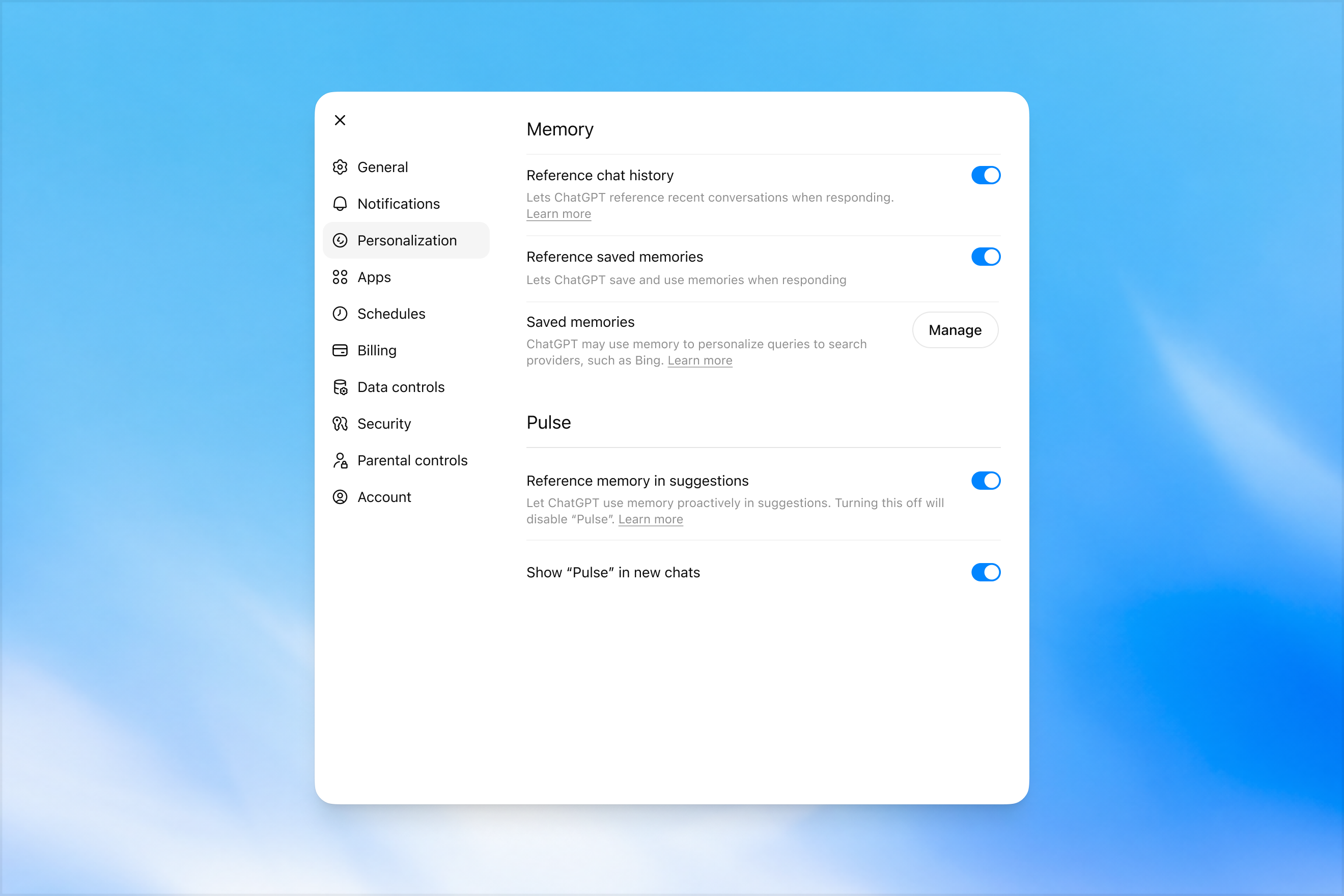
- What it teaches: memory ships as governable surface rather than as an implementation detail -
five switches, including one controlling proactive use ("Reference memory in suggestions...
turning this off will disable Pulse").
n11§How memory has evolved - Corroborated by: the prose describing the summary as reviewable and instructable.
The settings panel makes the same point at a coarser grain, which is that memory here is treated as
something a user governs rather than as an implementation detail they experience. But it also quietly
complicates the article's own framing, and that is worth reading carefully (n10). The prose presents
a new architecture "built on top of dreaming" as the memory foundation, which is replacement
language. The shipped panel still exposes Reference saved memories as its own toggle beside
Reference chat history. This is not a contradiction, and nodes.md is deliberately careful not to
file it as one, because the article never claims the old store was removed. It is a completeness
gap. Nothing anywhere says what the write-once store is still for, or which store wins when the two
disagree.
Movement D - measuring a fuzzy quality#
flowchart TB
    G["'good memory'"]
    O1["is it <b>relevant</b>?"]
    O2["is it <b>current</b>?"]
    O3["is it <b>used well</b>?"]
    N["three objectives, not one metric - n12"]
    F["and the figures are exact while the<br/>methodology behind them is<br/>entirely undisclosed"]

    G --> O1 --> N
    G --> O2 --> N
    G --> O3 --> N
    N --> F

    style F fill:#fbf1dc,stroke:#b45309,color:#78350f
This is a measurement diagram, not a results table. The crux is that "good memory" decomposes into three objectives that can move independently, so a single number describing it is hiding which one it measured. It is drawn fanning out because the decomposition is the useful part and the figures are the part to hold loosely. The amber terminal names an unusual pairing that needs handling rather than a caveat: exact percentages with no stated methodology are not a weak measurement, they are an unreproducible one, and the difference matters when deciding what may be cited.
Synthesized from n12 and n13.
7. Three objectives, because "good memory" is not one thing#
The design is now settled, so the remaining question is how anyone would know whether it worked. The
post's answer is the most portable frame in it, and the part most likely to outlive the product (n7,
§How we evaluate memory). It refuses to measure "memory quality" as one number and asks three separate
questions instead.
The first is whether context carries forward, which asks whether something told once is still known later. That is the recall question, and it catches under-capture. The second is whether preferences and constraints are followed, which asks a different thing entirely, because it asks whether behaviour changes to match. That one catches capture without application, and it is the split most single-number evaluations lose. The third is whether the system stays current over time, which asks whether the answer changes when the world does. That is staleness, and it is the objective section 1 argued was doing the most damage.
Compressed as a recap:
| Objective | The question it asks | The failure it catches |
|---|---|---|
| Carry forward useful context | Told once, is it still known later? | Under-capture |
| Follow preferences and constraints | Does behaviour change to match? | Capture without application |
| Stay current over time | Does the answer change when the world does? | Staleness |
Row two is worth dwelling on because it separates recall from compliance. A system can retrieve "I'm vegetarian" perfectly and still recommend a steak house, and a single "memory accuracy" number hides that failure completely. Row three is the one most memory evaluations omit, and the reason is mechanical rather than careless. It is the only objective that requires a test case where the correct answer changes with the passage of time while the stored fact does not, and building that case costs more than writing another recall probe.
This is the same move this brain records in
evals.mdfrom a different domain: making a subjective quality gradable by fixing the question rather than finding a better judge. S4 does it to "is this design beautiful?"; S6 does it to "is the memory good?". Neither improves the grader; both decompose the question until each part has a nameable failure mode.
Three objectives with three published charts each, then. What do the charts actually say?
8. What the numbers say, and what they hide#
flowchart TB
    N["a <b>9.4%</b> staleness baseline - n13"]
    A["what it supports:<br/>the diagnosis is real, and the<br/>system was wrong roughly<br/>nine times in a hundred"]
    B["what it does not support:<br/>any comparison, because no<br/>methodology is disclosed"]
    C["exact figures with undisclosed method<br/>are <b>unreproducible</b> rather than weak,<br/>and that is a different thing"]

    N --> A
    N --> B --> C

    style B fill:#fbf1dc,stroke:#b45309,color:#78350f
    style C fill:#fbf1dc,stroke:#b45309,color:#78350f
This is an evidence diagram, not a results summary. The crux is that this number does real work and supports nothing comparative, because a percentage without a stated method cannot be checked, matched or beaten. It is drawn splitting a single figure into what it can and cannot carry, because the temptation with an exact-looking number is to use it for both. The 9.4% is genuinely what turns the staleness diagnosis from rhetoric into something measured, and it is also the only quantitative support the memory topic has anywhere in this brain, which is a reason to hold it carefully rather than to lean on it.
Synthesized from n13.
Start with how these numbers were obtained, because it is unusual and it bears on how far they can be
pushed. Each objective has a published chart, and none of them render in a static capture. They are
Vega-Lite components whose specifications, data arrays included, are embedded in the page's own
payload, and they were recovered from there (d1, chart_data.json). Task success, in percent:
| Objective | 2024 saved memories | 2025 + Dreaming V0 | 2026 Dreaming V3 | Total gain |
|---|---|---|---|---|
| Factual recall | 41.5 | 67.9 | 82.8 | +41.3 |
| Preference adherence | 31.4 | 55.3 | 71.3 | +39.9 |
| Staying correct over time | 9.4 | 52.2 | 75.1 | +65.7 |
Three readings follow that the article itself never states, and the first is the reason section 1's
diagnosis is more than rhetoric. Staleness was catastrophic rather than merely suboptimal (n13).
A 9.4% baseline describes a system that was wrong about time-sensitive facts nine times in ten,
and it is the only quantitative support anywhere in this topic for the write-once diagnosis.
The second reading is about where the value came from. Introducing dreaming beat improving it
(n14). The 2024 to 2025 step wins on every objective, by +26.4 against +14.9 on recall, +23.9 against
+16.0 on preferences, and +42.8 against +22.9 on staleness. In other words the architectural move
carries the value, and the V0 to V3 work is refinement on top of it. That is a useful thing to know
before deciding whether to copy the architecture or to invest in a better extractor.
The third reading is the one to carry into any design that depends on memory, and it is a warning rather than an endorsement. The ceiling is low. The 2026 generation tops out between 71% and 83%, so memory still fails roughly one task in five on the vendor's own measure, using the vendor's own definition of success. Any design that assumes memory is reliable should be carrying that number explicitly.
⚠️ Precise extraction, opaque method - handle those two facts together. These come from the publisher's own chart specs, so the figures are exact and there is no transcription risk. But "task success" is never defined, and no sample size, eval set, methodology or confidence interval is published anywhere. They are a vendor's directional self-report about its own product, not a benchmark result. Exactness is not evidence - and it makes them easier to over-trust than a rounded figure would be.
Diagram (mental model)#
flowchart LR
    subgraph TURN["during the conversation - one clock"]
        C["Conversation"] -->|"writes in the<br/>PRESENT TENSE"| RAW[("Raw records")]
    end
    subgraph BG["between sessions - a second clock"]
        D{{"Dreaming<br/>reads across MANY sessions<br/>synthesizes"}}
    end
    RAW --> D
    D -->|"rewrites the whole artifact"| SUM[("Memory summary<br/>maintained narrative")]
    SUM -->|"read at answer time"| C
    H(("Human")) -->|"Make a correction<br/>on the SUMMARY"| SUM
    SUM -.->|"durable override,<br/>or just another input?"| D

    style D fill:#cfe8cf
    style SUM fill:#e8f0fc
    style TURN fill:#f7f7f7
Read the two boxes first, because they are the two clocks and that separation is the entire design. Green is the background process and blue is the artifact it maintains, while the dotted arrow is the unresolved question from section 6 rather than a shipped mechanism. The crux is that the only arrow which can change an existing memory starts in the green box, and the green box is the one that does not run while you are talking.
The shape rewards a second look at where the human's arrow lands. It lands on the summary and not on the raw records, because correcting the inputs to a synthesis you did not perform is not a job anyone can actually do. Raw records meanwhile flow into dreaming and are never edited by it, so the conversation-time store stays append-only while all maintenance happens in the derived layer. That is what makes the rewrite safe to run repeatedly, since a pass that mutated its own inputs would compound its errors every night. And the dotted arrow is drawn as a question rather than as an edge on purpose, because whether a correction survives the next pass decides whether the human is in control or filling in a feedback form, and the source does not say which.
Synthesized from n1, n3, n4, n5, n6 - not a figure from the post.
💡 Terms#
| Term | Explanation |
|---|---|
| Dreaming | Memory maintenance as a background process on its own clock: reads across many past sessions and rewrites the memory state between them, rather than appending during one. |
| Saved memories | The write-once predecessor: a flat, append-only list of atomic assertions written during a conversation on an explicit cue and never revisited. The shape that makes staleness structural. |
| Memory staleness | A stored fact that was true when written and is false now. A missing fact degrades an answer; a stale fact poisons it, because the system acts on it with full confidence. |
| Implicit preference | Context governing what is relevant but never uttered as an instruction ("I live near San Francisco"). The category explicit-cue capture structurally misses. |
| Revision over expiry | Rewriting a stale memory into a new tense rather than deleting it. Expiry treats age as invalidity; revision treats age as information. |
| Memory summary | The synthesized narrative of what the system believes about a user, and the surface on which correction is offered in place of the underlying records. |
What to distrust in this note#
- A T2 vendor publishing evaluations of its own consumer product. Every number is self-reported and none is independently replicated.
- Exact figures, undisclosed method. Extraction from the page's own chart specs is exact, so there is no transcription risk - but "task success" is never defined and no sample size, eval set, method or confidence interval appears anywhere. Precision is not evidence.
- The screenshots are a genuinely good second leg, and there is exactly one thing they prove. A UI photograph is not the author restating himself in another rendering - it is evidence the described affordance shipped. It says nothing about whether the mechanism works, or how well.
n8,n9andn14aresingle-leg: the preference taxonomy, the ~5x serving-cost reduction, and the delta arithmetic.n14is computed overn12, so it inherits every limit above.- Do not borrow these numbers to settle claim 24. They measure a chat assistant's recall and
freshness about a user, not an agent's task reliability over long horizons. Different memory
design, different system class, different metric. See
memory.md. - The "Background, supplied" blocks are mine - cache miss versus stale hit, and batch reconciliation's three benefits. Uncited by construction.
Open questions#
- What is "task success"? Undefined, and it carries the entire quantitative case. The highest-value deep-research target on this source, though the answer may simply not be public.
- Does a user correction survive the next synthesis pass?
n6establishes the affordance; nothing establishes whether it is a durable override or another input. Control, or the appearance of it. - What is the write-once store still for? Both toggles still ship (
n10), and nothing says which wins on disagreement or whether saved memories feed dreaming. - Is the sleep analogy load-bearing or decorative? Cognitive science has an established literature on offline replay and schema formation that would predict which parts of this design generalise, and the post cites none of it. S8 calls the same operation lint, which is mild evidence the metaphor is decoration.
- What does the background pass cost per user, and how often does it run?
n9gives a ~5x reduction with no absolute figure and no cadence.
Feeds these topics#
../../brain/topics/memory.md- the founding source: staleness as structural, decoupled curation, revision over expiry, representation as a maintenance decision, the three-objective frame.../../brain/topics/context-engineering.md- memory as an input to the context problem.../../brain/topics/evals.md- decomposing a fuzzy quality into separately-gradable objectives.
Presentation narrative#
A talk track for a team building cross-session memory, derived entirely from the gated nodes above. It is a vendor product post, and its one quantitative claim carries an exact figure with no disclosed methodology, which the last slide handles rather than buries.
Slide 1 - The failure is staleness, and staleness is not irrelevance#
Memory written during a conversation is written in that conversation's tense, nothing ever revisits it, and it decays into confident wrongness rather than into uselessness [n1]. That distinction is the whole contribution and it is easy to slide past.
An irrelevant memory degrades gracefully: it gets retrieved, it adds nothing, and the answer is roughly as good as it would have been. A stale memory is retrieved with exactly the same confidence as a correct one, and the answer is now wrong in a way nothing flags. A fact about where you worked in March is not less relevant in September. It is false, and the system does not know.
This is the old shape, and its problem is not visible in it. The crux is that nothing in this list
carries a time, a source or a way to be rewritten [n1].
Slide 2 - Capturing more cannot fix it, because the extractor was never the bottleneck#
Capture quality and staleness are orthogonal. Improving what the system notices genuinely improves cues, which is why this is the response everyone reaches for first and why it feels productive.
It moves staleness not at all. Everything captured is still captured at the moment it was said, so a perfectly extracted fact ages exactly as badly as a poorly extracted one. The question this reframes for a team is therefore not how to notice more, but when the noticing gets revisited - and in most memory systems the answer is never.
flowchart LR
    M["capture more"] --> C["better cues"]
    M --> S["staleness: <b>unchanged</b>"]
    S --> R["the extractor was never<br/>the bottleneck - n2"]
    style S fill:#fee2e2,stroke:#b91c1c,color:#7f1d1d
This is an elimination slide. The crux is that the left branch is real - capturing more genuinely improves cues - which is why this response feels productive while moving staleness not at all.
Slide 3 - The fix is a second clock, not a better extractor#
Staleness is a property of when you write, not of what you store, so the write moves off the turn onto a background synthesis pass [n3]. That single relocation is the architectural answer, and the rest follows from it.
Two more decisions are forced rather than chosen. Moving the write off the turn only helps if something can be rewritten, which rules out an append-only list and gives you a maintained narrative instead [n4]. And once entries can be rewritten, the natural handling of a stale one is to revise it rather than expire it [n5]. Expiry treats the old value as wrong; revision treats it as previously right, which preserves the trajectory that makes the current value make sense.
This is the new shape, and the header is the tell. The crux is "Updated 2h ago": the store now has a
maintenance time distinct from the conversation that produced it [n4].
Slide 4 - Correction goes on the summary, and that leaves a real question open#
The user corrects the synthesized narrative rather than the raw records [n6]. For the person using it that is obviously right: the narrative is what they can read, and asking somebody to edit atomic assertions is asking them to debug a database.
It leaves something unresolved, and this is the one place the design admits a question instead of answering it. If the records a correction contradicts are untouched, the next synthesis pass can reintroduce exactly what was just corrected. The source shows where correction happens and does not say what it propagates to. That is the seam to ask about before copying this pattern.
This is the control surface, and five switches is itself a finding. The crux is that memory is not
one capability to toggle - storing, retrieving and proactively volunteering are separate decisions
[n7].
Slide 5 - "Good memory" is three objectives, and a single number hides which one moved#
Relevance, currency and use are separable and can move independently [n12]. A system can get more current while getting less relevant, and any single metric describing memory quality is reporting one of the three without saying which.
For a team building this, the useful consequence is that you need three measurements and a policy for trading them, not a quality score. That is more work up front and it is the difference between knowing your memory got better and knowing it got different.
flowchart TB
    G["'good memory'"] --> A["relevant?"]
    G --> B["current?"]
    G --> C["used well?"]
    N["three objectives that move<br/>independently - n12"]
    A --> N
    B --> N
    C --> N
    style N fill:#e8f0fc,stroke:#4285f4,color:#1a3a6b
This is a decomposition slide, not a scorecard. The crux is that a single number describing memory quality is reporting one of these three without saying which, so you need three measurements and a policy for trading them.
Slide 6 - The one number does real work and supports no comparison at all#
Their own evals put staleness at a 9.4% baseline, and that figure is what turns the diagnosis from rhetoric into something measured [n13]. It is also the only quantitative support the memory topic has anywhere in this brain, which is a reason to handle it carefully rather than to lean on it.
The methodology behind it is entirely undisclosed. That is worth naming precisely, because an exact number with no stated method is not a weak measurement - it is an unreproducible one, and the difference decides what you may do with it. You can cite it as evidence that staleness is real and common. You cannot use it as a baseline, a target, or a comparison against your own system, because there is nothing to match.
So the verdict is adopt the diagnosis and the three design decisions, which hold for any cross-session memory whoever builds it, and treat every figure as an unverifiable vendor report. Before copying the pattern, settle the question slide 4 raises: what a correction propagates to.
This is what the argument produces, shown once more for the decision. The crux is that everything
defensible here is in the shape of this artifact, and everything numeric is not [n4, n13].
Key takeaway message#
Memory written during a conversation is written in that conversation's tense and nothing revisits it, so it decays into confident wrongness rather than into uselessness - and a stale entry is retrieved with exactly the confidence of a correct one. That makes staleness a property of when you write rather than of what you store, which is why capturing more never touches it. The answer is three coupled decisions: move the write onto a background pass, store a maintained narrative rather than an append-only list so revision is expressible at all, and revise stale entries instead of expiring them. Correction belongs on the summary, and what it propagates to is the question the design leaves open. The 9.4% staleness baseline makes the diagnosis real and, with no methodology disclosed, supports no comparison whatsoever.