source
OAuth 2.0 and OpenID Connect (in plain English)
Nate Barbettini (Okta) / OktaDev
About this note
Persona: curator + mentor, always. Re-adopt when working this file.
The distilled document you learn from - text anchored by a few curated visuals. Built from the corroborated nodes in
nodes.md. Every claim is cited. Signal, not archive. SeeSOURCE.mdfor metadata - including the age warning: this talk is from 2018 and one recommendation in it has since been reversed. See "What has aged" before you apply anything here.Two kinds of material, kept visually distinct. Claims from the talk carry a node ID (
n5) and a timestamp. Blocks marked "Background, supplied" are context I am adding - established prior art the talk assumes or never names. They are uncited by construction and are not evidence about this source.
On this page
TL;DRThe 1-minute versionKey claimsWhat you will learn, and in what orderMovement A - why the subject feels harder than it is1. The confusion is structural, and it is not your fault2. The problem, in one screenshot3. What OAuth was aimed at, and what it left openMovement B - the protocol, once4. The vocabulary is renames, and that is the whole barrier5. The authorization code flow, which is the entire protocol6. The crux: front channel versus back channelMovement C - everything else is a variation7. The four flows are one question: which channels do you have?8. Why OpenID Connect had to exist9. The rule for choosingWhat has aged (read before applying)Diagram (mental model)💡 TermsWhat to distrust in this noteOpen questionsFeeds these topicsPresentation narrativeSlide 1 - OAuth solves exactly one problem, and everything else is machinerySlide 2 - One security fact generates the entire structureSlide 3 - The vocabulary is renames, and that is the entire barrierSlide 4 - Scopes are what the consent screen is generated fromSlide 5 - The four flows are one question, not four designsSlide 6 - This source is from 2018, and one of its recommendations has reversedKey takeaway messageTL;DR#
OAuth 2.0 solves exactly one problem, which is letting an app act on your behalf without giving it your password. Everything else in it is machinery in service of that, including the jargon, the four flows and the two-step token dance. The shape of that machinery is dictated by a single security fact, namely that the browser can be trusted to talk to a human, but not to hold a secret. OpenID Connect is a thin layer bolted on top, because the industry started using OAuth for login, which it was never built for, and OAuth has no way to say who you are. Learn the authorization code flow and you have learned the protocol &t=1323s.
flowchart TB
    F["<b>the security fact</b><br/>the browser can be trusted to talk to<br/>a human, but not to hold a secret"]
    C["so the protocol splits into two channels:<br/>a <b>front</b> channel through the browser<br/>and a <b>back</b> channel between servers"]
    O["one flow - authorization code -<br/>uses both"]
    V["and the other three flows are that flow<br/>with a channel removed"]
    I["OIDC is bolted on because OAuth has<br/>no way to say <i>who you are</i>,<br/>and the industry used it for login anyway"]

    F --> C --> O --> V
    C --> I

    style F fill:#e8f0fc,stroke:#4338ca,color:#312e81
    style V fill:#dcfce7,stroke:#15803d,color:#14532d
This is a derivation diagram, not a protocol diagram, and it draws why the specification has the shape it does rather than what the shape is. The crux is that a single fact about browsers generates the entire structure, including the jargon and the flow count, so there is really only one flow and three degradations of it. It is drawn descending from the security fact rather than starting at the flows because the usual failure with OAuth is meeting four flows as four options and trying to memorise which to pick. Read this way the choice stops being a lookup and becomes a question about which channels you actually have. OIDC hangs off the side deliberately: it is not part of the derivation, it is a patch for a use the protocol was never built for.
Synthesized from n1, n6 and n8.
The 1-minute version#
This article covers a 2018 conference talk that explains OAuth 2.0 and OpenID Connect from first principles, for engineers who have already integrated one of them and never quite felt they understood it. It spends most of its time on a single protocol flow, in detail, and then shows that the remaining flows and the whole of OpenID Connect are that one flow with pieces removed or a word added. That is an unusually strong claim for an introductory talk to make, so the first thing worth establishing is what the protocol was invented to do.
It was invented to kill password sharing. Before 2010, an application that wanted to read your
contacts asked you to type your email password into its own signup form, and enough people did it
that the pattern became normal (n1). The failure here is not that any particular company was
untrustworthy. A password is an all-or-nothing credential that cannot be narrowed, cannot be expired
independently, and cannot be taken back without changing it everywhere, and it sits on the account
that is the recovery path for every other account you own. That much is easy to see. What is much
less obvious is why fixing it needed a whole protocol.
The reason is that the fix has to be delivered through a channel nobody controls. What is needed
instead of a password is a narrow, expiring, independently revocable permission, and issuing one is
not the hard part. The hard part is that only the human can authorise the grant, the human is sitting
at a browser, and the browser is the one component in the system that can be observed. Anything the
browser carries ends up in the address bar, in browser history, in Referer headers and in server
logs. So the design has to route a human decision through an untrusted courier and still come out
holding a secret at the end.
At first glance you could avoid all of this by simply asking the app to behave. That is roughly what the pre-OAuth world did, and it collapses in three ways at once. The app has to store your password to keep using it, so a later breach of the app is a breach of your email. Nothing in the arrangement can express "only my contacts", because a password grants whatever the identity grants. And there is no way to withdraw one app's access without withdrawing everything, since there is nothing to withdraw other than the password itself. Each of those failures points at the same missing thing, which is a credential that is not the identity.
That credential is the access token, and the idea around it is delegated authorization. The client
names the permissions it wants as scopes, the authorization server generates the consent screen
from that request rather than hand-writing it, and the token it eventually issues is bound to
exactly the scopes the human approved and nothing more (n7). The human therefore approves an
enumerated list rather than a vague connection, and the app ends up holding something narrower than
you.
How that token reaches the app is where the browser problem gets answered. The design splits the
world into a front channel, which is the browser and is treated as permanently observable, and a
back channel, which is one server calling another over TLS (n6). The browser does the thing
only a browser can do, which is talk to the human, and the server does the thing only a server can
do, which is hold a secret. The joint between them is the authorization code, and the code is
deliberately useless on its own. It crosses the browser in the open precisely because redeeming
it requires a client_secret that never leaves the back channel (n5). Once you have that, the
other three grant types stop being four philosophies and become four answers to one question, which
is which channels this particular client actually has (n8).
What the design costs is paid in the cases where a client does not have both channels, and in what
OAuth deliberately never covered. OAuth reasons about permissions and has no standard way to say
who the user is, so when the industry started using it for login anyway, every provider bolted on
its own proprietary user-info mechanism and interoperability quietly disappeared (n12). OpenID
Connect closes that gap, and the striking part is how little it costs on the wire, which is one extra
scope in the request and an ID token in the response (n14). The cost that lands hardest, though, is
the one this note has to warn about rather than teach.
How far to trust it splits along a line worth naming. The mechanics in this talk are current, and it remains the clearest explanation of them available, so the flow diagrams, the scopes, the JWT structure and the grant types can be taken at face value. One recommendation has been reversed, which is the implicit flow for single-page apps, and "What has aged" below is where that is worked through. Beyond that, note the asymmetry running through the whole source, which is that the mechanics corroborate easily and travel poorly, while the judgement corroborates poorly and travels well.
The same argument, compressed for reference rather than for reading:
| The problem | To let an app act on your behalf you handed it your password - an all-or-nothing, non-scopable, non-revocable credential on the account that is the recovery path for every other account you own (n1). |
| Why the obvious answer fails | You cannot fix it by trusting the app more. A password is ambient authority; what is needed is a capability - narrow, expiring, revocable independently of the identity. |
| The idea | Delegated authorization: a token bound to named permissions (scopes), issued after the human approves a consent screen generated from the request (n7). |
| The crux | The browser can talk to a human but cannot hold a secret. That single fact dictates the whole shape: the front channel carries the human interaction, the back channel carries anything secret (n6). |
| How it works | The authorization code is deliberately useless - it crosses the browser in the open precisely because redeeming it needs a client_secret that never does (n5). Learn that one flow and the other three are it with a channel removed (n8). |
| Where OIDC fits | OAuth has no standard way to say who the user is, so the industry bolted on proprietary login and broke interoperability. OIDC closes that gap and costs one extra scope on the wire (n12, n14). |
| How far to trust it | Mechanics are current and unusually clear. One recommendation has been reversed - implicit flow for SPAs; see "What has aged". And note the asymmetry: the mechanics corroborate easily and travel poorly; the judgement corroborates poorly and travels well. |
Key claims#
- The original sin OAuth kills: password sharing. Pre-2010, "let this app see my contacts" meant
typing your Gmail password into a startup's signup form.
n1&t=648s - OAuth was built for delegated authorization, not login. That is the whole origin story, and
every later confusion traces back to it.
n2&t=539s - The terminology is renames of ordinary things. Resource owner = you. Client = the app.
n3&t=973s - The two-step code exchange exists because of the front channel. The code crosses the browser
in the open; it is useless without the
client_secret, which never does.n5&t=1937s - The four grant types differ only in which channels they use.
n8&t=2597s - OpenID Connect is a ~5-10% layer on OAuth, not a successor. It replaces misusing OAuth for
authentication, nothing else.
n13,n16&t=2979s - On the wire, OIDC is one extra scope. Ask for
openidand you get an ID token back.n14&t=3072s - You are not stupid for finding this confusing. The spec has genuine wiggle room, and half the
material online describes a misuse.
n20&t=385s
What you will learn, and in what order#
flowchart TB
    subgraph A["A. Why the subject feels harder than it is"]
        S1["1 - The confusion is<br/>structural, not yours"]
        S2["2 - The problem:<br/>password sharing"]
        S3["3 - What OAuth<br/>was aimed at"]
    end
    subgraph B["B. The protocol, once"]
        S4["4 - Vocabulary:<br/>renames, not concepts"]
        S5["5 - The authorization<br/>code flow"]
        S6["6 - THE CRUX<br/>front vs back channel"]
    end
    subgraph C["C. Everything else is a variation"]
        S7["7 - Four flows =<br/>which channels you have"]
        S8["8 - Why OIDC<br/>had to exist"]
        S9["9 - The rule<br/>for choosing"]
    end
    subgraph D["D. Reading a 2018 source in the present"]
        S10["What has aged:<br/>implicit flow reversed"]
    end
    A --> B --> C --> D
    S1 --- S2 --- S3
    S4 --- S5 --- S6
    S7 --- S8 --- S9

    style B fill:#e8f0fc
    style D fill:#fbf1dc
This is a reading-order diagram about the note rather than about OAuth, and every box is a numbered section below, gathered into four movements. Blue marks the protocol itself, and amber marks the age check that a 2018 source needs before any of it is applied. The crux is that there is only one flow, and the other three are it with a channel removed.
Movement A does no protocol work at all, and that is deliberate. The usual failure with OAuth is not difficulty but demoralisation, because people conclude they are slow when they have in fact been reading material that contradicts itself. If you already believe the confusion is structural rather than yours, you can move straight to movement B, and it will cost you nothing but the diagnosis.
Movement B is the payload and the one place to slow down. It teaches the vocabulary, then the authorization code flow in full, then the front-channel-versus-back-channel distinction that makes the flow's odd two-step shape inevitable rather than bureaucratic. Section 6 in particular is the load-bearing idea, because it is the one that turns every subsequent design choice into something you can derive instead of memorise. Skimming it will still leave you able to implement the flow, and it will leave you unable to work out why any of the other flows are shaped the way they are.
Movement C then costs almost nothing, which is the point of having spent so long on B. Each item in it is a deletion from the flow you have already learned rather than new material, so the four grant types, the reason OpenID Connect had to exist, and the rule for choosing between them all follow from one picture. Movement D is separated out rather than folded into the walkthrough for a single reason, which is that this source is eight years old and a reader who stops early must still not miss the recommendation the field has since reversed.
Synthesized roadmap of this note - not from the source.
Movement A - why the subject feels harder than it is#
flowchart TB
    C["the confusion is <b>structural</b><br/>and not the reader's fault"]
    R1["the spec renames familiar things<br/>rather than adding new ones"]
    R2["and it is routinely explained<br/>flow-first, as four options<br/>to choose between"]
    P["meanwhile the actual problem is small:<br/>let an app act on your behalf<br/>without giving it your password"]

    C --> R1
    C --> R2
    P --> D["everything else is machinery<br/>in service of that"]

    style P fill:#dcfce7,stroke:#15803d,color:#14532d
This is an orientation diagram, not protocol content, and this movement does no protocol work at all by design. The crux is that the difficulty is presentational rather than conceptual: the problem OAuth solves fits in one sentence, and almost every explanation opens somewhere else. It is drawn with the two sources of confusion separated from the problem statement because they are independent failures - renaming makes the vocabulary opaque, and flow-first teaching makes the structure look arbitrary. A reader who already knows what problem OAuth solves can move straight to Movement B.
Synthesized from n1 and the sections below.
1. The confusion is structural, and it is not your fault#
Start here, because most people arrive at OAuth already convinced they are missing something obvious.
They are not. The protocols are hard to learn for a structural reason. The spec has genuine
"wiggle room", so the same question has several confidently contradictory answers online. Worse,
half the material describes OAuth being used for authorization and half describes it being used for
authentication, and almost none of it says which (n20, &t=385s).
⚠️ single-leg - narrated, no slide.
That is not a footnote, it is the diagnosis. To see why it matters, consider what re-reading actually buys you here. If two tutorials disagree because they are quietly solving different problems, then reading either of them more carefully cannot resolve the disagreement, and the harder you try the more convinced you become that the gap is in you. The way out is to learn what OAuth was actually built for, and to treat everything else as a deviation from that, which is what the rest of this note does and why section 8 exists at all.
So the question to answer first is what it was built for.
2. The problem, in one screenshot#
In 2006, an app that wanted your contacts asked for your password. Here is what Yelp shipped.
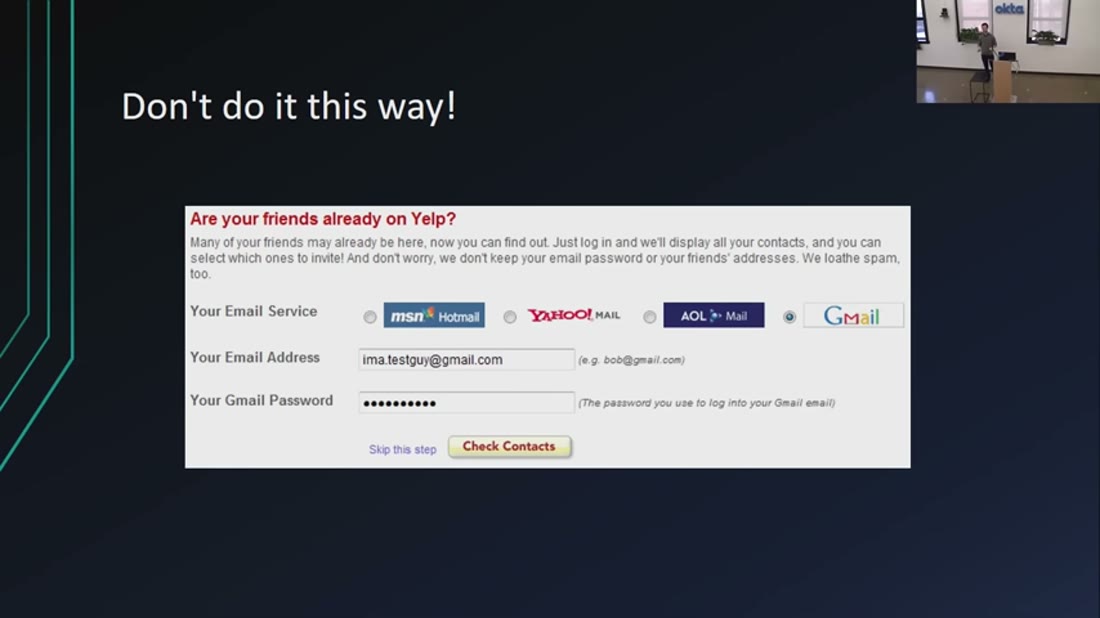
- What it teaches: the entire reason OAuth exists. Note the parenthetical - "The password you use to
log into your Gmail email" - clarifying which password they wanted, as though the problem were
ambiguity.
n1&t=664s - Corroborated by: "we'll log into your Gmail account for you ... we'll throw away your password. We promise we won't do anything evil with it."
At first glance the problem looks like trust, and the promise on that form is trying to answer it. The real failure is not that Yelp was untrustworthy. It is that a password is an all-or-nothing, non-revocable, non-scopable credential. Handing it over grants read, write, delete and password-reset on the account that is the recovery path for every other account you own, forever, and to anyone who later breaches Yelp. There is no way to say "only contacts". There is no way to say "only once". And there is no way to take it back short of changing the password everywhere.
💡 Delegated authorization - granting a third party a subset of your permissions on a fourth party's system, without sharing your credentials. The four-party shape is what makes it hard enough to need a protocol.
Background, supplied - the security-literature name for this. A password is ambient authority: possessing it grants everything the identity can do, everywhere, with no way to attenuate it. The alternative is a capability - an unforgeable token that carries a specific, narrow permission and can be handed out, expired and revoked independently of the identity. That distinction goes back to capability-based security in the 1960s, and it is the whole conceptual move OAuth makes. Everything below is machinery for minting and delivering a capability, which is why the design cares so intensely about who can see the token in transit.
And lest this feel historical, Nate's aside is that banks still do it this way. Every account-aggregation app you have used asked for your actual banking password, because the sector had not adopted OAuth &t=765s.
The pattern was obviously bad at the time. So why did a protocol take until 2010, and what did it deliberately not try to fix?
3. What OAuth was aimed at, and what it left open#
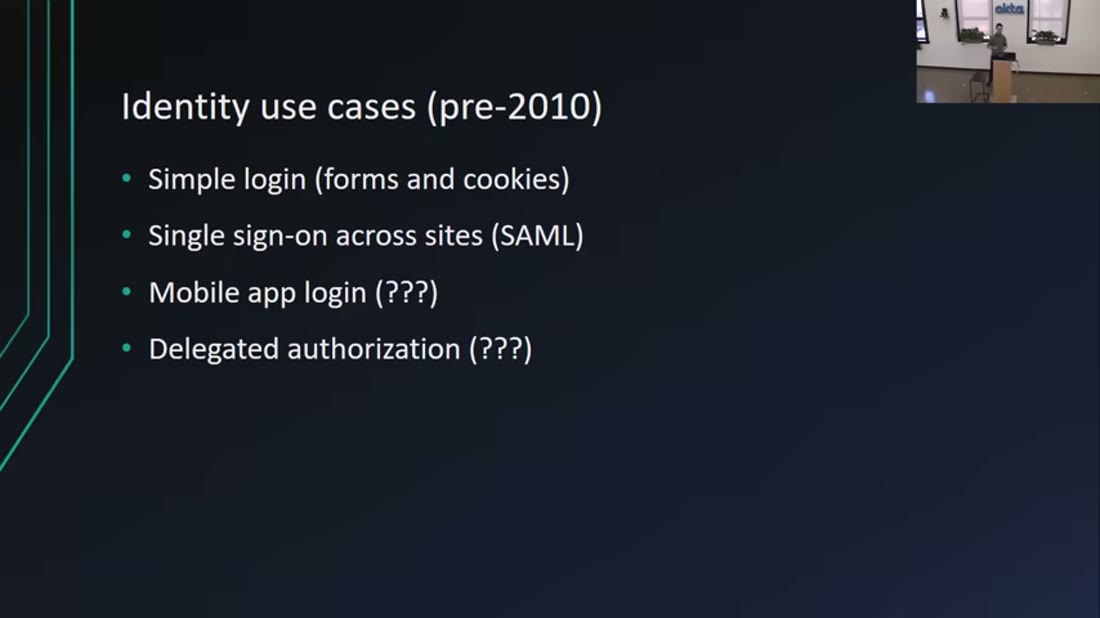
- What it teaches: OAuth did not arrive into a vacuum. Simple login and SSO were solved problems
(forms and cookies; SAML). Two items were open, marked
(???)on the slide: mobile app login and delegated authorization. OAuth was aimed at the second one only.n2&t=453s
Hold onto that (???) next to "mobile app login". It is unresolved on this slide, the industry
later decided to solve it with OAuth anyway, and that decision is what section 8 is about. Almost
every confusion in section 1 descends from this one slide having two question marks and the industry
answering both with the same tool.
For now, take the narrow reading, which is that OAuth is a delegated-authorization protocol and says nothing about who you are. That narrow reading is what the next section starts from, and it is also where most people stop before they have met any of the ideas.
Movement B - the protocol, once#
flowchart TB
    V["4. the vocabulary is <b>renames</b>,<br/>not new concepts - and that is<br/>the whole barrier"]
    F["5. the authorization code flow,<br/>which is the entire protocol"]
    Q{"6. why is it two steps<br/>instead of one?"}
    A["because the browser can be trusted to<br/>talk to a human but not to hold a secret,<br/>so the code goes through the <b>front</b> channel<br/>and the token through the <b>back</b>"]

    V --> F --> Q --> A

    style A fill:#e8f0fc,stroke:#4338ca,color:#312e81
This is a derivation diagram, not a sequence diagram, and section 6 is the payload of the whole note. The crux is that the two-step dance is not bureaucracy: it exists because exactly one of the two parties in the exchange can be trusted with a secret, and it is not the one talking to the user. It is drawn as a question arriving after the flow rather than before it because the question only becomes interesting once you have seen the extra round trip and wondered why it is there. Learn this movement and you have learned OAuth; everything in Movement C is this flow with something taken away.
Synthesized from n4, n5 and n6.
4. The vocabulary is renames, and that is the whole barrier#
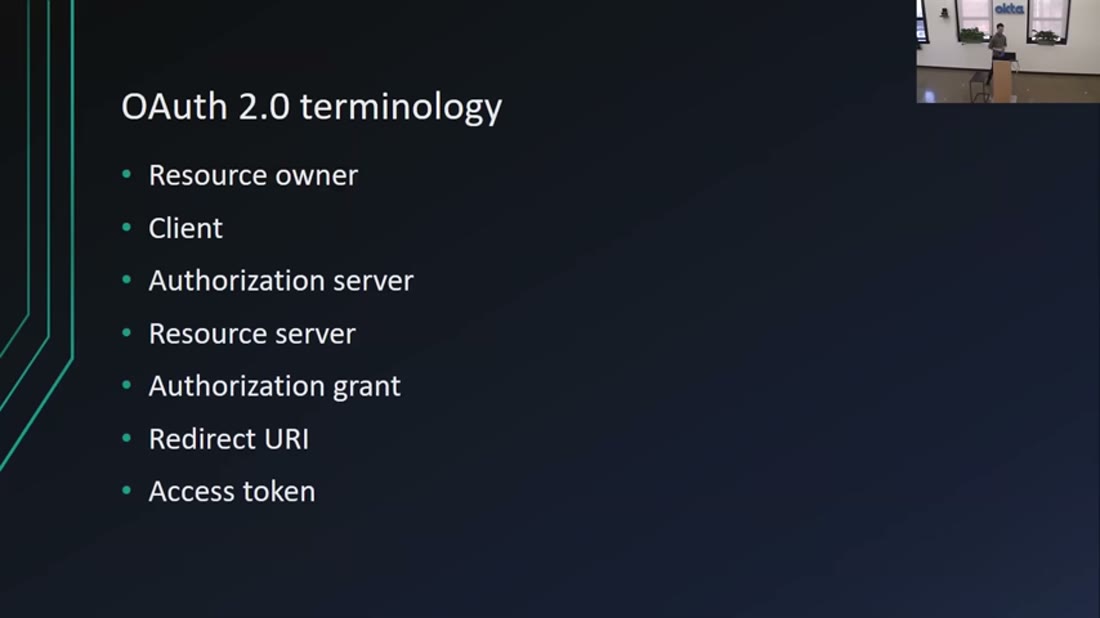
- What it teaches: seven terms that are renames of things you already understand.
n3&t=990s
Work through them once and the intimidation drains out. The resource owner is you, the human who
can click Yes. The client is the app that wants the data, which in section 2 was Yelp. The
authorization server is wherever you log in and consent, such as accounts.google.com, and the
resource server is the API that actually holds the data, which is often but not always a separate
system. An authorization grant is proof that you clicked Yes, the redirect URI is where the
browser gets sent back to afterwards, and the access token is the key the app wanted all along.
| OAuth says | It means |
|---|---|
| Resource owner | You. The human who can click Yes. |
| Client | The app that wants the data (Yelp). |
| Authorization server | Where you log in and consent (accounts.google.com). |
| Resource server | The API holding the data (the Contacts API). Often, but not always, separate. |
| Authorization grant | Proof that you clicked Yes. |
| Redirect URI | Where to send the browser back to afterwards. |
| Access token | The key the app actually wanted. |
The single most useful reframe in that list is that resource owner means you. Most of the intimidation is vocabulary rather than concept, which matters practically rather than psychologically, because it means the diagram in the next section becomes readable the moment the labels stop throwing you.
5. The authorization code flow, which is the entire protocol#
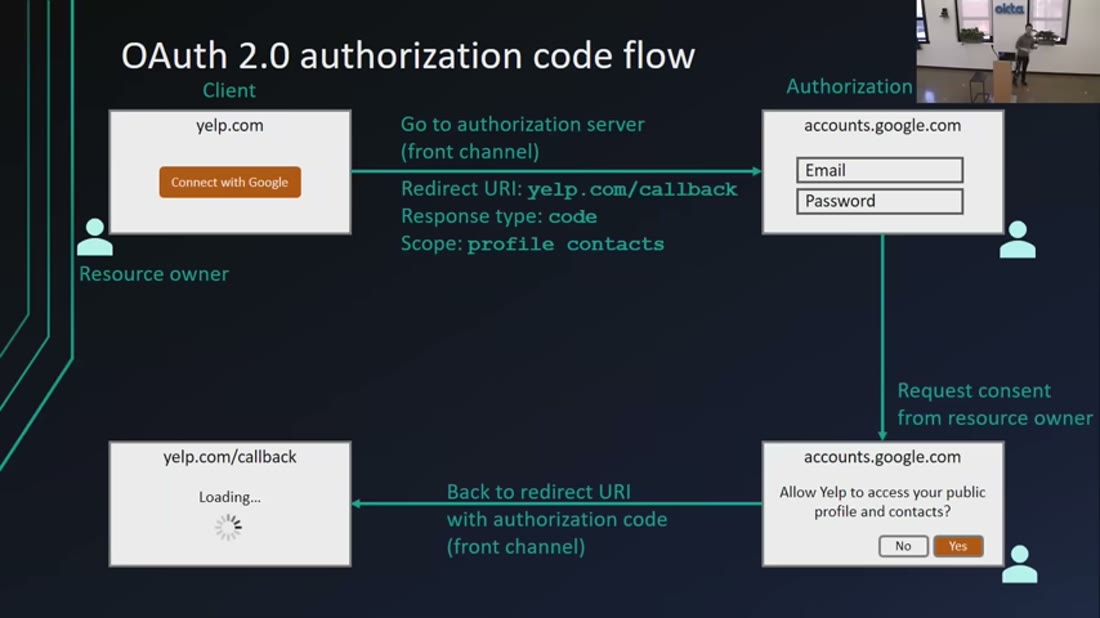
- What it teaches: the complete round trip, and the channel annotations that explain its shape.
n4,n6&t=1323s - Corroborated by: "this whole flow here, this is the whole thing. The entire rest of this talk we're basically just going to be talking about slight variations."
Take that quote literally. This is the only flow you need to learn. Everything in section 7 is this picture with something taken away.
Background, supplied - what "redirect" actually means here, because it is doing more work than it looks. Each arrow crossing the browser is an ordinary HTTP redirect: the server answers with a
302and aLocationURL, and the browser obediently makes the next request, carrying whatever is in that URL's query string. Nobody is transmitting anything to anybody - the user's browser is the courier, which is precisely why what rides in those parameters matters so much, and why the exchange in section 6 has to happen somewhere else entirely.
Scopes ride along in that first redirect, and they do three jobs rather than one. They are the request the client makes. They become the consent text the human reads. And they are the boundary of the capability that the resulting token carries.
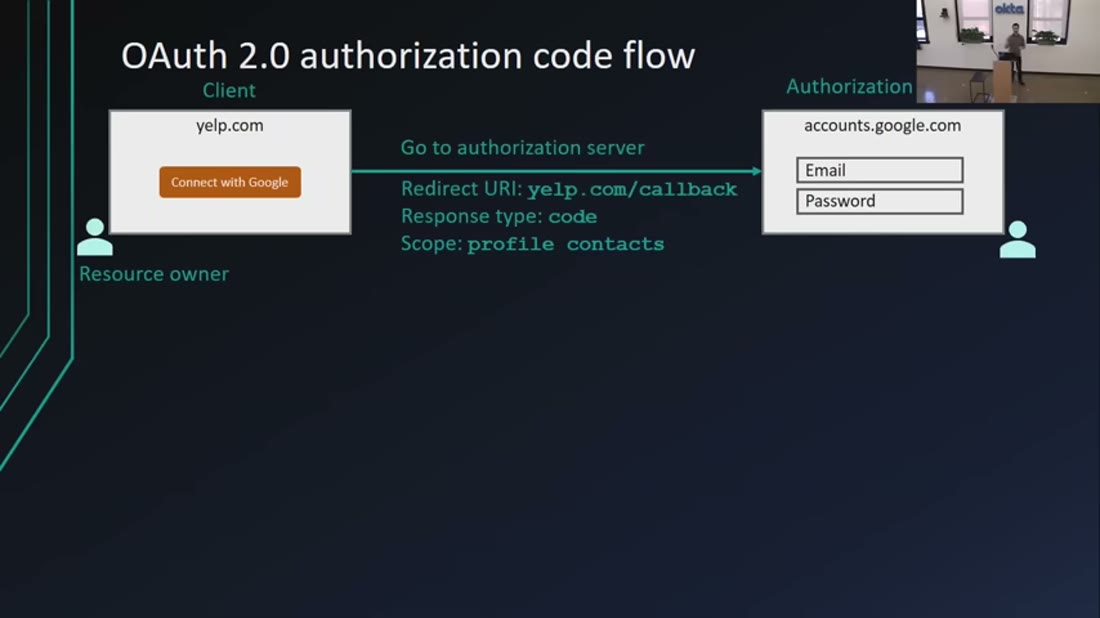
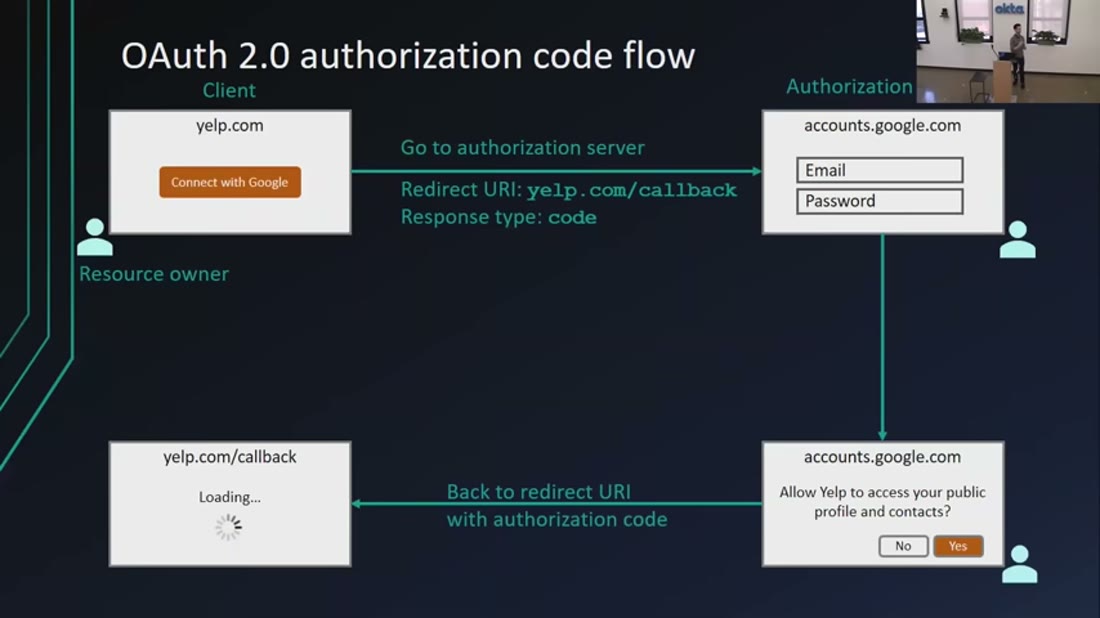
- What it teaches: the client enumerates scopes up front; the authorization server generates the
consent screen from them; the issued token is bound to exactly those scopes and nothing more.
n7&t=1549s
💡 Scope - a named permission (
contacts.read) that the client asks for, the user sees in plain language, and the token is limited to. It is what turns "access my account" into "read my contacts".
Notice how much that second screenshot is doing. The consent screen is generated from the request rather than hand-written by the provider, so the human approves a specific enumerated list instead of a vague connection. In other words, this is the capability from section 2 becoming visible to the person granting it, and it is the reason scope design is a user-experience decision as much as a security one.
So the flow works. Look at it once more, though, and one thing should nag. Why does the app receive a code and then immediately have to trade it for a token, rather than simply being sent the token?
6. The crux: front channel versus back channel#
This is the idea that makes everything else inevitable, and it is not OAuth terminology at all. It is network security terminology that the talk borrows &t=1634s.
The front channel is the browser, and the assumption to make about it is that anything you put there can be read. Query parameters are visible in the address bar, a malicious extension can log requests, and somebody can read over your shoulder. As the talk puts it, "we can trust the browser, but we only trust it as far as we can throw it." &t=1725s The back channel, by contrast, is your server calling another server over TLS, where nobody in between sees anything. The distinction sounds like a matter of degree, and it is not.
Background, supplied - the leak is worse than "someone might look". A value in a URL query string does not merely appear on screen. It is written to browser history, sent to third parties in the
Refererheader when the page loads external resources, and captured in server access logs and any proxy in between - often retained for months by systems nobody thinks of as security-sensitive. That is why "it was only in the URL briefly" is not a defence, and why the design treats the front channel as permanently compromised rather than observable in the moment.
With that established, the two-step dance stops looking like bureaucracy and starts looking like the only available answer.
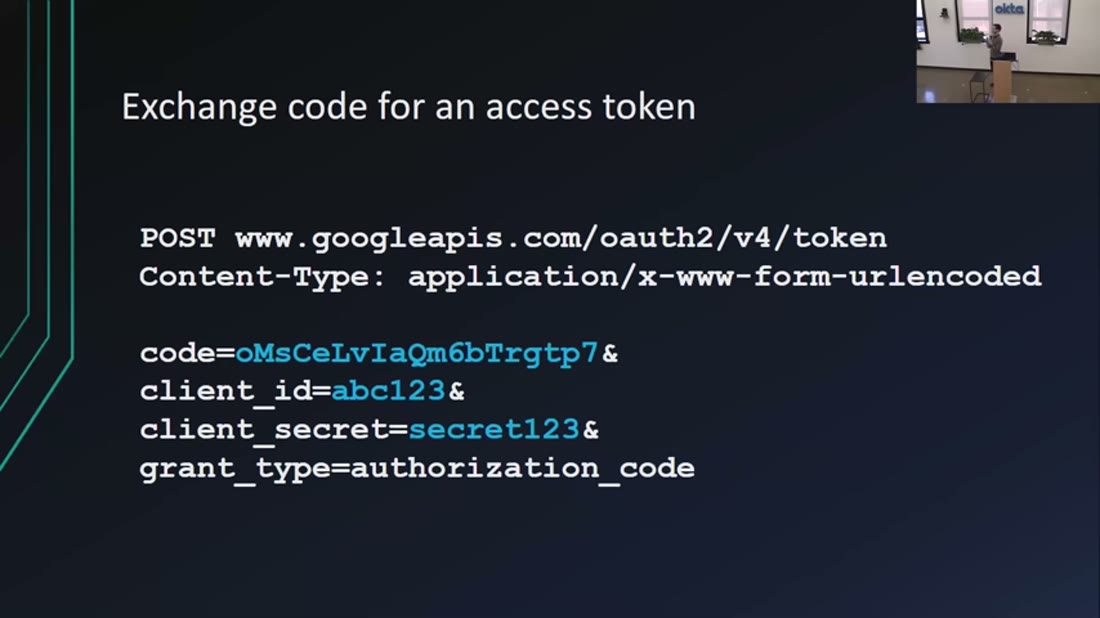
- What it teaches: the exchange is a
POSTcarryingclient_secret- which is exactly why it cannot happen in the browser.n5&t=1937s - Corroborated by: "even if someone stole the authorization code, they wouldn't be able to make that exchange request ... because they don't have that secret key."
The design in one line is that the authorization code is deliberately a useless token. It travels
the insecure channel precisely because stealing it achieves nothing, since redeeming it requires a
secret that only ever exists on the back channel. The protocol therefore splits the job so that each
channel does what it is good at. The browser talks to the human, handling login and consent, which a
server cannot do. The server handles secrets, which a browser cannot be trusted with n6
&t=1989s.
This is a stronger pattern than "encrypt the channel", and worth stealing wholesale. The design assumes the untrusted leg is compromised and arranges for that not to matter, rather than trying to make it trustworthy. Any time you must route something sensitive through a channel you do not control, ask what you could send instead that is worthless on its own.
Background, supplied - and it is the asymmetry the whole scheme rests on. The access token that comes back is a bearer token: possession alone is sufficient to use it, with nothing binding it to the holder's identity. That is why token leakage is catastrophic in a way code leakage is not, why tokens are short-lived, and why every design decision above is about keeping the bearer token off the front channel while accepting that the code goes there freely.
Every remaining flow is this same picture with one or both channels removed, which is what makes the next section short.
Movement C - everything else is a variation#
flowchart TB
    Q{"which channels does this<br/>client actually have?"}
    B["both front and back<br/><i>authorization code</i>"]
    N["front only, no secret<br/><i>implicit - and now reversed, see<br/>What has aged</i>"]
    S["back only, no user present<br/><i>client credentials</i>"]
    O["8. and OIDC exists because OAuth<br/>cannot say <b>who you are</b>,<br/>while the industry used it for login"]

    Q --> B
    Q --> N
    Q --> S
    B --> O

    style Q fill:#dcfce7,stroke:#15803d,color:#14532d
    style N fill:#fbf1dc,stroke:#b45309,color:#78350f
This is a selection diagram, not a catalogue. The crux is that the four flows are not four designs to compare but one design answered against one question, so choosing is a matter of reading your own architecture rather than memorising a table. It is drawn as a single question fanning out because that is the move section 9 turns into a rule, and because a table of four flows invites exactly the memorisation this movement exists to replace. The amber branch is flagged because the 2018 advice on it has since reversed, which the age-check section handles.
Synthesized from n7, n8 and n9.
7. The four flows are one question: which channels do you have?#
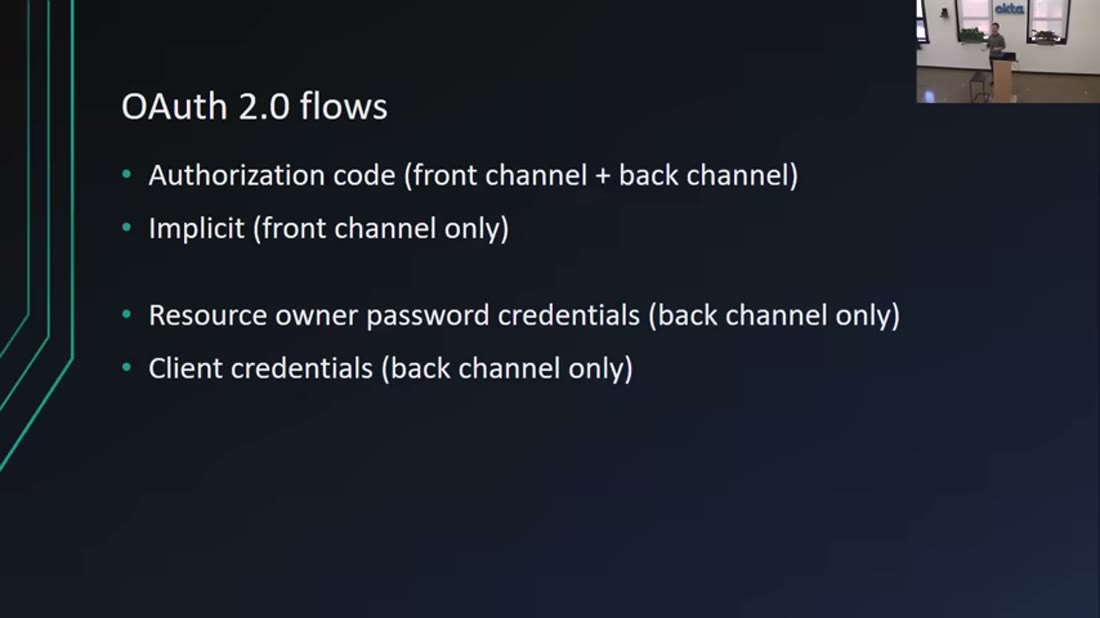
- What it teaches: the four grant types are not four philosophies. They are four answers to "which
channels do you have?"
n8&t=2597s
Walk the four cases in that order and none of them needs memorising. First, the client you have
already met. A server-side web app has both channels available, so it uses the authorization code
flow of section 5 and gets the full guarantee, which is why it is the default. Second, suppose the
client has no back end at all, as a single-page app does not. It has only the front channel, so there
is nowhere for a client_secret to live and nothing to redeem a code with, which is what the
implicit flow exists for.
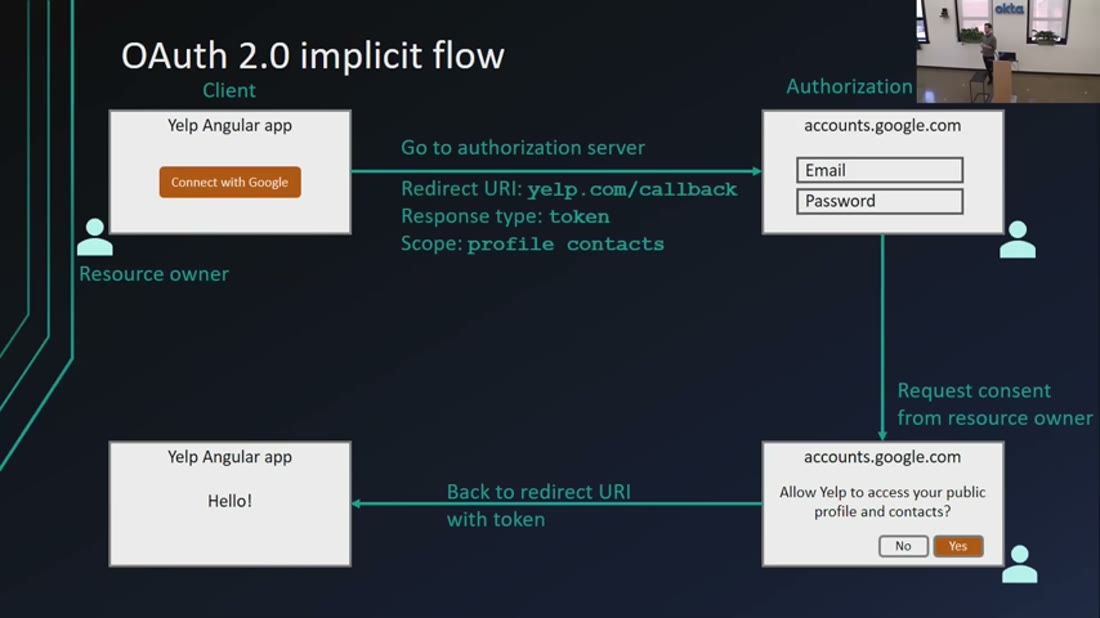
- What it teaches: with no back channel,
response_type=tokenhands the access token straight to the browser and skips the exchange entirely.n9&t=2530s
Third, suppose the reverse, a client that has a server but no human at all. Machine-to-machine
integrations use the client credentials flow, which drops the front channel entirely because there is
nobody to consent to anything (n10, ⚠️ single-leg - narrated without a supporting slide).
Finally, the resource owner password flow also uses only the back channel, and the talk presents it
purely as a legacy migration path that it did not recommend even in 2018.
| Flow | Channels | When |
|---|---|---|
| Authorization code | front + back | You have a server. The default. |
| Implicit | front only | No back end at all (see "What has aged") |
| Resource owner password | back only | Legacy migration; not recommended even in 2018 |
| Client credentials | back only | Machine to machine - no user involved. n10 ⚠️ single-leg |
Now read the implicit flow back against section 6 and you can price it without being told the price.
The implicit flow puts a bearer token into the front channel, which means browser history,
Referer headers and server logs, and that is the one place the previous section spent ten minutes
explaining you cannot trust. In 2018 that was an accepted trade, because single-page apps genuinely
had no alternative. It is no longer accepted, and "What has aged" below is where that lands.
Everything so far has been about authorization, meaning permission to act against an API. But look
back at section 3's slide, where "mobile app login" also carried a (???). The industry did not wait
for a purpose-built answer to that one.
8. Why OpenID Connect had to exist#
OAuth became a victim of its own success. It was adopted so widely that people reached for it for
login, which it was never designed for (n11,
&t=2824s). ⚠️ single-leg.
The defect that creates is concrete rather than academic, and it is worth stating on its own.
OAuth has no standard way to tell you who the user is. It reasons about permissions, not identity (
n12, &t=2894s). ⚠️single-leg.
The consequence followed directly. Every provider, meaning Google, Facebook, Twitter, LinkedIn and
Microsoft, bolted its own proprietary "get user info" mechanism on top. Each login button worked
perfectly well on its own. None of them were interchangeable. In other words, a standard had
stopped being a standard. This is also the direct cause of the confusion in section 1, because half
the OAuth material online describes authorization, the other half describes this authentication
misuse, and neither half announces which it is doing (n20).
The general lesson, and it is the most transferable thing in the talk. The failure was not that OAuth was bad. It was that a near-fit got adopted for a use case it did not name, and the gap was then closed privately by each vendor rather than publicly by the spec. Any protocol currently being stretched to cover a use case it never named is running the same experiment - which is worth holding while reading anything about agent authorization today.
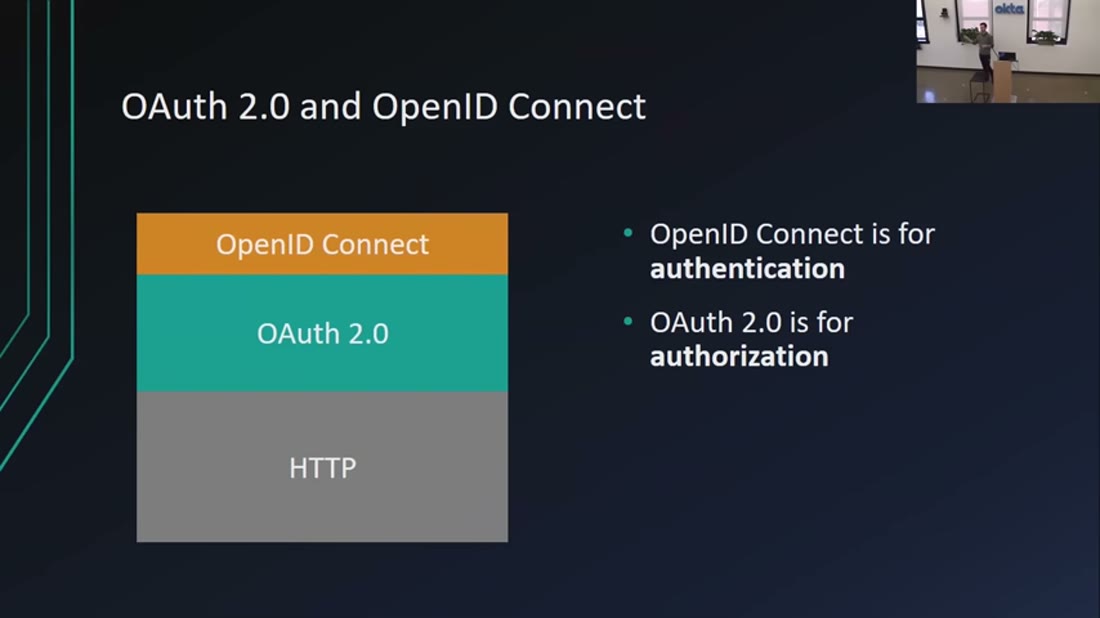
- What it teaches: OIDC sits on OAuth exactly as OAuth sits on HTTP - a "5-10% layer", not a
replacement.
n13&t=2979s
If a layer really is that thin, the obvious question is what it changes on the wire. The answer is almost nothing.
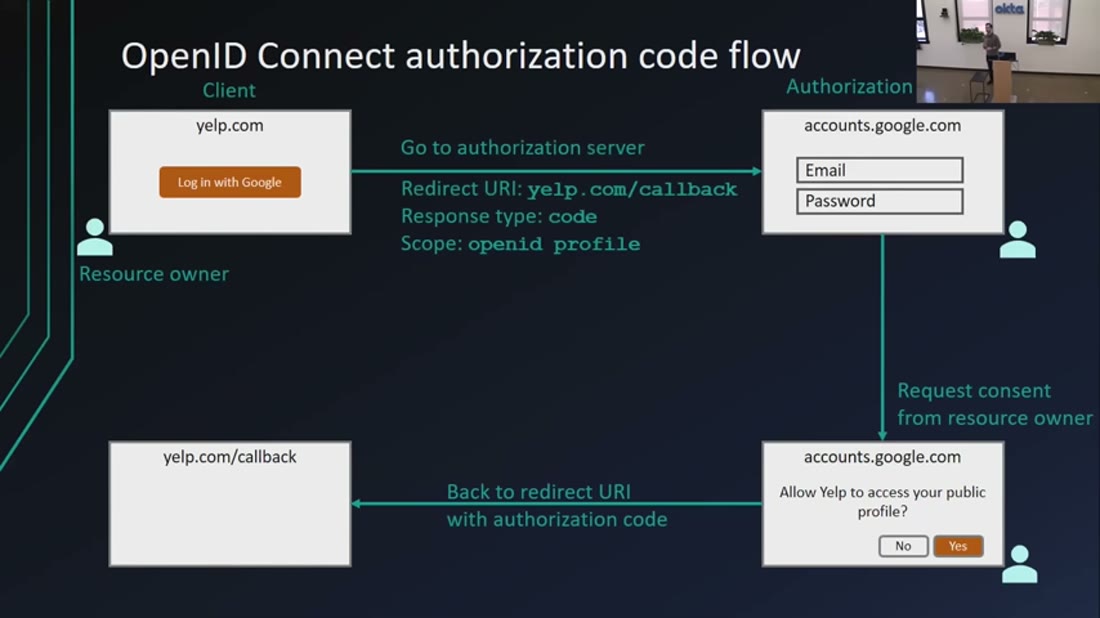
- What it teaches: put this beside the slide in section 5 and the only difference is
Scope: openid profile. That one scope makes a request an OIDC request, and it buys you an ID token alongside the access token.n14&t=3072s
That is worth pausing on, because it is the payoff for having learned one flow properly. An entire authentication standard costs you one extra word in a query string. What comes back for that word is the piece OAuth never had.
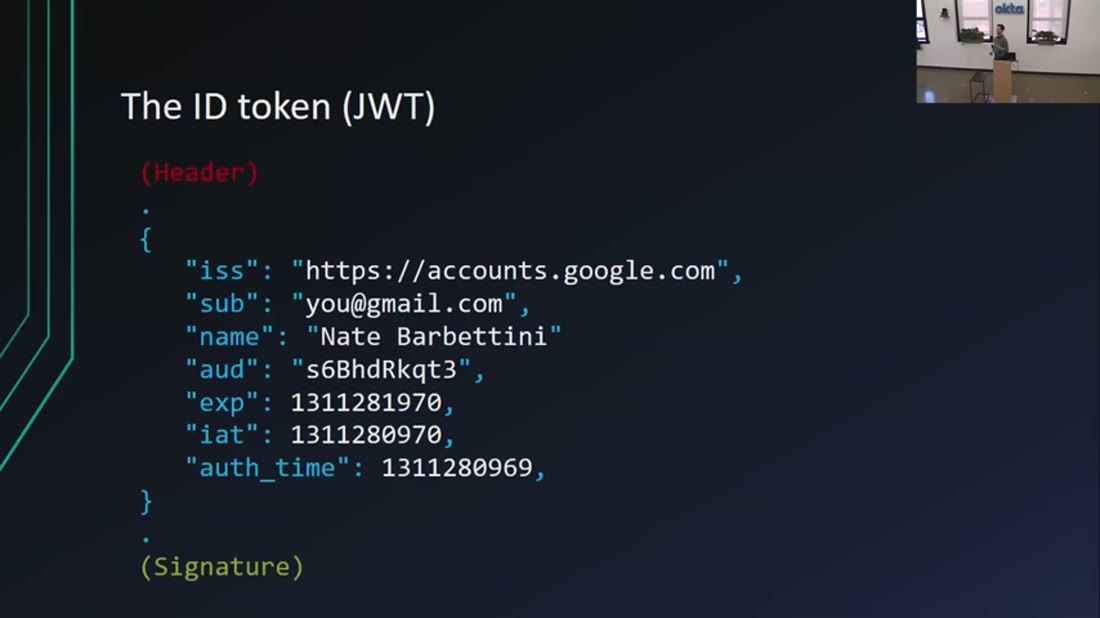
- What it teaches: the ID token is a JWT - header, claims, signature. The claims answer who
logged in (
sub,name,iss,aud,exp). The signature lets the app verify authenticity locally, without another round trip.n15&t=3347s
💡 JWT ("jot") - a signed, base64url-encoded JSON envelope in three dot-separated parts. Signed, not encrypted: anyone holding it can read the claims, so never put secrets in one.
💡 Access token vs ID token - the distinction that makes the whole talk click. An access token is for a machine: the app presents it to an API and the API decides what it may do; the app is not meant to look inside it. An ID token is for the app: it says who signed in, and it is never sent to an API.
Background, supplied - why "verify locally" is possible at all. The signature is asymmetric: the authorization server signs with a private key and publishes the matching public key, so any client can check the signature without contacting anyone. That is what removes the round trip. It also means the security of an ID token rests entirely on checking it properly - verifying the signature, the issuer, the audience and the expiry. A JWT accepted without those checks is just a JSON blob the client believed, which is a recurring source of real vulnerabilities.
9. The rule for choosing#
Having both tools on the table raises the question the talk closes on, which is when to reach for which.
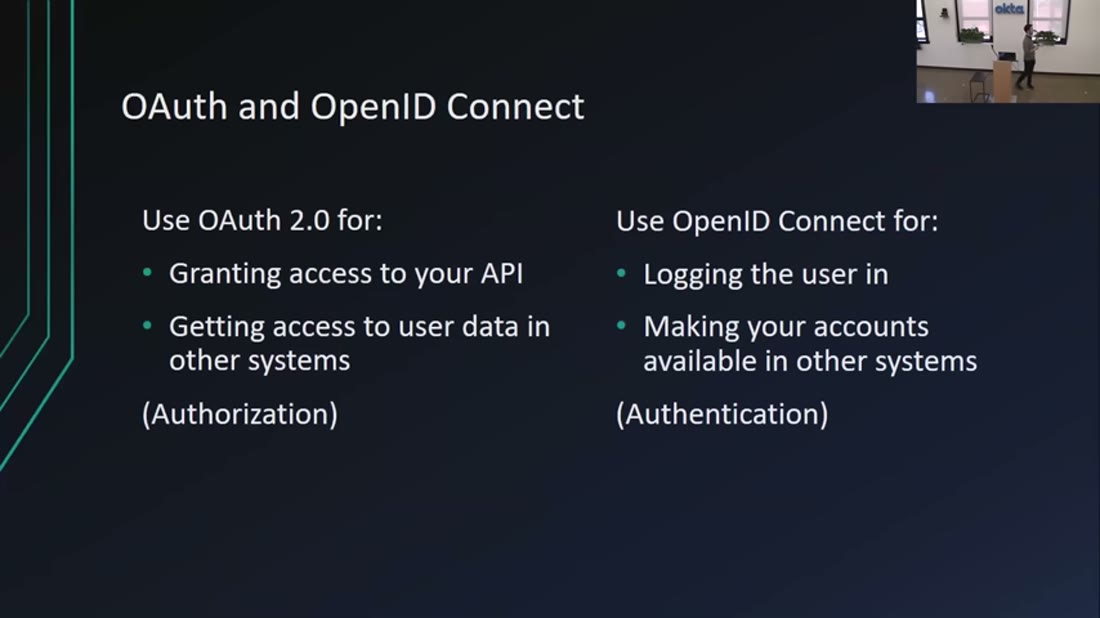
- What it teaches: the decision rule, and the correction of a common misreading - OIDC being newer
does not make it a replacement. They are different tools for different jobs; the only thing OIDC
replaces is misusing OAuth for authentication.
n16&t=3416s
The case that most obviously needs the rule is the one section 3 left with a question mark.
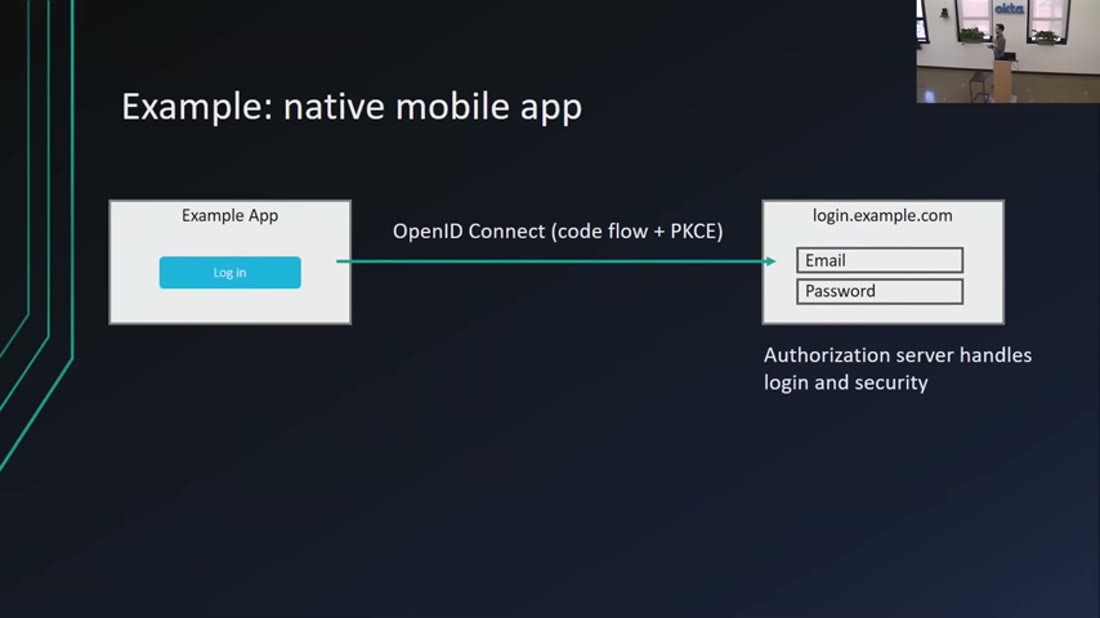
- What it teaches: for native mobile, the answer is OIDC authorization code flow + PKCE.
n18&t=3562s
💡 PKCE ("pixie", Proof Key for Code Exchange) - the fix for clients that cannot hold a
client_secret. The client invents a random secret per request, sends only its hash up front, and reveals the original at exchange time. It restores the guarantee of section 6 - a stolen code is useless - without needing a back channel. Hold this term; it is the hinge of the next section.
One durable architectural argument arrives at the very end, and it is easy to miss there. Delegating
login decouples the authentication system from the application, so that each can be maintained
and evolve separately (n19, &t=3527s)
⚠️ single-leg. That is the reason to adopt these protocols even when you could write the login
form yourself, and it is the same separation-of-concerns argument that shows up whenever an identity
provider is worth its integration cost.
Which leaves one thing. You now understand the protocol as the talk teaches it, and the talk is eight years old.
What has aged (read before applying)#
This talk is from February 2018. The mechanics above are unchanged, and it remains the clearest explanation of them available. One recommendation has been reversed by the field, and it happens to be the one a web developer would reach for first.
| The talk says | Status | What to do |
|---|---|---|
| Authorization code flow for server-rendered web apps | Still correct | Use it. |
| Code flow plus PKCE for native mobile | Still correct, now universal | Use it. |
Implicit flow for single-page apps (n17) |
Superseded | Do not use. Use authorization code + PKCE. |
| Resource owner password flow for legacy | Deprecated harder since | Avoid entirely. |
| Client credentials for machine-to-machine | Still correct | Use it. |
The useful part is that you can derive the reason from section 6 without any outside information.
The implicit flow puts the access token directly into the browser's URL, and that is the one place
the talk spends ten minutes explaining you cannot trust. In 2018 that was an accepted trade because
single-page apps had no alternative, so the recommendation was correct against the options that
existed. Then PKCE removed the trade, by giving secret-less clients a way to prove they started
the flow they are finishing. The talk already teaches PKCE, for mobile (n18), and the field simply
extended the same fix to browser apps.
This is the real skill the section teaches, and it generalises past OAuth: when a source ages, the mechanics usually survive and the recommendations usually do not. Mechanics describe how something works; recommendations encode a trade-off against the alternatives available at the time. New alternatives change the recommendation while leaving the mechanics untouched. When reading anything more than a few years old, separate the two and re-check only the second.
⚠️ Provenance: this table is commentary, not sourced evidence. The "superseded" verdicts are the agent's background knowledge - not from this source, and not externally verified here (
AGENTS.md: unverified statements are commentary, not fact). The direction is reliable; treat specific document names, dates and wording as unconfirmed. A future OAuth 2.1 source will settle it - that is the intended resolution path, not a research pass.
Diagram (mental model)#
flowchart TD
    Q{"Who is asking,<br/>and can they keep a secret?"}
    Q -->|"No user involved<br/>(service to service)"| CC["Client credentials<br/>back channel only"]
    Q -->|"A user, and I have<br/>a back end server"| AC["Authorization code<br/>front + back channel"]
    Q -->|"A user, but no back end<br/>(SPA, mobile)"| PK["Authorization code + PKCE<br/>see 'What has aged'"]
    AC --> W{"What do I need<br/>out of this?"}
    PK --> W
    W -->|"Act on the user's<br/>behalf against an API"| AT["Access token<br/>scoped permissions<br/>OAuth 2.0"]
    W -->|"Know who the user is"| IDT["Plus an ID token (JWT)<br/>add scope=openid<br/>OpenID Connect"]
Read it top to bottom as two decisions, one about your client and one about your goal. The first fork is not about your framework or your language, and that is the thing to notice. It is about which channels you have, in the section 6 sense. The second fork is the authorization-versus-authentication question that section 9 answers. The crux is that you never choose between OAuth and OpenID Connect - you choose a flow based on whether your client can hold a secret, then add one scope if you also need to know who the user is.
Most explanations are shaped differently, organising around the four grant types as a menu, and that
shape is what does the damage. A menu invites you to pick by application type, so you reason "I have
an Angular app, so ... implicit?", which is precisely the reasoning the field has since overturned.
Organising around secret-holding capability instead is more durable, because that is the actual
security property the protocol cares about, and it explains why PKCE could later absorb the
no-back-end case without anyone having to invent a new flow. Note also what this shape rules out.
There is no branch anywhere in it where you pick OIDC instead of OAuth, because OIDC is a suffix on
the second decision and never an alternative at the first, which is the misconception n16 exists to
kill.
Synthesized from n8, n9, n13, n14, n16, n18, plus the age warning above. Not a slide from
the talk.
💡 Terms#
| Term | Explanation |
|---|---|
| Delegated authorization | Granting a third party a subset of your permissions on a fourth party's system, without sharing your credentials. The four-party shape is what needs a protocol. |
| Ambient authority vs capability | A password is ambient authority - it grants everything, everywhere, unrevocably. A token is a capability - narrow, expiring, revocable independently of the identity. OAuth's whole move. |
| Front channel / back channel | Front = the browser, observable and logged in places you do not control. Back = server to server over TLS. The entire flow shape follows from trusting the browser with the human and never with a secret. |
| Authorization code | A deliberately useless token: it crosses the browser in the open because redeeming it requires a client_secret that only exists on the back channel. |
| Bearer token | A token where possession alone is sufficient to use it, with nothing binding it to the holder. Why token leakage is catastrophic and tokens are short-lived. |
| Scope | A named permission the client requests, the user sees in plain language on a generated consent screen, and the token is bound to. |
| JWT ("jot") | A signed, base64url-encoded JSON envelope in three parts. Signed, not encrypted - readable by anyone holding it, so never put secrets in one. Verified locally against the issuer's published public key. |
| Access token vs ID token | Access token is for a machine (presented to an API, not read by the app). ID token is for the app (says who signed in, never sent to an API). Confusing the two is the root of most OAuth/OIDC mix-ups. |
| PKCE ("pixie") | Proof Key for Code Exchange: the client invents a per-request secret, sends its hash up front, reveals the original at exchange. Restores "a stolen code is useless" without a back channel. |
What to distrust in this note#
- It is eight years old, and that is the headline. See "What has aged". Nothing else in this note matters if you skip that section and reach for the implicit flow.
- The mechanics are corroborated; the argument is not. This is the sharp asymmetry
nodes.mdrecords, and it is worth quoting: the mechanics corroborate easily and travel poorly; the judgement corroborates poorly and travels well. The flow diagrams, scopes, JWT structure and grant types all gate slide ↔ narration. The claims you will actually want to reuse - why OAuth drifted into authentication (n11), what it structurally lacks (n12), the decoupling argument (n19), and why the literature is so confusing (n20) - are allsingle-leg, narrated over absent or decorative slides. - Two legs means internally consistent, not correct. Slide agreeing with narration proves the deck and the talk agree, nothing more.
- A vendor employee explaining a standard his company sells against. Nate Barbettini worked at Okta, an identity provider. The explanation is unusually clean and shows no sign of distortion, but the choice of what to emphasise - "delegate your login to an authorization server" - is not disinterested.
- The "Background, supplied" blocks are mine, not the talk's. Capability versus ambient authority, the specifics of front-channel leakage, bearer-token semantics, asymmetric JWT verification - all established prior art the talk assumes or never names. Uncited by construction, carrying no evidential weight about this source.
- Nothing here is measured, and nothing in it could be. This is an explanation, not a study.
Open questions#
- What exactly replaced the implicit flow, and when? Which document carries the current guidance, what does it actually say about browser apps, and is implicit discouraged or removed? Needs T1 evidence (a spec or IETF BCP), not memory. Deliberately left open - to be answered by an OAuth 2.1 source rather than a research pass (owner's call, 2026-07-25).
- How does any of this map onto agents? MCP's authorization spec builds on this machinery, and an
agent calling tools on a user's behalf is the delegated-authorization problem with a new actor
in the client role. Does the four-party model still hold when the client is non-deterministic? See
../../brain/topics/agent-security.md. - What is the consent story when the user is not present? The whole design assumes a human at a
browser who clicks Yes. Long-running agents break that assumption. The client credentials flow
n10removes the user entirely - is that the agent answer, or does it discard exactly the protection that made OAuth worth having? - Is
single-legthe right verdict for the argument claims?n11,n12,n19,n20are the most transferable content in the talk and the least corroborated. External evidence would settle them cheaply.
Feeds these topics#
../../brain/topics/agent-security.md- the delegated-authorization substrate: scopes as least privilege, consent as human-in-the-loop, channel separation, PKCE.
Presentation narrative#
A talk track for engineers meeting OAuth properly for the first time, and for the architects who have to review their choices. Derived entirely from the gated nodes above. One thing governs how to read it: the source is from 2018, and one of its recommendations has since reversed, which the last slide handles rather than burying.
Slide 1 - OAuth solves exactly one problem, and everything else is machinery#
It lets an app act on your behalf without giving it your password. That is the whole of it. The jargon, the four flows and the two-step token dance are all in service of that single sentence.
The reason this needs saying out loud is that the difficulty people experience with OAuth is presentational rather than conceptual. The specification renames familiar things instead of adding new ones, and almost every explanation opens with the four flows as options to choose between. Meet it that way and the structure looks arbitrary. The confusion is structural and it is not the reader's fault.
This is the problem, in one screenshot, and it dates from before the protocol existed. The crux is
that the alternative to OAuth is not a worse protocol, it is this - handing your actual password to
a third party [n2].
Slide 2 - One security fact generates the entire structure#
The browser can be trusted to talk to a human, but not to hold a secret. Every shape in the protocol follows from that, and it is the sentence to take away if you take away one.
It is why there are two channels rather than one. The front channel runs through the browser, where a human can see and consent to what is being asked, and where nothing confidential can be kept. The back channel runs server to server, where a secret is safe but no human is present. Neither channel alone can do the job, which is why the authorization code flow has the extra round trip that looks like bureaucracy until you know what it is for.
This is the whole protocol, annotated by channel. The crux is that the two-step dance is not
overhead: the code travels where a human can consent, and the token travels where a secret can be
kept [n6].
Slide 3 - The vocabulary is renames, and that is the entire barrier#
Resource owner is you. Client is the app. Authorization server is the thing that issues tokens. Resource server is the API holding your data. Nothing in that list is a new concept, and the barrier people hit is almost entirely the mapping.
What engineers should take from this is that time spent memorising the glossary is time well spent, because once the words resolve the flows read as ordinary engineering. What architects should take from it is that the jargon is a poor proxy for understanding, since somebody can use the terms fluently and still not know which channel their client has.
This is a rename table, not a concept map. The crux is that every row is a familiar thing under an
unfamiliar name [n4].
Slide 4 - Scopes are what the consent screen is generated from#
The scopes a client requests become the words the user is shown before agreeing. That connection is worth making explicit in a mixed room, because it is where a protocol detail turns into a product decision somebody will be judged on.
Ask for broad scopes and the consent screen asks the user for a lot, which costs conversion and invites refusal. Ask for narrow scopes and you may have to re-prompt later. The scope list is therefore not only a permissions decision, it is the copy on a screen that decides whether people complete signup.
This is a product slide wearing protocol clothing. The crux is that the permissions you request are
rendered directly to the user, so scope design and consent design are the same task [n7].
Slide 5 - The four flows are one question, not four designs#
Which channels does this client actually have? Answer that and the flow is chosen for you.
A client with both a browser and a server keeps the authorization code flow, which is the full protocol. A client with only a front channel and nowhere to keep a secret historically got the implicit flow. A client with only a back channel and no user present gets client credentials. That is the entire selection rule, and it replaces the table people try to memorise.
OpenID Connect then exists for a reason worth stating plainly: the industry started using OAuth for login, which it was never built for, and OAuth has no way to say who you are. OIDC is a thin layer bolted on to supply exactly that.
This is a layering slide. The crux is that OIDC is a patch for a use case rather than part of the
derivation, which is why identity questions do not have clean answers inside OAuth alone [n8].
Slide 6 - This source is from 2018, and one of its recommendations has reversed#
The mechanics in this talk have aged well and one recommendation has not: the implicit flow, taught here as the answer for browser clients that cannot hold a secret, is now discouraged. The replacement is the authorization code flow with PKCE.
That divergence is worth generalising rather than just noting, because it is the pattern for reading any dated technical source. Mechanics describe how something works and tend to survive. Recommendations encode a trade-off against the alternatives available at the time, and those expire when the alternatives change. Read the channel argument as durable and the flow advice as dated.
So the decision is straightforward. Learn the authorization code flow, because it is the protocol. Choose flows by asking which channels you have. And check any 2018-era OAuth advice against the current guidance before shipping it, since this source contains a worked example of exactly that going stale.
This is the slide that aged. The crux is that nothing about the mechanism shown here is wrong - what changed is the availability of a better option, which is how technical recommendations usually expire.
Key takeaway message#
OAuth solves one problem, letting an app act on your behalf without your password, and every piece of its machinery follows from one security fact: the browser can talk to a human but cannot keep a secret. That fact produces the two channels, the two-step dance and the flow family, so there is really one flow and three versions of it with a channel removed. The vocabulary is renames rather than new concepts, and it is most of the difficulty. OpenID Connect is bolted on because OAuth cannot say who you are and the industry used it for login regardless. Learn the authorization code flow, choose by asking which channels you have, and treat this 2018 source's mechanics as durable and its recommendations as dated.