source
12-Factor Agents: Patterns of reliable LLM applications
Dex Horthy (HumanLayer) - AI Engineer (World's Fair 2025)
About this note
Persona: curator + mentor, always - + architect for the topic mapping. Re-adopt when working this file.
The distilled document you learn from - text anchored by a few curated visuals. Built from the corroborated nodes in
nodes.md. Every claim is cited. Signal, not archive. SeeSOURCE.md.Voice: an AI architect ramping up a new senior engineer who has never built an agent. Foundations are marked as scaffolding; everything else carries a node ID; evidence is labelled where the claim is made. Shape per
AGENTS.md§ "Writing aLEARNING.md(the required shape)".
On this page
TL;DRThe 1-minute versionKey claimsWhat you will learn, and in what orderWhy you should care: the 70-80% wallFoundations (scaffolding, not from the source)The naive attempt, and precisely how it failsThe crux, derived: four parts, each named by a question the previous one cannot answerOne instance traced end to end: HumanLayer's deploy botSecond-order problems: what breaks once it is runningHow would you know it works?Where this sitsDiagram (mental model)💡 TermsThe evidence, weighedOpen questionsFeeds these topicsPresentation narrativeSlide 1 - The agents that work in production are barely agenticSlide 2 - An agent is four things, and every framework convenience takes one of them from youSlide 3 - Context engineering is the part that is actually yoursSlide 4 - What ships is micro agents inside deterministic codeSlide 5 - Contacting a human is a tool call, not an exception pathSlide 6 - Judge it by four questions, and treat the source as a pattern languageKey takeaway messageTL;DR#
Dex Horthy reports interviewing 100+ people building agents and found that the ones that work in
production are barely agentic - ordinary deterministic software with small, tightly-scoped LLM
steps inside (n1). From that he distilled 12 factors, named after Heroku's 12-factor app. The
through-line is that an agent is a prompt, a switch statement, a context-window builder, and a
loop, and reliability problems trace back to letting a framework own one of those four instead of
you (n5). https://www.youtube.com/watch?v=8kMaTybvDUw
What that first sentence is worth. The 100+ interviews are the entire empirical basis of the talk and you cannot check them - no names, no method, no counts (
n1). Take the factors as a well-argued pattern language from someone who has clearly built this, not as a survey result. Full accounting in "The evidence, weighed".
flowchart TB
    A["an agent is four things"]
    P["a <b>prompt</b>"]
    S["a <b>switch statement</b>"]
    C["a <b>context-window builder</b>"]
    L["a <b>loop</b>"]
    F["hand any one of the four<br/>to a framework..."]
    R["...and your reliability problems<br/>trace back to exactly that one - n5"]
    W["which is why the agents that work in<br/>production are <b>barely agentic</b>:<br/>ordinary deterministic software with<br/>small, tightly-scoped LLM steps inside - n1"]

    A --> P --> F
    A --> S --> F
    A --> C --> F
    A --> L --> F
    F --> R --> W

    style F fill:#fee2e2,stroke:#b91c1c,color:#7f1d1d
    style W fill:#dcfce7,stroke:#15803d,color:#14532d
This is an ownership diagram, not an architecture diagram, and the question it answers is which parts you must not delegate. The crux is that the four components are the complete list of things an agent is, so every framework convenience is a decision to stop owning one of them. It is drawn with all four converging on a single hand-off node because the failure mode does not depend on which one you give away; it depends only on having given one away. The green terminal is the talk's headline finding and reads as a paradox until the diagram above it is accepted: barely agentic is what you get when you keep all four.
Synthesized from n1 and n5.
The 1-minute version#
This article covers a conference talk in which Dex Horthy reports interviewing more than a hundred
people building agents, and then answers a deliberately deflating question about what the working
ones have in common (n1). His answer is that they are barely agentic at all. What ships in
production is ordinary deterministic software with small, tightly-scoped language-model steps inside
it, and the twelve factors are his attempt to name which pieces of that software you have to write
yourself. To see why such a list needs to exist at all, start with the failure that produces it.
That failure has a specific and recognisable shape, and it arrives on a schedule. You pick a
framework, you move fast, and you reach roughly 70-80% quality quickly, which is enough to get
a team assigned to you. Then you need the last 20%, and the character of the work changes. You find
yourself seven layers deep in a call stack trying to reverse-engineer how your own prompt was
built and how your tools were passed in, and many people at that point throw the whole thing away
and start over (n18). At first glance that reads as a complaint about one bad framework, which
would be answered by picking a better one.
The reason it is not that is what makes the problem hard rather than merely annoying. The model is a
stateless function from tokens to tokens, so the only lever you have on quality, short of retraining,
is which tokens go in (n9). The code that decides which tokens go in is exactly the code the
framework took ownership of. Everything you would normally reach for as an engineer, whether that is
a log line, a test, or a breakpoint, sits on the far side of that boundary. In other words, the
abstraction is load-bearing while you are at seventy per cent and in the way once you need ninety,
which is why the naive design fails in a manner that feels like bad luck rather than like a
consequence.
The naive design is the one everybody writes first, and it is worth stating plainly before
criticising it. You prompt the model, it picks a next step, you execute that step, you append the
result to the context, and you go round again until it reports that it is done (n4). Run it and it
materialises a workflow graph at runtime, which is precisely the promise on offer: you no longer
write the workflow, you state the goal. Then it stops working on longer workflows, and the reason is
that the loop appends every step and every result and removes nothing. Context grows without bound.
The failure that follows is not the one people expect, because it is not an error thrown at a token
limit. Quality degrades continuously, long before any limit is reached, and nothing in the system
tells you it is happening (n4). Two failure modes therefore compound. The context grows
unboundedly, and a framework owns the loop, so when quality stalls you cannot get at any of it
(n18).
The idea that answers both is not a list to memorise but a derivation to follow. Begin with the only
thing you actually have, which is a stateless function that turns text into text, and ask what has
to be added. Something must instruct it how to choose a next step, and that is the prompt. Something
must turn the text it returns into an action, which requires structured output and then a switch
statement. Something must decide what the stateless model sees on the next turn, and that is the
context builder. Something must decide when to stop, and that is the loop (n5). Four questions
produce four parts you own, and every remaining factor is an answer to what happens once you take
one of those four seriously.
How it works underneath is narrower than the vocabulary suggests. The enabling capability is a
sentence becoming JSON that matches a schema you defined, and in the talk's framing it does not even
matter what you do with that JSON afterwards (n2). "Tool use" is that JSON plus deterministic code
that switches on it, which is why Horthy borrows Dijkstra's title to call the abstraction harmful
while leaving the capability alone (n3). Ownership then pays back in concrete places rather than
in principle. Own the serialisation of the thread and a tool call that takes days becomes a pause and
a resume instead of a blocked process. Own the loop and you can break out mid-run to summarise, to
switch strategy, or to ask a person. What ships on top of all this is deliberately small, namely
micro agents of three to ten steps placed at the genuinely ambiguous points of an otherwise
deterministic pipeline, with a human contacted as a tool call rather than as a branch in your code
(n13, n11).
What that costs arrives in two forms. The first is that you now write the parts the framework would
have written, and the talk is honest that a framework will hand you a better prompt than you will
write on day one (n7). The second cost is a judgement you cannot delegate to anyone, which is
where the boundary between deterministic code and model is drawn. Horthy keeps a counterweight for
exactly that, and it is his own story rather than someone else's. His first DevOps agent was handed
a Makefile, ran the steps in the wrong order, and after two hours of increasingly specific prompting
he had effectively specified the exact build order that a 90-second bash script would have encoded
(n17, single-leg - an anecdote with no slide behind it). The twelve factors make agents reliable.
They do not make an agent the right tool.
So how far should any of this be trusted? This is a T4 conference talk by a founder who sells agent tooling, and the worked example is his own company's product. Nothing here is measured. There is no benchmark, no ablation and no failure rate, neither for the factors individually nor for the argument as a whole. The nodes marked "corroborated (external)" gate against a companion repository that shares the same author, which corroborates that the factors are stated consistently and says nothing whatsoever about whether they work. Every real number in this note arrived later, from a separate research pass. Read the twelve as a well-argued pattern language from someone who has clearly built this, and take the shape rather than the confidence.
The same argument, compressed for reference rather than for reading:
| The problem | You pick a framework, reach 70-80% quality fast, then need the last 20% and find yourself seven layers deep in a call stack reverse-engineering how your own prompt was built (n18). |
| Why the obvious answer fails | The naive loop - prompt, pick next step, append result, repeat - materialises a DAG at runtime and breaks on long workflows, because context grows without bound and quality degrades continuously long before any limit (n4). |
| The idea | An agent is four parts you should own, and they are derivable rather than memorable: something must instruct the choice (prompt), turn text into action (switch on structured JSON), decide what the stateless model sees next (context builder), and decide when to stop (loop) (n5). |
| How it works | The enabling capability is narrower than it looks - a sentence becoming JSON matching a schema you defined. "Tool use" adds nothing magical on top (n2, n3). Own the serialisation and pause/resume becomes possible; own the loop and mid-run intervention becomes possible. |
| What ships | Micro agents: 3-10 step loops at the genuinely ambiguous points of an otherwise deterministic pipeline, with humans contacted as a tool call rather than a structural branch (n13, n11). |
| The counterweight | Not every problem needs an agent. Two hours of prompt engineering versus a 90-second bash script (n17). |
| How far to trust it | T4 talk by a founder selling agent tooling. Nothing is measured - no benchmark, ablation or failure rate anywhere. Its "corroborated (external)" nodes gate against a companion repo that shares the same author. Every real number here came from a later research pass. |
Key claims#
- An agent = prompt + switch statement + context builder + loop. Own all four.
n5&t=406s - The enabling capability is structured output - a sentence becomes JSON matching your schema.
"Tool use" is that JSON plus deterministic code.
n2n3&t=229s&t=264s - LLMs are stateless pure functions. Prompt, memory, RAG and history are one problem: which
tokens reach the model.
n9&t=616s - The naive loop breaks on long workflows because context grows unboundedly.
n4&t=371s - What ships is micro agents: 3-10 step loops at the hard points of a deterministic pipeline.
n13&t=741s - Make contacting a human a tool call, not a structural branch.
n11&t=687s - Not every problem needs an agent.
n17&t=71ssingle-leg
What you will learn, and in what order#
flowchart TB
    subgraph A["A. Why this matters before any technique"]
        S1["Why you should care:<br/>the 70-80% wall"]
        S2["Foundations<br/><i>scaffolding, uncited</i>"]
    end
    subgraph B["B. The derivation - the payload"]
        S3["The naive attempt,<br/>and precisely how it fails"]
        S4["The crux, derived:<br/>four parts, each named by a question<br/>the previous one cannot answer"]
    end
    subgraph C["C. What it looks like running"]
        S5["One instance traced<br/>end to end"]
        S6["Second-order problems:<br/>what breaks once it is running"]
    end
    subgraph D["D. Judging it"]
        S7["How would you<br/>know it works?"]
        S8["Where this sits"]
    end

    A --> B --> C --> D

    style B fill:#dcfce7,stroke:#15803d,color:#14532d
    style S2 fill:#e8f0fc,stroke:#4338ca,color:#312e81
This is a reading-order diagram about the note rather than about agents, and the colours mark two different kinds of material. Green is the derivation and it is the part that transfers, because it arrives at the four components by asking what the previous one structurally cannot answer rather than by listing them. Blue is scaffolding supplied by this brain, uncited by construction, and it is the one block safe to skip outright if you already build LLM applications. Group A does no technique work at all and exists to make the derivation feel necessary rather than elaborate; a reader who already believes agents stall around 70-80% can move straight to B. Group C is where the design stops being a diagram, and group D is where the note stops describing and starts judging, including the accounting for a talk whose entire empirical basis cannot be checked.
Generated from the structure of this note - a diagram the source does not contain.
Why you should care: the 70-80% wall#
flowchart TB
    D["a demo, built in a weekend"]
    G["70-80% of the way there,<br/>fast, and genuinely impressive"]
    W["<b>the wall</b>"]
    Q["and the last 20% does not yield<br/>to more prompting, a better model,<br/>or a bigger framework"]
    R["because what remains is not a<br/>capability problem - it is the parts<br/>you stopped owning"]

    D --> G --> W --> Q --> R

    style W fill:#fee2e2,stroke:#b91c1c,color:#7f1d1d
    style R fill:#dcfce7,stroke:#15803d,color:#14532d
This is a trajectory diagram, not a benchmark, and the shape rather than the numbers is the argument. The crux is that the wall is not where capability runs out but where delegated control starts costing you, which is why the usual responses aim at the wrong thing. It is drawn as a flat run into a stop because the experience being described is discontinuous: progress is fast and then it is not, with no gradual slowing to warn you. Everything the note proposes is an answer to the last box, so a reader who has not met this wall will find the derivation over-engineered and a reader who has will find it obvious.
Synthesized from n1 and n5. The trajectory is this brain's rendering of the talk's framing.
You will hit this personally, and the shape of it is specific enough that you can learn to recognise it in advance.
It starts well. You pick a framework and you move fast, and you reach 70-80% quality quickly,
which is "enough to get the CEO excited and get six more people added to your team." Then you need
the last 20%, and the work changes character entirely. You find yourself seven layers deep in a
call stack trying to reverse-engineer how the prompt got built and how the tools got passed in
(n18, &t=37s). Many people throw it away at that point and start over.
At first glance this is a story about one badly designed framework, and the natural response is to pick a better one. The reason it is not that story is what turns an anecdote into a design argument. The seventy per cent arrives fast precisely because the framework wrote the parts you had not written yet, and the same ownership is what stands between you and the last twenty per cent. The abstraction is helping and hindering for the same reason, so no amount of shopping for a better one removes the shape of the problem.
That wall is the reason for all twelve factors, because each one is a piece of the system you
should have owned from the start. The entry price for owning them is also lower than it looks,
since this is "software engineering 101" and requires no AI background (n1, &t=141s). Which
leaves the question the rest of the talk answers, namely what those pieces actually are.
⚠️
n18issingle-leg- an anecdote with no slide behind it. It is the motivating story, not a measured failure rate, and no failure rate appears anywhere in this talk.
Foundations (scaffolding, not from the source)#
flowchart LR
    T["<b>tool call</b><br/>structured JSON the model emits,<br/>which your code decides<br/>what to do with"]
    C["<b>context window</b><br/>everything the model sees<br/>on this one call"]
    L["<b>the loop</b><br/>who decides there is<br/>a next step, and what it is"]
    N["none of these is magic,<br/>and all three are yours to own"]

    T --> N
    C --> N
    L --> N

    style N fill:#e8f0fc,stroke:#4338ca,color:#312e81
This is a vocabulary diagram and it is scaffolding, supplied by this brain and uncited by construction - the source assumes all three. The crux is that each term names a thing you write rather than a thing you receive, which is the mental shift the rest of the note depends on. It is drawn flat rather than as a pipeline because these are not stages in a sequence, they are three independent surfaces, and the note's argument is about who owns each. Skip this block entirely if you have built an LLM application before; nothing in it comes from the talk.
Background, supplied. Uncited by construction.
Uncited by construction - this section is background I am supplying so the rest reads. The source assumes all of it. Every sentence outside this section carries a node ID.
Skip this part if you have already built something that calls an LLM in a loop and dispatches on its output.
Start with the fact the whole talk rests on, which is that an LLM call is a pure function. Tokens go in, tokens come out, and nothing persists between calls. Anything that looks like memory, whether that is a chat history or an assistant that "remembers" what you said, is your own code re-sending text it stored somewhere else. Almost everything below is a consequence of that single property.
The second thing to hold is structured output, which providers also sell as function calling. You hand the model a JSON schema and it returns JSON conforming to that schema rather than prose. Mechanically nothing new is happening, because it is still text prediction, only constrained.
Third, a DAG - a directed acyclic graph - is a workflow of steps with a direction and no cycles,
which is what Airflow or Prefect exist to orchestrate. Horthy's framing of it is worth keeping,
because he uses the term to deflate rather than to impress. In his words, "if you've written an if
statement, you've written a directed graph."
Finally there is "agent" itself, which the field uses loosely to mean an LLM in a loop that chooses its own next action rather than following a fixed script. Hold that definition loosely on purpose, because narrowing it is most of what this source does.
The naive attempt, and precisely how it fails#
Here is the design everyone writes first. Read it before the critique, because the critique only lands if the design looks reasonable to you first.
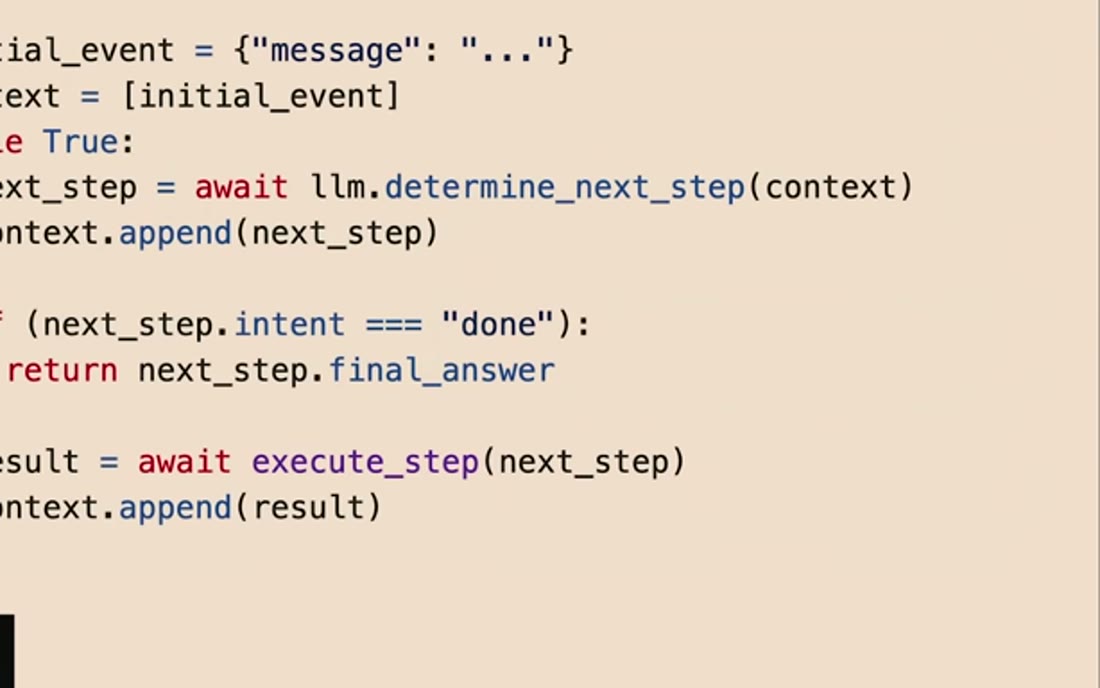
- What it teaches: the whole of "agent" in about ten lines - an event arrives, you prompt, the model
picks the next step, you append the result, you repeat until
done.n4&t=334s - Corroborated by: the narration walking the same loop aloud.
&t=406s
Run it and it materialises a DAG at runtime. That is the promise being made, and it is a real one: you no longer write the workflow, you state the goal and the workflow appears.
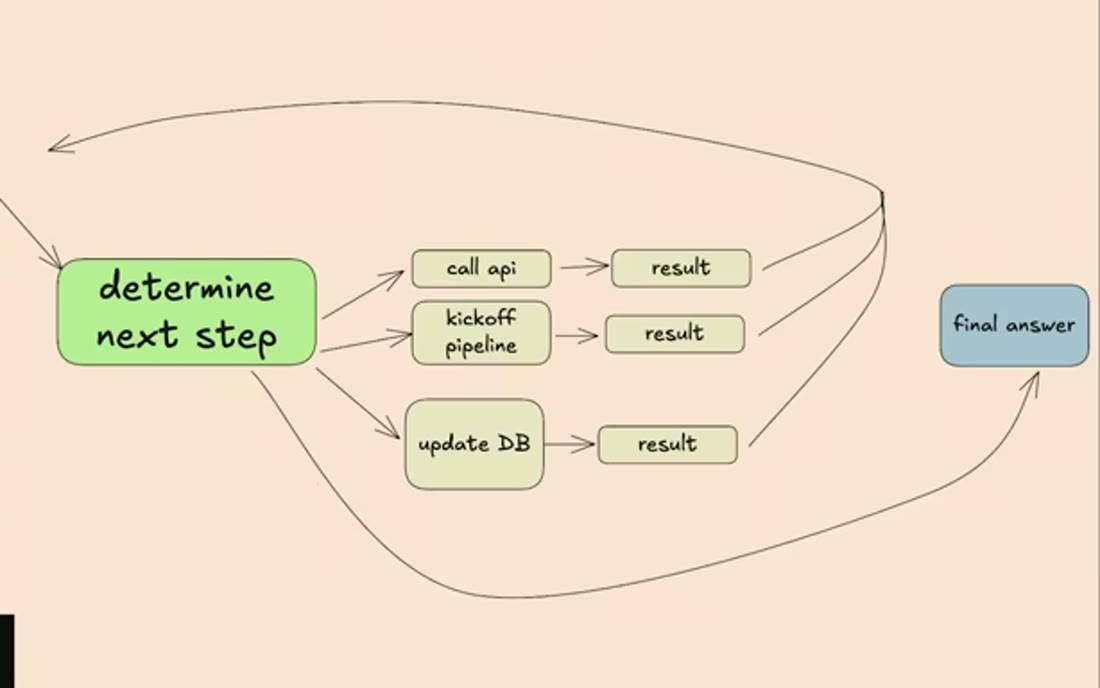
- What it teaches: the graph the loop produces without anyone drawing it.
n4&t=334s - Corroborated by: "turns out this doesn't really work. Especially when you get to longer workflows.
Mostly it's long context windows."
&t=371s
Before reading on, name the failure yourself. The loop appends every step and every result, and never removes anything. What runs out?
The answer is the context window, and the failure is not the one most people expect. It is not
that you hit the token limit and get an error back. It is that quality degrades continuously, long
before any limit, and you cannot see it happening (n4, &t=388s). Horthy is careful about the
nuance here, and the care is worth copying. This is not the claim that long context is useless. You
can put 2M tokens into Gemini and get an answer back. The claim is narrower and stronger, which is
that you will always get tighter, higher-reliability results by controlling and limiting what
goes in.
This is the one claim in the talk that has since been measured, and the measurements are harsher than the talk's framing (
en2, external). Degradation is position-dependent and U-shaped across six model families (Lost in the Middle, TACL, T1); it appears "even on simple tasks" across 18 models, with a 200K-window model degrading materially by 50K (Context Rot, T2); and the mechanism is an n² attention budget (Anthropic, T2). S2 undersells its own best claim. See R1.
So the naive loop has two failure modes and they compound. The context grows without bound, which
degrades quality invisibly. And a framework owns the loop, so when quality stalls you cannot get
at any of it (n18). Fixing either one alone leaves you stuck, which suggests the repair has to
start further back, from what an agent minimally is.
The crux, derived: four parts, each named by a question the previous one cannot answer#
Do not memorise "the four owned parts". Derive them, and they stop feeling like a list somebody chose and start feeling like the only available answers.
Start from the only thing you actually have, which is a stateless function that turns text into text.
The first question is what makes it choose a next step at all. Nothing in the model knows your
domain, so something must instruct it how to select. That something is the prompt, and it is the
first part you own. The obvious objection here is that a framework will write you a genuinely good
one immediately, and Horthy concedes it in strong terms, saying "you would have to go to prompt
school for like three months to build a prompt this good". Past a certain quality bar you write
every single token by hand anyway, and the reason is the pure-function property from the
foundations: input tokens are the only lever you have short of retraining (n7, &t=531s).
The second question follows immediately. The model returned text, so what turns that into an action? It must return something your code can branch on, which means structured output, and then something has to do the branching. That is the switch statement, the second part you own.
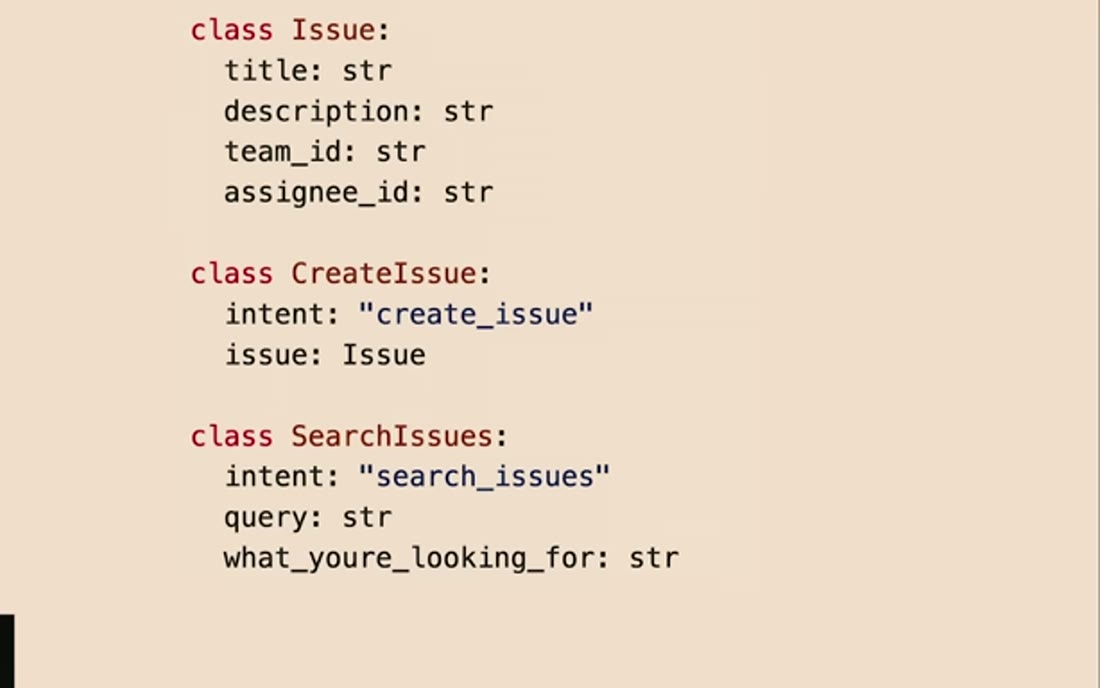
- What it teaches: the most magical thing an LLM does has nothing to do with agency - it turns "can
you create a payment link to Terri for $750 for sponsoring the February meetup?" into JSON matching
a schema you defined.
n2&t=229s - Corroborated by: "It is turning a sentence like this into JSON that looks like this. Doesn't even
matter what you do with that JSON."
&t=229s
This is why Horthy borrows Dijkstra's title for "tool use is harmful", and the aim of that title is
the abstraction rather than the capability (n3, &t=264s). The harmful idea is that tool use is
"this magical thing where this ethereal alien entity is interacting with its environment." What
actually happens is duller and far more useful. The model emits JSON, deterministic code switches on
it, and maybe a result goes back.
💡 Why the demystification is load-bearing. If tool use is magic, debugging it is guesswork and you defer to the framework. If it is "JSON, then a switch statement", every ordinary engineering instinct you already have - types, tests, logging, error handling - applies again.
The third question is the one the pure-function property forces. The model is stateless, so what does it see on the next turn? Something must assemble the window each time, and that something is the context builder, the third part. The moment you own it, you are also no longer obliged to use the standard messages format, which is a freedom most people never notice they have.
![class Thread with events List[Event]; Event.type as a Literal of list_git_tags / deploy_backend / deploy_frontend / request_more_information / done_for_now; event_to_prompt renders XML-ish blocks; thread_to_prompt joins events](../media/260725_12-factor-agents/frame_590.jpg)
- What it teaches: model the thread as typed events and stringify however maximises density and
clarity - here XML-ish blocks joined into one user message.
n8&t=563s - Corroborated by: "your only job is to tell it what's happened so far. You can put all that
information however you want into a single user message."
&t=563s
Once you are choosing tokens deliberately, something quietly collapses. The four things you had been treating as separate subsystems turn out to be one question asked four ways.
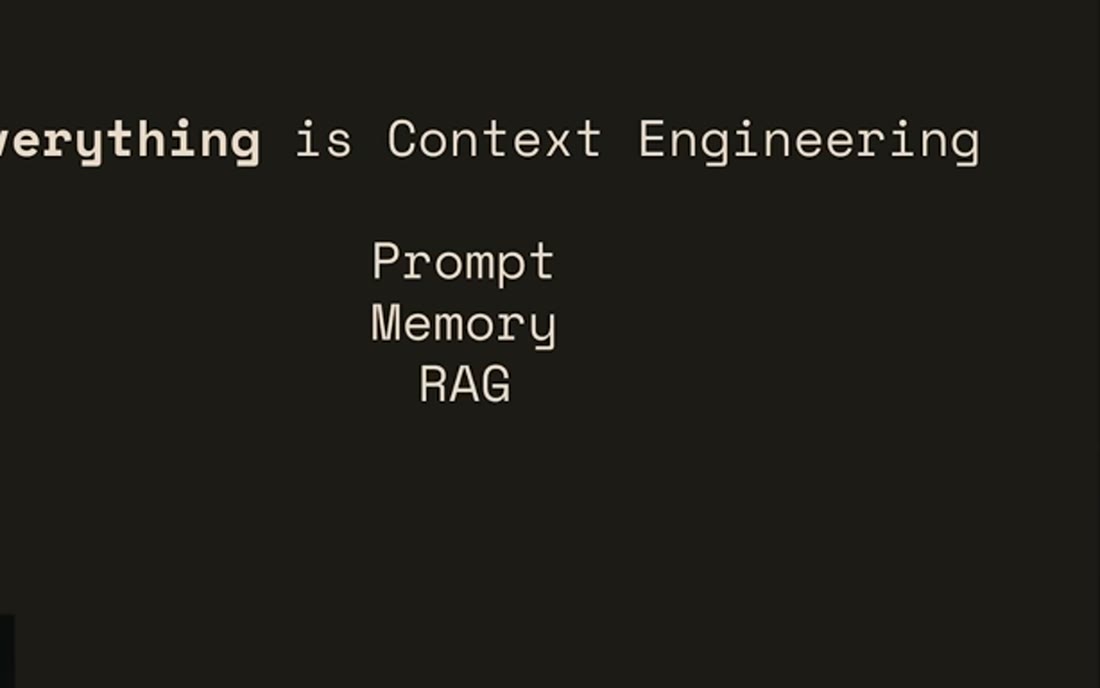
- What it teaches: prompt, memory, RAG and history are not four problems but one - which tokens reach
the model.
n9&t=616s - Corroborated by: the slide states it and the narration repeats it verbatim.
&t=599s
That leaves the fourth question, which is when any of this stops. Something must decide to go round
again or to exit, and that is the loop, the fourth part. Owning it is what makes mid-run
intervention possible at all, because in his words, "if you own your control flow, you can do fun
things like break and switch and summarize and LLM-as-judge and all this stuff" (n5, &t=423s).
Four questions have produced four parts, which raises the obvious arithmetic problem: if the answer is four, why are there twelve factors? The reason is that every remaining factor is an answer to "what happens when you take one of those four seriously?" Factor 2 is the prompt. Factor 3 is the context builder. Factor 9 is what you append when things fail. Factor 8 is the loop. That is why the list is twelve and not four, and it is also why the numbering is not the order in which the ideas depend on each other.
⚠️ The factor numbering is corroborated externally; the factors are not. The repo README's twelve match the talk's numbering exactly, including the ones delivered out of order (
en1) - which is real evidence about the mapping and no evidence about whether the factors work, since the repo and the talk share one author.
One instance traced end to end: HumanLayer's deploy bot#
The abstract design is four boxes, and four boxes is where most design arguments stop being useful. Here is one real request travelling through all of them.
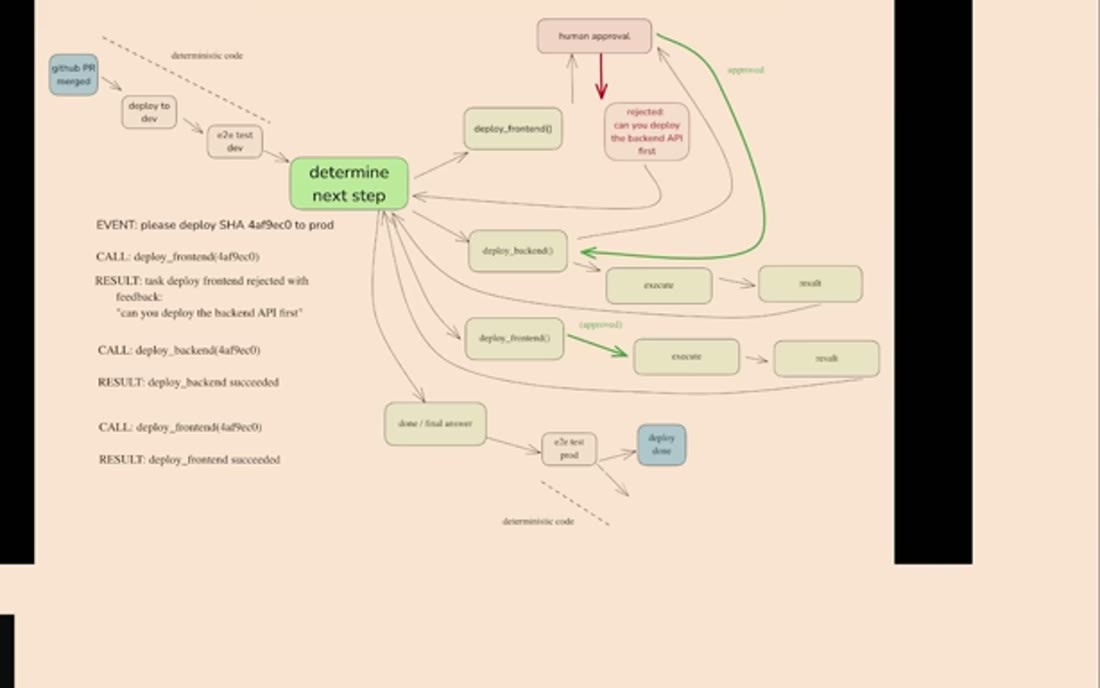
- What it teaches: factor 10, and the most important slide in the talk. Most of the pipeline is
deterministic CI/CD; a small agent takes over only at the genuinely ambiguous point, for 3 to 10
steps, then hands control back.
n13&t=741s - Corroborated by: the narration walking the same pipeline, including the human's redirect.
&t=776s
Walk it step by step, and at each step note what breaks if that part is missing:
- A PR merges. Deterministic CI deploys to dev and runs e2e tests, with no model involved at all. Remove the deterministic bracket and you have handed a language model your production deploy, and the failure is not a subtle one.
- The ambiguous question arrives. Dev is green, so what do we ship, and in what order? The context builder renders the thread so far as typed events. Without it you are appending raw messages, and by step eight the model is reasoning over its own noise.
- The prompt asks for the next step, and the model returns
deploy_frontendas JSON. Without owning that prompt you are debugging someone else's string at 80%. - The switch dispatches on that JSON. Without structured output you are regex-parsing prose.
- A human redirects. The message "can you deploy the backend API first" arrives as just another
event in the same thread rather than as a branch in your code (
n11). - The loop goes round with the correction appended, emits
deploy_backend, thendone. - Control returns to deterministic code for prod e2e tests, with a separate small rollback agent sitting on the failure path.
The payoff, in his words, is "100 tools, 20 steps, easy. Manageable context, clear
responsibilities" (n14, &t=814s). Before moving on, look at the dashed "deterministic code"
labels at either end of the slide, because that boundary is the actual design artefact, and
deciding where it sits is the job. Everything else in the talk is downstream of that one line.
Evidence, since this is the claim the whole talk rests on. The slide is HumanLayer's own deploy bot and "easy" is the speaker describing his own product, with no baseline, no failure rate and no comparison against the big-loop design he is arguing against. Internally corroborated only (slide ↔ narration). It is nonetheless the best-supported claim in this brain, because two independent things landed on it later: S1 reached the same shape from Uber's production practice, and
en3measured decomposition at +13.1 to +41.5 pp reliability across 10 models (brain/claims.mdclaim 11). Believe the shape; "easy" is a founder's word, not a result.
Second-order problems: what breaks once it is running#
The four parts get you a working loop, which is not the same as a loop that keeps working. These are the failures that arrive afterwards, and each one turns out to be a factor.
The first is that errors accumulate and the agent spins out. When a tool call fails, the naive move
is to append the error and retry, and doing that blindly means the agent loses the thread and gets
stuck in a retry cycle. The fix has two halves. Once a valid tool call succeeds, clear the pending
errors rather than leaving them in the thread. And when an error does go in, summarise it instead
of pasting the stack trace (n10, &t=653s). This is factor 9, and it is the sharpest practical
rule in the talk, because it is the one you can apply this afternoon without redesigning anything.
The second problem is harder to patch, because it is about time. Some tool calls take days rather than milliseconds, and a human approval is not a function that returns.
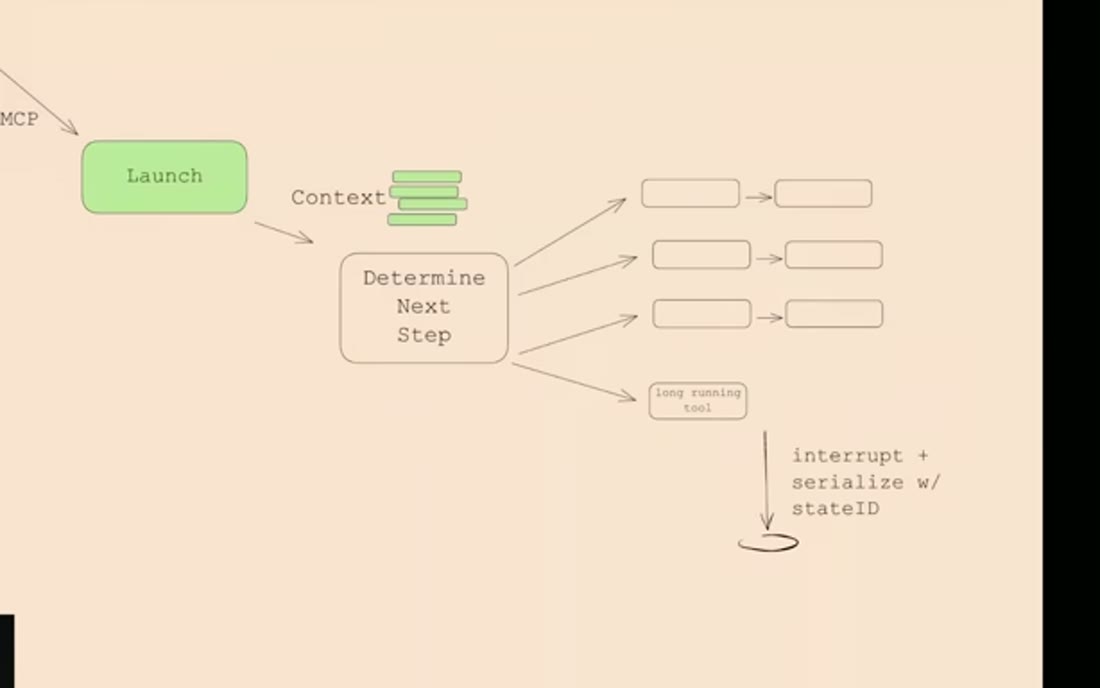
- What it teaches: factors 5 and 6. Unify execution state (current step, retry counts) with
business state (messages, pending approvals), put the agent behind a REST or MCP endpoint, and on a
long-running call serialise the context window to a store keyed by a state ID. On callback,
reload, append, resume.
n6&t=460s - Corroborated by: "the agent doesn't even know that things happened in the background."
&t=495s
Notice that you can only do this because you owned the context window, which makes this the first
factor that visibly pays back an earlier one. Factor 12 completes the thought by pushing it to its
limit: the agent holds no state of its own, and is a stateless reducer over a thread you own
(n16, needs-check - mentioned in passing, no worked example). If the agent holds nothing, though,
the humans still have to get in somehow.
That is the third problem, and it is where most designs reach for a special case. Horthy does not.
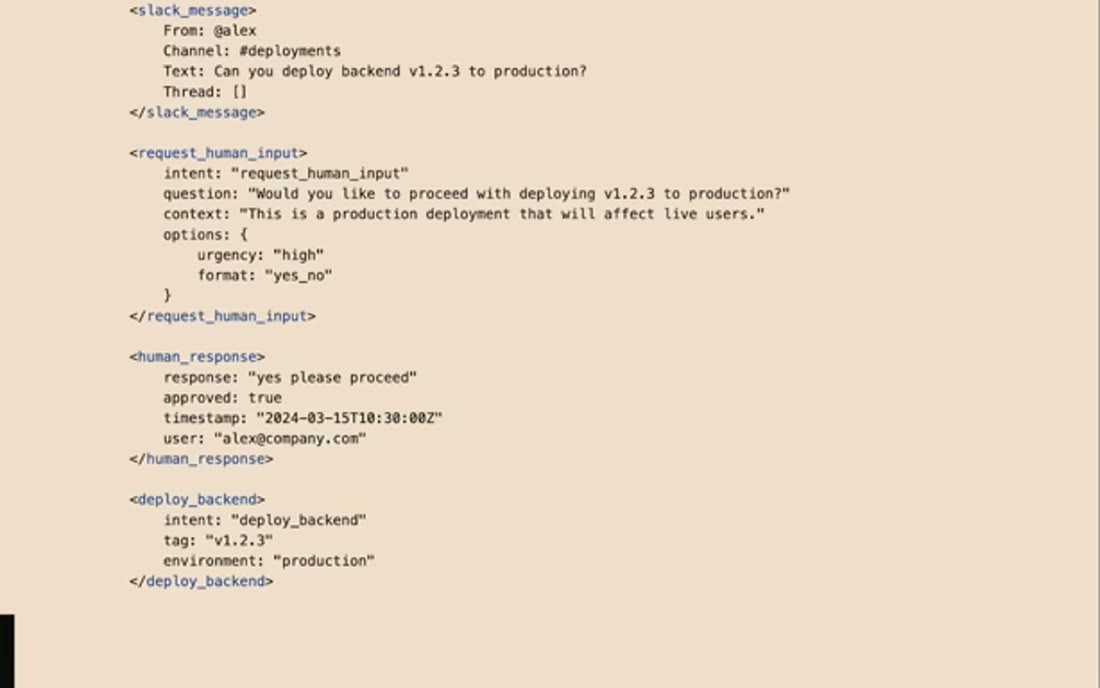
- What it teaches: factor 7. Rather than forcing the model's first output token to choose between
"tool call" and "message to human", make human contact just another intent -
request_human_inputalongsidedeploy_backend.n11&t=687s - Corroborated by: the trace shows the human turn rendered in the same event format as everything
else.
&t=687s
Two payoffs are worth remembering here. First, the model gets richer modes than a binary, so it can
say done, or need clarification, or escalate. Second, the decision now rides on a natural-language
token the model understands rather than on a structural branch it was never trained on. Factor 11
rides along with this, since an agent reachable by tool call is also reachable from email, Slack,
Discord or SMS, and the reason given is that "people don't want to have seven tabs open of different
ChatGPT style agents" (n12, needs-check, no dedicated slide). At which point the design is
complete enough to ask the question nobody in the talk asks.
How would you know it works?#
flowchart TB
    Q["'the agent works'"]
    A["<b>does it recover?</b><br/>can a failed step be retried<br/>without redoing everything?"]
    B["<b>can you pause it?</b><br/>is state serialisable mid-run,<br/>and resumable elsewhere?"]
    C["<b>can a human enter?</b><br/>is contacting a person a tool call<br/>rather than an exception path?"]
    D["<b>can you read the trace?</b><br/>is every step an event you can<br/>replay and inspect?"]

    Q --> A
    Q --> B
    Q --> C
    Q --> D

    style Q fill:#fee2e2,stroke:#b91c1c,color:#7f1d1d
This is a test diagram, not a metric, and it replaces an unanswerable question with four answerable ones. The crux is that "does it work" cannot be evaluated on a long-running agent, while each of these four can be checked by reading your own code. It is drawn as one vague claim decomposing into four concrete checks because that is the section's whole move, and because the four are independent: an agent can be perfectly resumable and still have no path for a human to intervene. Notice that none of the four is about model quality, which is consistent with the note's central argument.
Synthesized from the factors discussed in this section; the four-question framing is this brain's.
This source measures nothing. There is no benchmark, no ablation, no failure rate and no A/B
test, neither for the factors individually nor for the framework as a whole (nodes.md standing
caveat). That is the honest headline, and it should shape how you use the talk rather than whether
you use it.
Something does exist in place of measurement, and it is worth walking through piece by piece, because
the four pieces are unequal in a way a quick glance hides. The repo README matching the talk's
numbering (en1) is genuine evidence that the factors are stated consistently, and it is no evidence
at all about efficacy, because the repo and the talk share an author. The "100+ builders interviewed"
line (n1) supports the claim that the factors were distilled from real practice, but it comes with
no names, no method and no counts, so it cannot be checked from the source. HumanLayer's deploy bot
(n13) shows the shape is buildable and that one team runs it in production, which is one pipeline,
with no baseline, described by its vendor. Only the external pass in R1 (en2, en3) measured
anything, and it reached exactly two of the twelve ideas, leaving the other ten untouched.
| Evidence | What it supports | What it does not |
|---|---|---|
The repo README matching the talk's numbering (en1) |
that the factors are stated consistently | anything about efficacy - same author |
"100+ builders interviewed" (n1) |
the factors are distilled from real practice | uncheckable: no names, method or counts |
HumanLayer's deploy bot (n13) |
the shape is buildable and one team runs it | one pipeline, no baseline, vendor's own |
R1's external pass (en2, en3) |
context degradation and decomposition, measured | the other ten factors, untouched |
The eval you would build first, if you wanted to test this yourself, is the one en3 already
describes. Take a long task, run it as one loop and then as short restarted segments, and compare
reliability. That is the single claim here with a published method behind it, at +13.1 to +41.5 pp
across 10 models, T3 preprint. Note also the boundary the same paper draws and S2 misses, which
is that a naive memory scaffold "never improves long-horizon reliability, and hurts 6 of 10 models"
(en4). Decompose and keep segments short; do not bolt memory onto a long loop.
Where this sits#
Three connections are worth holding, because each one tells you something the talk cannot tell you about itself.
The first is that the factors have a dependency order, and it is not the numbering. Factor 3, owning
the context window, is load-bearing for factors 5, 6 and 12, because resumption works only if the
thread was serialisable in the first place. A design that skips factor 3 therefore cannot later add
pause and resume without a rewrite (n6, n8). Factor 1 sits at the other extreme, adoptable inside
an existing codebase with no rewrite at all, because structured output changes one function rather
than an architecture (n2). The numbering is presentational; the dependencies are real.
The second connection is that this design already has an older name, and the talk never mentions it.
Factors 3, 5, 6 and 12 describe an append-only typed event log, state reconstructed by replay, and a
stateless processor, which together are Event Sourcing, named by Fowler in 2005 (d3, T1). That
matters in two directions at once. It is mild evidence the shape is right, since a different field
converged on it decades earlier under entirely different pressures. It also means three failure modes
are already documented that S2 never mentions, namely replay determinism, snapshotting and event
versioning. If you build this, read that literature rather than rediscovering them at your own
expense.
The third connection corrects how the source is usually read. This is not an anti-framework talk,
despite the repo's reputation. Horthy explicitly reframes the twelve as "a wish list, a list of
feature requests" for framework authors (d1, &t=178s). The argument is about which seams stay
yours, not about writing everything from scratch, and a framework whose loop is inspectable and
overridable satisfies him completely.
Which leaves the counterweight, kept deliberately last, that not every problem needs an agent.
Horthy's first DevOps agent was handed a Makefile and ran the steps in the wrong order. Two hours of
increasingly specific prompting later, he had specified the exact build order himself, and as he puts
it, "I could have written the bash script to do this in about 90 seconds" (n17, &t=71s,
single-leg). The twelve factors make agents reliable. They do not make an agent the right tool, and
the difference between those two sentences is where the remaining judgement lives.
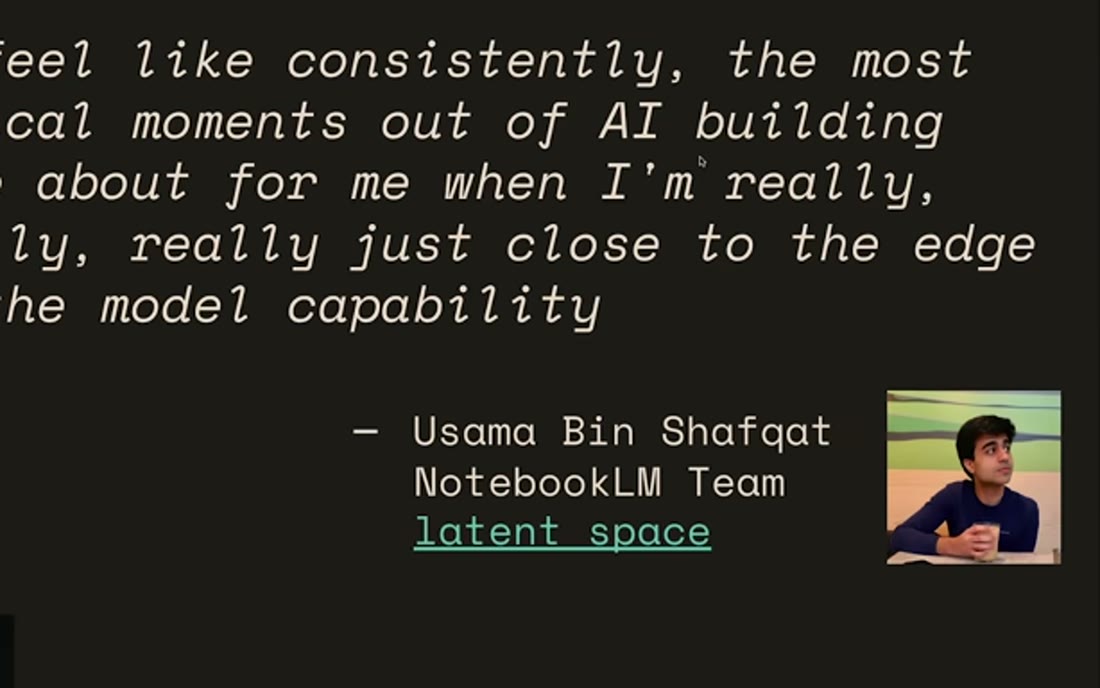
- What it teaches: the differentiator is picking work right at the boundary of what the model does
reliably - something it cannot get right every time - and engineering reliability around it
anyway.
n15&t=848s - Corroborated by: the narration expanding the quote into the "find the bleeding edge" argument.
&t=848s
Note what this one is. A quoted slide of one practitioner describing a feeling - not a finding, and the weakest evidence in the note. It earns its place because S4 later reaches the same boundary-relative framing from an entirely different direction (a harness rebuilt when the boundary moved), which is why claim 18 is
corroborated (2 sources)while this slide alone would not carry it. It is also the answer to "won't better models make this obsolete?" - a better model moves the boundary, and the engineering moves with it.
Diagram (mental model)#
flowchart TB
    subgraph OWN["the 4 things you own (factor 8)"]
        P["prompt<br/>selects next step<br/>factor 2"]
        S["switch<br/>dispatch on JSON<br/>factor 4"]
        C["context builder<br/>typed events -> string<br/>factors 3, 9"]
        L["loop<br/>explicit exit<br/>factor 8"]
    end

    E["event in<br/>slack / email / API<br/>factor 11"] --> P
    P --> M["LLM<br/>stateless pure function"]
    M -->|"structured JSON<br/>factor 1"| S
    S --> T["deterministic tool code"]
    S --> H["request_human_input<br/>factor 7"]
    S --> D["done_for_now"]
    T --> C
    H --> C
    C --> L
    L -->|"not done"| P
    L -.->|"long running tool:<br/>serialize w/ stateID<br/>factors 5, 6"| DB[("state store")]
    DB -.->|"resume"| C
    D --> OUT["final answer"]

    style M fill:#cfe8cf
    style OUT fill:#a8c8e0
Read the flow top to bottom as one pass around the loop. The boxed group holds the four parts you write, green marks the only LLM call anywhere in the picture, and the dotted path shows what happens when a tool call takes minutes or days instead of milliseconds. Factor numbers are marked on the box they belong to, so the diagram doubles as an index into the twelve.
The crux: there is exactly one green box, and everything else is ordinary software you already know how to write.
The placement of that green box is the whole argument. The LLM sits in the middle of the diagram
rather than around the outside, and frameworks invert exactly this. They own the loop, the dispatch
and the context assembly, then hand you a callback, which is how you end up seven layers deep in a
call stack looking for where your prompt was built &t=55s. Drawn this way instead, every arrow into
and out of the model is a seam you control, so you can log it, test it, replay it, or break out of
the loop mid-run. One detail repays a second look, which is that the dotted path leaves and re-enters
at the context builder rather than at the prompt. Resumption works only because the thread was
serialisable in the first place, which is the reason factor 3 has to be in place before factors 5 and
6 are even possible.
Synthesized from n2, n5, n6, n8, n11 - not a slide from the talk.
flowchart LR
    A["github PR merged"] --> B["deploy to dev"] --> C["e2e test dev"]
    C --> AG{{"micro agent<br/>3-10 steps<br/>factor 10"}}
    AG --> HU["human approval<br/>in Slack"]
    HU -->|"rejected: backend first"| AG
    HU -->|"approved"| AG
    AG --> DONE["done / final answer"]
    DONE --> E2E["e2e test prod"] --> F["deploy done"]
    E2E -->|"fail"| RB{{"rollback agent"}}

    style AG fill:#cfe8cf
    style RB fill:#cfe8cf
    style A fill:#a8c8e0
    style F fill:#a8c8e0
Read this one left to right as a single deployment from start to finish. Blue marks a boundary event, green marks the parts that are LLM-driven, and plain boxes are ordinary deterministic code. The two hexagons are the agent loops, and everything else is CI/CD you already have.
The crux: the agent owns only the genuinely ambiguous middle - what to ship and in what order - and hands control straight back to deterministic code.
To see why it is shaped this way, count the green. There are two small hexagons in a pipeline of
seven steps, and the talk reports this arrangement handling "100 tools, 20 steps, easy" &t=814s.
The instinct when an agent underperforms is to give it more scope, and this shape says the
opposite, which is to shrink the window until the model only decides the thing that actually requires
judgement. Look closely at where the boundary sits, because it is not drawn at "hard versus easy".
It is drawn at deterministic versus ambiguous. Running the tests is hard and stays in code,
because the answer is knowable in advance. Deciding deploy order is easy for a human and goes to the
model, because it depends on context nobody encoded anywhere. One further detail is easy to miss: the
human sits inside the agent loop rather than gating it from outside. Approval is an event in the
thread, which is factor 7, and that is what lets a rejection carry a reason the agent can act on
instead of a bare "no".
Synthesized from n1, n11, n13, n14 - a redrawing of frame_800.jpg &t=741s.
💡 Terms#
| Term | Explanation |
|---|---|
| 12-factor agent | Horthy's list of 12 design rules for reliable LLM applications, named after Heroku's 12-factor app. Each factor is a piece of the system you should own rather than delegate to a framework. |
| Context engineering | The single discipline behind prompt, memory, RAG and history: deciding exactly which tokens reach the model. &t=616s |
| Micro agent | A small agent loop of roughly 3-10 steps embedded at a hard point inside an otherwise deterministic pipeline - the shape that works in production. &t=741s |
| Materialised DAG | The graph of steps that an agent loop produces at runtime, as opposed to a DAG you wrote up front in Airflow or Prefect. &t=371s |
| Spin-out | The failure mode where raw errors are blindly appended to the context window, the agent loses the thread and gets stuck retrying. Factor 9's target. &t=653s |
| Stateless reducer | Factor 12: the agent holds no state of its own; it folds an event into a thread you own. Pedantically a transducer, since there are multiple steps. &t=865s |
| Structured output | The model emitting JSON conforming to a schema you defined, rather than prose. Factor 1 - and per factor 4, all "tool use" really is. &t=229s |
The evidence, weighed#
Read this before citing anything above.
- Tier and interest: T4 conference talk, and the speaker sells agent tooling. Horthy is the founder of HumanLayer, and the worked example is HumanLayer's own product. That does not make the factors wrong, but it does mean no claim here is disinterested.
- The empirical basis is uncheckable. "100+ founders, builders, engineers" (
n1) comes with no names, no method and no breakdown. It is the load-bearing sentence of the talk and it cannot be verified from the source. - "Corroborated (external)" here does not mean independent. Nine nodes gate against the companion
repo README (
en1). The README and the talk share one author, so that corroborates the framework as stated, never that it works. - Two internal legs means consistent, not correct. The remaining nodes gate slide ↔ narration. That proves the deck and the talk agree.
- Nothing is measured by this source. There is no benchmark, ablation, or failure rate. Every number in this note that means anything came from R1.
n17,n18aresingle-leg(anecdote, no slide);n12,n16areneeds-check(mentioned in passing, no worked example).
Open questions#
A deep-research pass has run on this source (2026-07-25):
context/01_context-limits-and-decomposition.md. It closed both original open questions. External evidence lives in that note, not here - this file answers only what did this source teach?
- ~~No independent corroboration.~~ Closed by R1. Anthropic - a different organisation with
no shared interest - independently reaches
n17andn18, the latter near-verbatim on frameworks obscuring the prompt (en5). - ~~No measurements anywhere.~~ Closed by R1, and the measurements are harsher than the
talk's framing (
en2). - The boundary S2 misses. Decomposition helps, but naive memory scaffolding hurts 6 of 10
models (
en4). "Own your context window" must not drift into "accumulate a richer thread". - Whether the Event Sourcing inheritance actually bites. "Where this sits" records that factors
3/5/6/12 are Event Sourcing (
d3) and that the pattern already names replay determinism, snapshotting and event versioning. Nobody has checked which of the three a real agent thread hits first, or whether an LLM thread's replay is deterministic enough for the pattern to apply cleanly. d2- open: the proposedcreate-12-factor-agentis scaffold-not-wrapper, modelled on shadcn/ui. Whether generated-code-you-own beats an abstraction is the old duplication-vs-abstraction argument, unresolved in the talk.&t=882s
Feeds these topics#
../../brain/topics/agents.md- n1..n9, n13..n18 (the four owned parts, micro agents, control flow, pause/resume, structured output).../../brain/topics/context-engineering.md- n4, n8, n9, n10 (context window ownership, event-thread rendering, error compaction, token budget as the reliability lever).
Presentation narrative#
A talk track for a team deciding how much of their agent to build themselves, derived entirely from the gated nodes above. One caveat shapes everything: the talk's empirical basis is 100+ interviews with no names, no method and no counts, so this is a well-argued pattern language from somebody who has clearly built the thing, and not a survey result.
Slide 1 - The agents that work in production are barely agentic#
Dex Horthy reports interviewing more than a hundred people building agents, and found that the ones running in production are ordinary deterministic software with small, tightly-scoped LLM steps inside [n1]. That is the headline and it reads as a paradox until you see what it is arguing against.
The pattern most teams follow is the opposite: hand the whole problem to a loop and let the model decide everything. That gets you a demo in a weekend and roughly 70 to 80% of the way there. Then it stops, and the remaining 20% does not yield to more prompting, a better model or a bigger framework.
I should be precise about the evidence, because this is the number everyone quotes. The interviews are the entire empirical basis of the talk and you cannot check them - no names, no method, no counts. Take the shape as instructive and do not cite the sample.
This is the naive shape, drawn honestly. The crux is that this diagram is correct and it is also the
thing that stalls, because every arrow is a decision you have delegated [n1].
Slide 2 - An agent is four things, and every framework convenience takes one of them from you#
A prompt, a switch statement, a context-window builder, and a loop [n5]. That is the complete list. Reliability problems trace back to letting something else own one of the four.
What makes this useful rather than purist is that it turns an open-ended architectural argument into an inventory. You can walk a codebase and answer, for each of the four, who owns it. The question for this room is not whether to use a framework. It is which of the four you have handed over without deciding to, because that is where the last 20% is hiding.
This is what owning the switch statement looks like. The crux is that a tool call is just structured
JSON your code decides what to do with - there is no magic in it, and treating it as ordinary data
is what lets you keep control [n6].
Slide 3 - Context engineering is the part that is actually yours#
Prompt, memory and retrieval are all the same activity: deciding what the model sees on this one call. Once the context window is a thing you build rather than a thing that accumulates, a whole class of failure becomes addressable.
The concrete form in the talk is worth showing engineers, because it is unglamorous. A thread is a list of typed events, and rendering it to a prompt is a function you wrote. That is the entire mechanism. It means you can drop, reorder, summarise or replay any part of the history, which is not available to you when a framework owns the transcript.
This is ownership made concrete. The crux is that the context window is a data structure you build,
not a log that happens to you [n8].
Slide 4 - What ships is micro agents inside deterministic code#
Three to ten steps of LLM work, wrapped in ordinary software that decides when to call it. The deploy pipeline in the talk is the worked example: deterministic code handles the merge, the dev deploy and the end-to-end test, and the model is invoked for the narrow judgement in the middle.
The leadership significance is a scoping rule you can apply immediately. The right size for an agentic step is the smallest span where the path is genuinely unknown. Everywhere the path is known, determinism is cheaper, faster and correct every time, and using inference there buys nothing but variance.
This is the shape that ships. The crux is how little of the picture is the agent [n10].
Slide 5 - Contacting a human is a tool call, not an exception path#
Pause and resume, and human contact, are the same design problem: state you can serialise mid-run and hand to somebody else. Model it as an interrupt with a state ID and both fall out.
This is the factor most often skipped and the one that decides whether the thing survives contact with production. If asking a person is an error path, every approval becomes a special case. If it is a tool call like any other, the agent can request input, stop, and be resumed by a Slack reply hours later, with the trace showing exactly what was asked and what was approved.
This is the payoff of the previous three slides. The crux is that the human turn is just another
event in the thread, which is only possible because you own the event type and the renderer [n14].
Slide 6 - Judge it by four questions, and treat the source as a pattern language#
"Does the agent work" is not answerable, so replace it with four things you can check by reading your own code. Does it recover from a failed step without redoing everything? Can you pause it mid-run and resume elsewhere? Can a human enter without it being an exception? Can you replay the trace? None of the four is about model quality.
On how far to trust the source: the factors are well argued and clearly come from somebody who has built this, and the empirical claim underneath them cannot be checked at all. So the verdict is adopt the pattern language and do not cite the survey. The decision that follows is cheap and specific - before adding a framework, write down who owns the prompt, the switch statement, the context builder and the loop, and treat any answer that is not "us" as the place your last 20% will hide.
This is the closing tension, and it cuts against the rest deliberately. The crux is that owning the
four components is what lets you sit close to the edge safely - the discipline is not the opposite
of ambition, it is what makes ambition survivable [n20].
Key takeaway message#
The agents that work in production are barely agentic: ordinary deterministic software with small, tightly-scoped LLM steps inside. An agent is exactly four things - a prompt, a switch statement, a context-window builder and a loop - and reliability problems trace back to whichever of the four you stopped owning. Tool calls are structured JSON your code interprets, the context window is a data structure you build, and contacting a human is a tool call rather than an exception path. Judge the result by whether it recovers, pauses, admits a human and replays, none of which is about model quality. And hold the evidence honestly: the hundred interviews cannot be checked, so this is a pattern language rather than a survey.